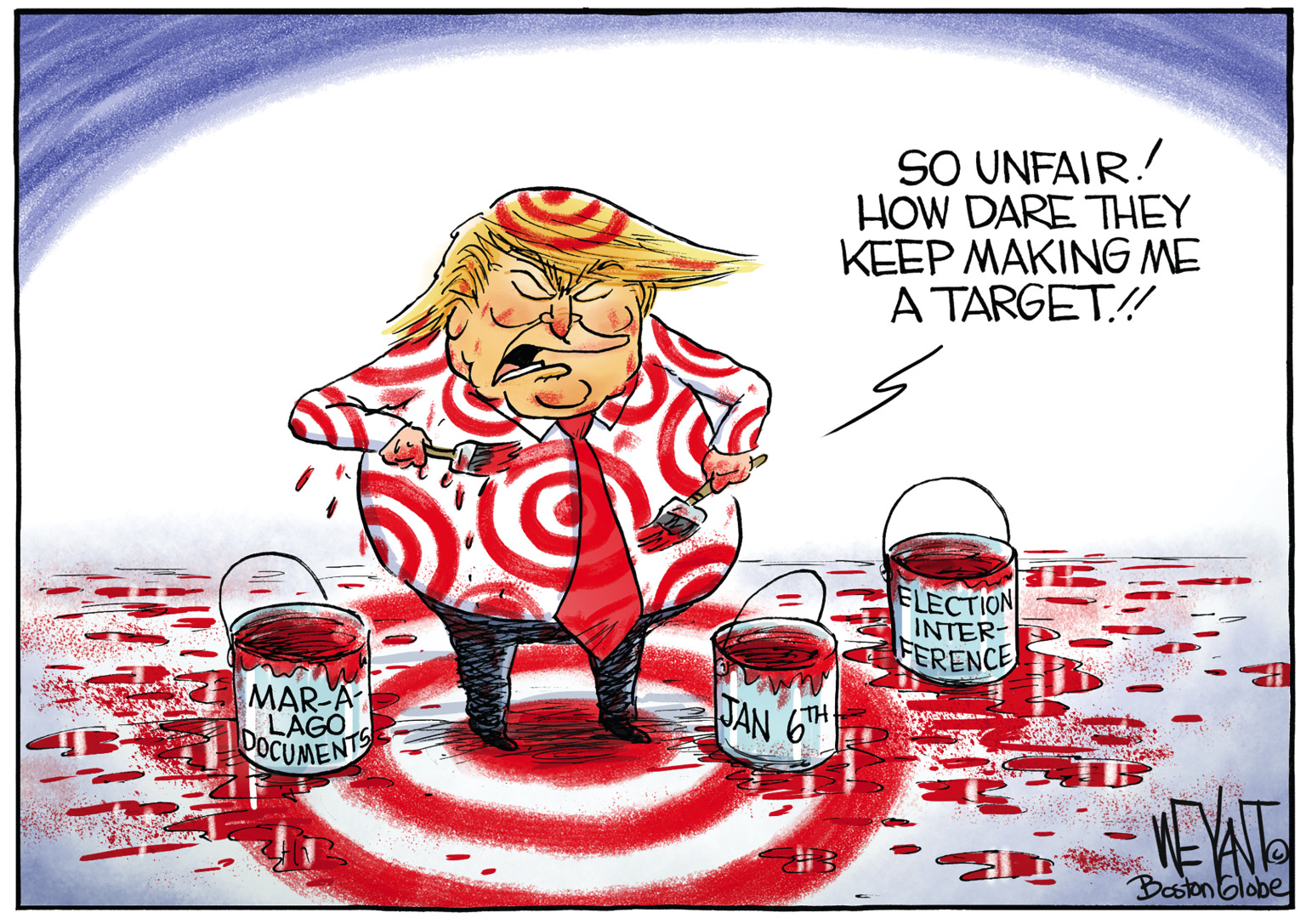
The Defendant lost the 2020 presidential election. Despite having lost, the Defendant was determined to remain in power. So for more than two months following election day on November 3, 2020, the Defendant spread lies that there had been outcome-determinative fraud in the election and that he had actually won. These claims were false, and the Defendant knew they were false. ... Shortly after election day, the Defendant also pursued unlawful means of discounting legitimate votes and subverting the election results. In so doing, the Defendant perpetrated three criminal conspiracies.
This week everybody was talking about Trump's January 6 indictment
Tuesday, Donald Trump was indicted for his plot to overturn his loss in the 2020 presidential election. The indictment was widely covered in the media, so I'll try not to rehash things you've undoubtedly seen many times.
The indictment is only 45 double-spaced pages, so if you don't want somebody else's interpretation to get in your way, you can easily read it yourself. If you do want to read somebody's summary, let me me recommend Marcy Wheeler and Jay Kuo.
The indictment tells a simple story: Trump lost the election. He knew he had lost the election, but wanted to stay in power anyway. So he invented and spread lies about election fraud, which he used to justify a series of illegal actions:
pressuring election officials either to baselessly refuse to certify the legitimate election results or to change the results in his favor (as in his famous call urging Georgia Secretary of State Brad Raffensperger to "find 11,780 votes").
pressuring Republican state legislatures to illegally overrule their state's voters and instead award Trump their electoral votes.
enlisting Republican officials in eight states he lost to falsely claim to be the state's electors and cast electoral votes in his favor.
pressuring Vice President Pence to exceed his constitutional authority and recognize the fake Trump electors.
taking advantage of the January 6 riot to push Republicans in Congress not to certify the votes cast by legitimate electors.
The previous indictments were all vulnerable to the criticism: "You're indicting him for this because you can't nail him for what you really want." This one isn't. The central thing I want Trump to answer for is his attempt to stay in power after losing an election. What's more, this indictment goes to the heart of why Trump can never be allowed to wield power again: He was a danger to the republic in January 2021, and his possible return to power represents a fresh threat to the republic.
Jack Smith appears to have gone to some trouble to streamline this indictment, so that he has a chance to get a trial done before the election. That's why the six co-conspirators are not named or indicted (though they may be later). It's also why Trump isn't charged with inciting a riot, because that would raise Supreme-Court-level issues about the limits of free speech.
Klingenstein asked Eastman whether he would have acted in the same way in 1960 as he did in 2020, referencing the belief on the right that John F. Kennedy stole that year’s election from Richard Nixon.
Eastman replied no, and added that the stakes of 2020 represented an “existential threat to the very survivability, not just of our nation, but of the example that our nation, properly understood, provides to the world.”
The Trump 2020 lawyer went on to reference the Declaration of Independence, saying that “our founders lay this case out.”
“There’s actually a provision in the Declaration of Independence that a people will suffer abuses while they remain sufferable, tolerable while they remain tolerable,” he said. “At some point abuses become so intolerable that it becomes not only their right but their duty to alter or abolish the existing government.”
“So that’s the question,” he added. “Have the abuses or the threat of abuses become so intolerable that we have to be willing to push back?”
The January 6 indictment has overshadowed other important recent developments, like the superseding indictment in the Mar-a-Lago case, or the states that have been going after local conspirators. In addition, Fani Willis' indictment in Fulton County will probably drop sometime in the next two weeks.
Rosenberg points to a new willingness to demonize opponents, which he calls "an utter collapse of shared solidarity". Boot's column is an elegy to "the nation I fell in love with" 40 years ago. The current Israel, Boot says, "remains freer than its neighbors", but he "simply cannot support it as unreservedly as I once did."
but you should pay attention to this Republican vision
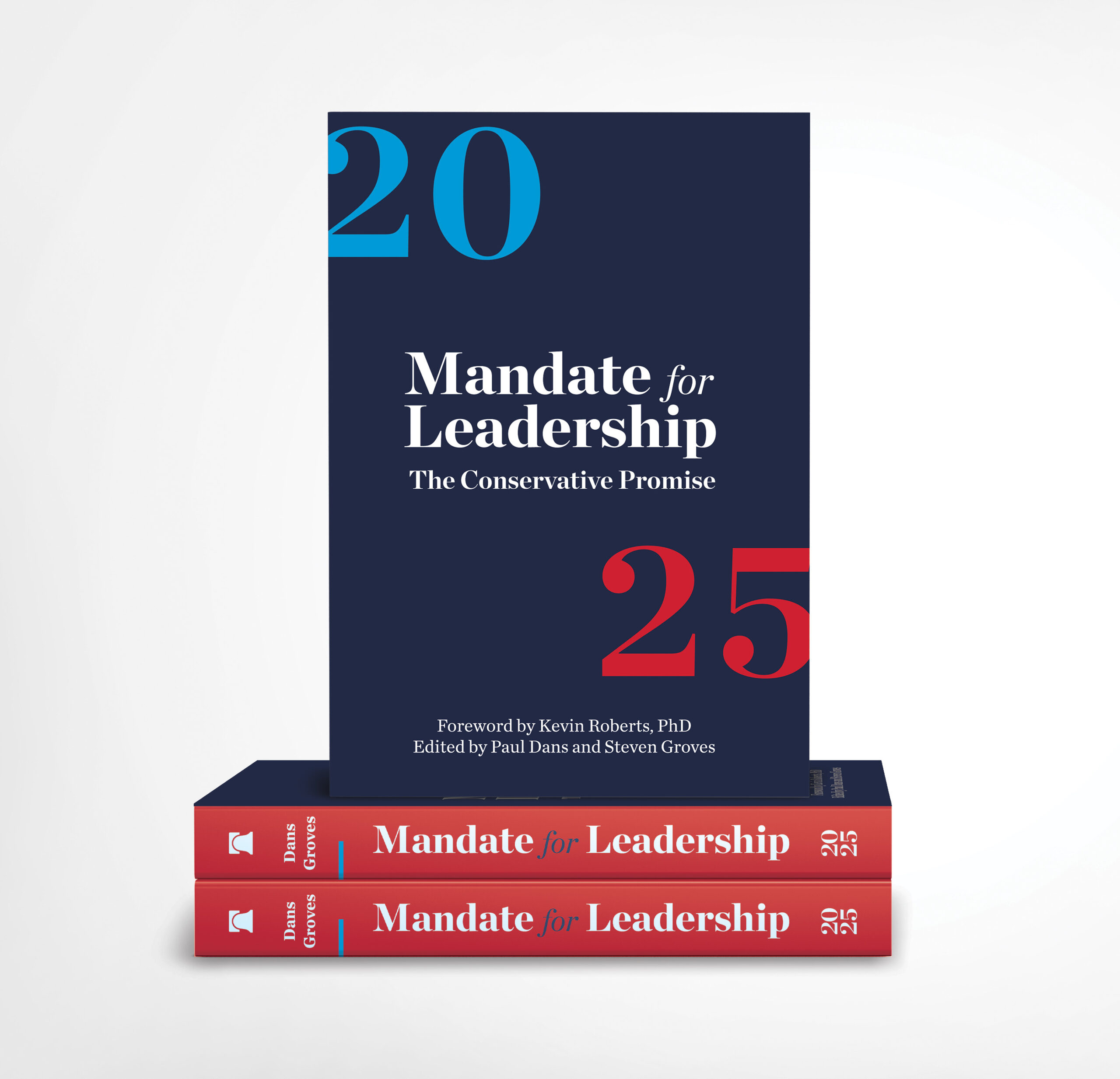
The Heritage Foundation has spearheaded Project 2025, a collaboration of many conservative groups that has produced Mandate for Leadership 2025. This is sets out to be a handbook for the next Republican administration, and will likely have a considerable influence on the any Republican who wins in 2024, whether it's Donald Trump or not.
There are two main things to know about Project 2025:
It would make the executive branch a more perfect instrument of the President's will by expanding the power of political appointees and making more government employees fireable.
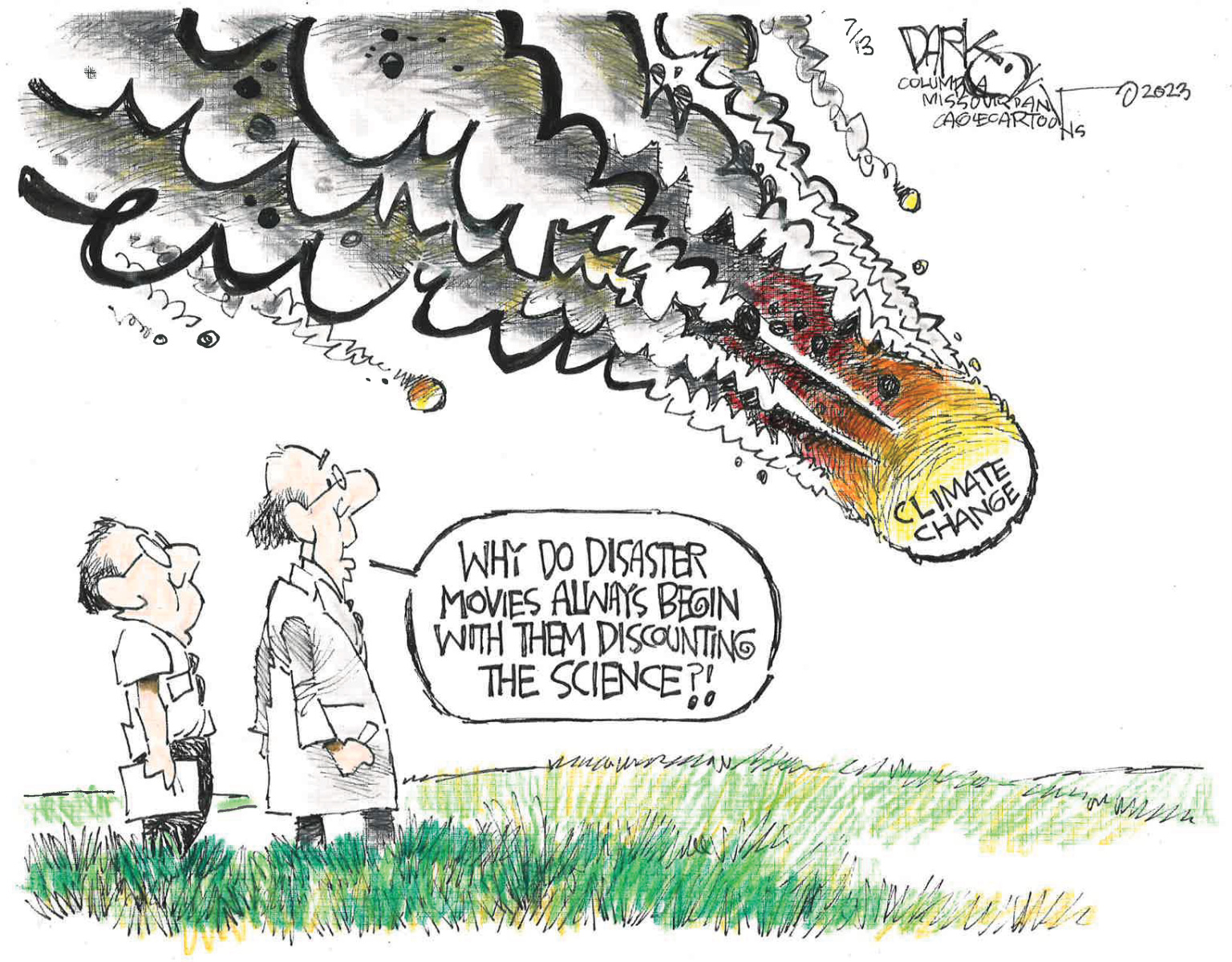
It would eliminate any consideration of climate change from US government policies.
When it comes to ensuring that freedom can flourish, nothing is more important than deconstructing the centralized administrative state. Political appointees who are answerable to the President and have decision-making authority in the executive branch are key to this essential task. The next Administration must not cede such authority to non-partisan “experts,” who pursue their own ends while engaging in groupthink, insulated from American voters.
So the next time there's a pandemic, Heritage wants a CDC committed to the president's agenda, not public health. It wants an EPA whose top loyalty is to the president, not the environment. This harmonizes with Trump's Agenda 47, particularly with its plans to "crush the Deep State".
The NYT summarizes Project 2025's energy provisions:
The plan calls for shredding regulations to curb greenhouse gas pollution from cars, oil and gas wells and power plants, dismantling almost every clean energy program in the federal government and boosting the production of fossil fuels — the burning of which is the chief cause of planetary warming.
If you want to dig into the details, look at the chapters on the Department of Energy and the EPA. Anything related to climate change is ripped out root-and-branch: Repeal the Inflation Reduction Act, eliminate subsidies for sustainable energy, scuttle standards for energy-efficient appliances, and go full-speed-ahead on fossil fuel drilling, mining, and pipeline-building (in a quest for "American energy dominance" in the world).
These policies are laid out without ever stating an opinion about the reality of climate change or its consequences. It's as if whatever inadequate climate-change-mitigating programs Biden has managed to install are just some irrational fad that it's time to be done with.
Bear this plan in mind if you start thinking that the 2024 election is just about Trump. Project 2025 is the consensus of conservative thinking. If you vote for any Republican for any office, this is what you're voting for. If you decide to stay home or vote third-party because the Democrats aren't inspiring enough, this is what you're acquiescing to.
and you also might be interested in ...
When a state legislature is as gerrymandered as Ohio's, a ballot initiative is really the only chance the People have to make their will known. In an election tomorrow -- one specially scheduled to get a low turnout -- Ohio Republicans are trying to shut that avenue down.
Issue 1, which Ohio Republican legislators put on the ballot, would make future ballot measures to change the state Constitution harder to pass in two key ways. If it’s approved, citizens who hope to put amendments to the voters would first have to collect signatures in each of the state’s 88 counties, up from 44 now. And to pass, constitutional ballot initiatives would need to win 60 percent of the vote, rather than a simple majority.
The measure’s import may not be immediately clear to voters, but it’s meant to thwart a November ballot initiative that will decide whether reproductive rights should be constitutionally protected in Ohio, where a sweeping abortion ban is tied up in court.
Republicans know they can't win this vote on the merits, so instead they've launched a confusing campaign implying that this measure has something to do with protecting your children from "trans ideology".
Remember Justin Jones and Justin Pearson, the two Black lawmakers who were expelled by the Tennessee legislature in April? They were each reinstated by local councils until a special election could be held. Those elections were held Tuesday, and both won reelection. Jones got 78% of the vote in his Nashville district, and Pearson got 90% in his Memphis district.
Is the Gulf Stream about to collapse, as The Guardian reports? Well, no. Some system related to the Gulf Stream might stop working, but not the Gulf Stream itself. Skepchick explains: The report results from a confusion between the Atlantic meridional overturning circuit, which is slowing and could conceivably stop, and the Gulf Stream, which isn't in danger of stopping.
Now, the AMOC stopping would have serious consequences. But it's not the Gulf Stream.
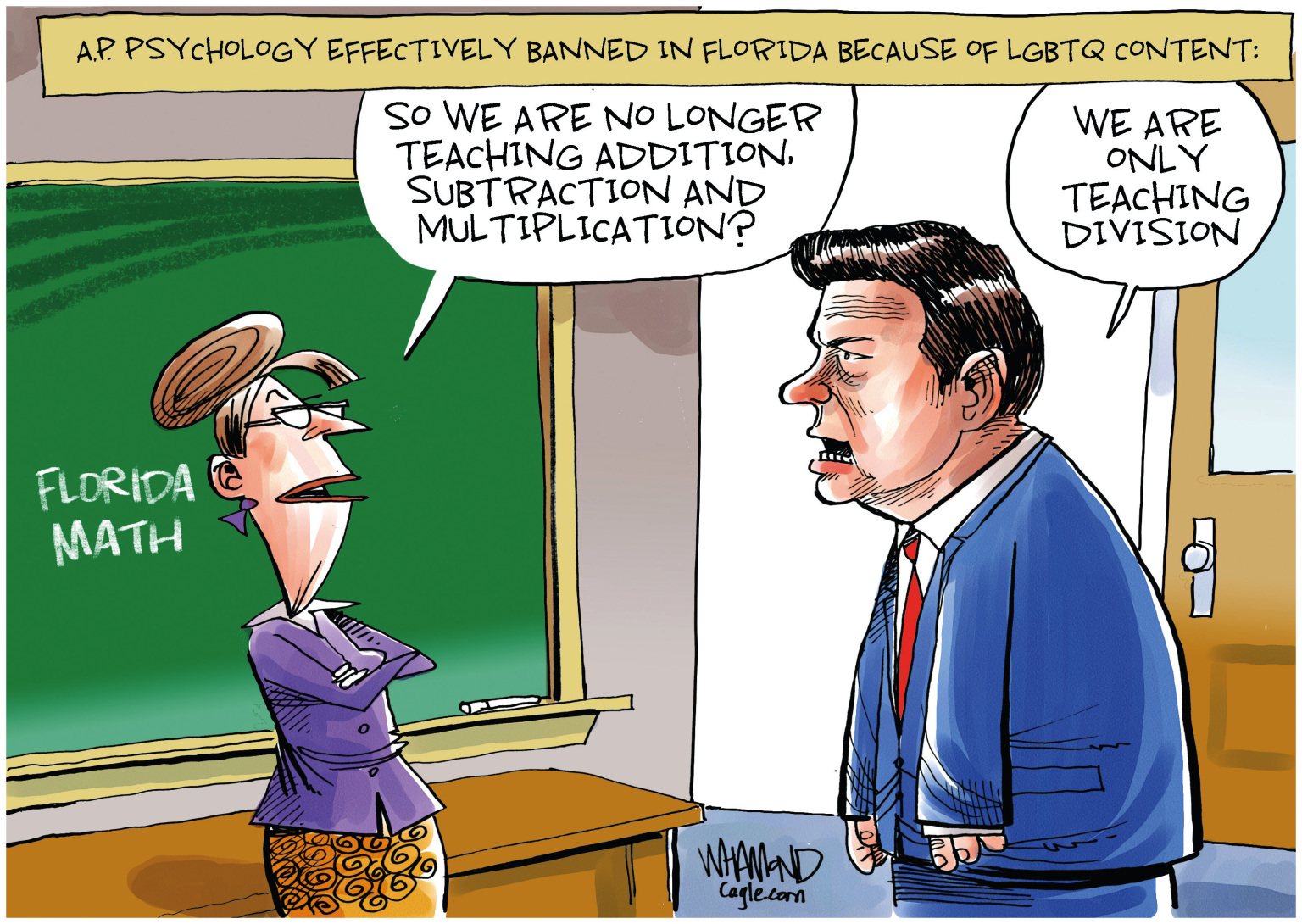
Another skirmish in Florida's fight against education: It briefly looked like AP Psychology courses would have to be withdrawn from the state.
According to the College Board (which created the curriculum and administers the test for AP credit) "how sex and gender influence socialization and other aspects of development" has been part of the course for 30 years. But the Florida Department of Education had told superintendents that "teaching foundational content on sexual orientation and gender identity is illegal under state law". The College Board announced that if the whole course couldn't be taught, any mention of "AP Psychology" would have to be dropped from student transcripts.
The future of the course appeared to be in jeopardy until, late Friday, Florida Education Commissioner Manny Diaz, Jr., informed school superintendents that students will be able to take the class “in its entirety” but only if the course is taught “in a manner that is age and developmentally appropriate.”
Nobody knows yet what that means, but it seems to me to place the onus on Florida teachers, who will have to stake their careers on their interpretation of this vague guidance.
Grist examines the downturn in the plant-based meat market. Not so long ago, beef-like patties from Impossible Foods or Beyond Meat seemed like the next big thing. But rather than exploding, sales fell 8% in 2022.
Several factors are in play here: high costs (compared to actual beef), whether or not the taste is convincing (opinions vary), and an increased focus among health-conscious consumers on avoiding ultra-processed foods (plant-based meat derives as much from labs as from farms).
Personally, I experimented with imitation beef exactly once: I used it to replace the ground beef in a spaghetti sauce. I knew I was in trouble when I started browning the "meat", and my housemates' dog didn't come over to investigate.
About those ultra-processed foods: The New Yorker's Adam Gropnik paints a more ambiguous picture: He agrees that a lot of what we buy in the store includes unhealthy ingredients, but "processing" is largely in the eye of the beholder.
The history of humanity is the history of processing foodstuffs—by fire, by smoke, by pounding and pulverizing—and it can be hard to find a boundary between those ever more hallowed traditional kitchen practices and the modern ones that we are asked to condemn.
Many of the substances that look suspicious on an ingredient list are as close to "natural" as ones that we instinctively trust.
why is guar gum, extracted from one seed, any more artificial than cornstarch, extracted from another (originally by means of a method patented in the eighteen-fifties by a British industrialist)? Some version of carrageenan, which comes from the seaweed Irish moss, has been used in cooking for centuries; Great-Grandmother certainly used the lecithin from egg yolks, if not from soy oil, to emulsify her sauces.
This week everybody was talking about a January 6 Trump indictment
Tuesday, Donald Trump announced that he had received a target letter from Jack Smith, warning of a possible indictment by the DC grand jury investigating January 6 and the overall plot to reverse Trump's 2020 defeat at the polls. The letter gave him the opportunity to tell his side of the story last week, which he decided not to do. (Trump doesn't actually have a side of the story. His defense relies on delay, getting evidence thrown out, accusing the prosecutors of political bias, and intimidating the legal system with thinly veiled threats of violence.)
If the timing follows the pattern of the Mar-a-Lago case, an indictment should appear this week.
Much discussion ensued about what that indictment might contain, based on the target letter (that was never officially released). I repeat earlier caveats: Indulge in this speculation if you find it engaging, but don't imagine that you're making a wise use of your time. We'll all see the same indictment soon enough.
Jack Smith is also looking into the fake electors in seven states, but Michigan's action suggests a sensible division of labor: The states should charge the electors themselves, and federal prosecutors should go after the Trump campaign officials who organized and promoted the plot across multiple states.
After all, trying to steal a state's electoral votes is fundamentally an offense against that state. Also, the fake electors proceeded somewhat differently in different states, so they shouldn't all face the same consequences. The Michigan electors created and signed a fraudulent certificate naming themselves as "the duly elected and qualified for President and Vice President of the United States from the State of Michigan" and casting Michigan's 16 electoral votes for Donald Trump, who lost Michigan by over 150,000 votes.
New Mexico's fake electors, by contrast, signed a certificate "on the understanding that it might later be determined that we are the duly elected and qualified Electors" -- a statement that seems considerably less fraudulent.
Speaking of the Mar-a-Lago case, Judge Cannon set a trial date: May 20.
As we awaited Judge Aileen Cannon's announcement of a trial schedule for the Mar-a-Lago documents case, the big question was: How biased towards Trump is Cannon going to be? Her previous rulings on the items seized in the Mar-a-Lago search were absurdly pro-Trump, so divorced from law and logic that they earned her a stern rebuke from a three-judge panel at the next level, in spite of two of them being Trump appointees.
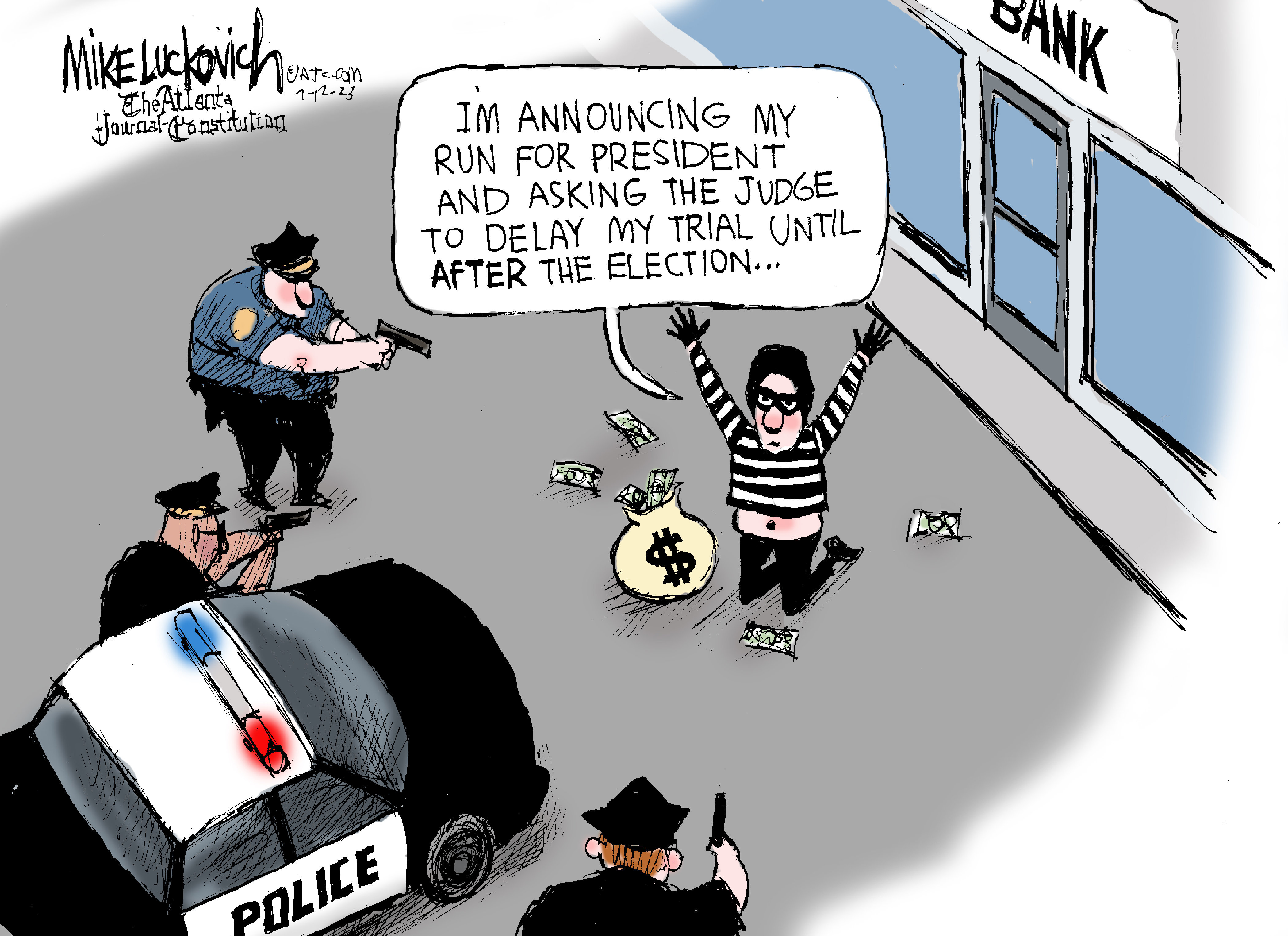
Jack Smith's people had asked for the trial to start in December, a schedule widely recognized as ambitious but not unreasonable. Trump's lawyers asked the judge not to set a trial date at all, which would violate the law. And they argued that Trump should not be tried until after the election, when he might again be protected by a DoJ policy of not indicting a sitting president, and he could be in a position to fire Smith himself.
Giving Trump what he wanted would be asking for another slap from the appeals court, so May 20 looks like the longest delay she thought she could get away with. Most presidential primaries will be over, and Trump may well have the Republican nomination locked up. From there the date could slip further, so Trump may yet get his wish not to be tried until after the election.
But that may not be as good for Trump as he imagines. If the trial still hasn't happened when voting starts, the election becomes a referendum on his guilt. "Vote to keep me out of jail" is not a compelling campaign slogan.
and culture wars
I'm always torn about how much play to give culture-war skirmishes. On the one hand, people saying ridiculous or obnoxious things should be called out. They're telling us who they are, and we should take that seriously. But on the other, a lot of them are intentionally trolling so that they can ride a wave of backlash when liberals like me criticize them. And finally, culture-war issues are often shiny objects that are supposed to distract us from real problems like climate change and racism.
Even so, sometimes I just can't ignore them.
Exhibit #1 this week was Jason Aldean's country-music song and video "Try That in a Small Town", which was all over my social media news feed.
Now, I grew up in a relatively small town. (Quincy, Illinois has about 40K people, making it about 1/5 the size of Macon, Georgia, where Aldean grew up.) I don't live there any more (and Aldean doesn't live in Macon), but I still go back regularly, a decade after my parents died. So I see the charm of small-town life, recognize the importance of respecting your roots, and understand the sting of big-city people dismissing "fly-over country" as "the middle of nowhere".
That sting is why small-town and rural people occasionally need to cut loose with a shout of pride in who they are and where they come from, in anthems like John Mellencamp's "Small Town", John Denver's "Thank God I'm a Country Boy", and others even older. Those songs are full of positive emotions like affection, contentment, and gratitude. Fundamentally, they are what therapists refer to as I-statements: "This is what life is like for me. You may not want to live this way, but I love it."
Aldean's song, by contrast, is addressed to "you", the kind of urbanite he has violent fantasies about. He's daring you to "cross that line", because small towns are "Full of good ol' boys, raised up right", so "If you're looking for a fight, try that in a small town".
He underscores the point by centering the video on a Tennessee courthouse that was the site of a famous lynching. And I was particularly amused by one behavior he recommends you leave in the city: "pull a gun on the owner of a liquor store" -- like that never happened where I grew up. (In the real world, robbing a liquor store is the quintessential redneck crime. Grab me a six-pack on your way out the door.)
Several people on social media mentioned Ahmaud Arbery, a Black man who tried jogging in a small town, and was murdered by gun-toting racists. Sadly, his killers can't go to an Aldean concert because they're in prison now. Whenever this song comes up on the radio, though, I'm sure they sing along.
But you know who really ought to be upset? People who live in small towns, but somehow aren't filled with hate and possessed by violent fantasies. (I know lots of them.) Aldean has very effectively validated all the stereotypes the rest of the country holds against them. Thanks, Jason.
And then there's the over-the-top conservative outrage against the Barbie movie, which I haven't seen. OK, I just wrote about a conservative music video, but at least I didn't post a 45-minute rant and then set fire to a doll like Ben Shapiro did.
One theme of Barbie for decades has been that girls can do anything (and look fabulous). So I can't figure why anybody would be surprised that a Barbie movie is "woke". (I'm reminded of the people who keep asking "When did Star Trek get so woke?" Star Trek was always woke.)
I also shake my head at the people who are outraged that one of the Barbies is played by a trans woman. Seriously: You think that kids who were called "boys" but believed they were girls didn't didn't play with Barbies? That piece of the fan base must go back to the beginning.
and you also might be interested in ...
Today, Netanyahu's coalition in the Knesset passed his bill to limit the power of the nation's supreme court. The bill had been the target of massive protests for months, with critics claiming that Israel would no longer be a democracy if it passed. I guess we'll find out how accurate that assessment was.
One of the few good decisions the Supreme Court made this year was to uphold a lower-court injunction against Alabama's congressional-district map. The map's problem was that only 1 of the 7 districts were majority-Black, when Blacks make up 1/4th of the state's population. The Court ruled that this was very likely a violation of the Voting Rights Act, and so could not be used for the 2024 congressional elections.
Everyone assumed the Alabama legislature would go back to the drawing board and come up with a map that had two majority-Black districts. But apparently not: The two houses of the legislature have each proposed new maps that again have only one majority-Black district. They need to finalize their decision by Friday.
Ian Milhiser makes a tongue-in-cheek reference to the days before John Roberts gutted VRA enforcement:
One novel idea that someone should try is that we could make states with a history of enacting racist voting laws, often in defiance of federal court orders, to “pre clear” their election laws with officials in Washington, DC.
Russia has pulled out of the Black Sea Grain Initiative, which had allowed Ukraine to export food. Prewar Ukraine was the source of 10% of the world's wheat exports and half of its sunflower oil. Instead, Russia has begun bombing infrastructure in Odesa, Ukraine's main grain-shipping port. Food prices around the world are expected to rise.
Anti-abortion activists often deny that they want to criminalize women, but that's what's happening. In Nebraska, a teen-aged woman was sentenced to 90 days in jail and two years probation. Her crime: She took miscarriage-inducing pills past the 20-week mark of her pregnancy, miscarried, and then disposed of the dead fetus' body without notifying authorities. She was 17 at the time. The sentence follows her guilty plea for "concealing or abandoning a dead body", a felony. Her mother, who acquired the pills, is awaiting sentencing.
When voters in the UK voted "Leave" in the 2016 Brexit referendum, many people foresaw a trend in which political ties of all sorts would begin to dissolve. But instead, the struggles of the post-Brexit UK have become a cautionary tale.
Researchers examined the diets of 55,500 people and found that vegans are responsible for 75 percent fewer greenhouse gases than meat-eaters.
Actually, I don't like that way of framing the result, because it emphasizes the extremes. Even if you aren't willing to go all the way to a vegan diet, cutting down the amount of meat you eat or shifting from beef to poultry and fish could still make a large difference. The body of the article is clear about that, but the headline lends itself to an all-or-nothing view.
That's the subject of one featured post. Short version: When climate-related disasters happen one at a time, they're easy to deny: "We've always had floods" or heat waves or hurricanes or whatever. But when several apocalyptic weather events are happening at the same time, it feels qualitatively different. Those of us who care about the future need to jump on this moment. The debate over the existence and seriousness of climate change needs to be over.
and politicizing the NDAA
In 1948, the Senate paved the way for Democratic President Truman to negotiate the treaty that formed NATO by passing the Vandenberg Resolution, named for the Republican Senator who chaired the Foreign Relations Committee, Arthur Vandenberg. At that time, Vandenberg said something that has been quoted many times since: "Politics stops at the water's edge."
In other words: Republicans and Democrats might have their partisan struggles, but when it came to defending the country, all that would be put aside. That sentiment has always been more of an aspiration than a hard-and-fast principle, but it was never blatantly rejected until this week, when House Republicans loaded up the annual National Defense Authorization Act (which has to pass if our troops are going to be funded in FY2024, which starts in October) with a long list of culture-war provisions that Democrats in the Senate are bound to reject.
Rep Jeff Jackson (D-NC) explains how this process is supposed to work, and how it actually worked this year within the Armed Services Committee: There's a behind-the-scenes negotiation to draft a bill that can get broad bipartisan support, and then on the final day the committee has to vote on hundreds of proposed amendments.
On this day, the chair of the committee has a very specific job: It’s to say no to his own party.
Why? Because he knows that some of the amendments his party is proposing are absolute deal-breakers for the minority party and he wants a big bipartisan vote out of committee to give the bill the best chance when it reaches the whole House.
Honestly, he did a pretty good job of knocking away the real grenades that would have blown up the whole thing. He definitely knew what he was doing. He let in just enough of the culture war stuff to satisfy his party without going that step too far that could have sunk it.
So Jackson, a Democrat, praised Chairman Mike Rogers, a Republican, for putting national defense above scoring political points. And while that bill would ban the Pentagon from funding drag shows, along with a few other culture-war provisions of little practical significance, it got out of the committee on a 58-1 vote.
Unfortunately, the bill then went to the House floor, where Speaker McCarthy could not stand up to his party's radicals. Several amendments passed on party-line votes, turning the NDAA into a culture-war messaging vehicle that will make it much harder for servicewomen (or spouses of people in the armed forces) to get abortions, will eliminate the Pentagon's office of diversity, equity and inclusion, and end coverage for transgender health care. As a result, the NDAA itself became a near-party-line vote, passing the House 219-210.
Now the Senate will undoubtedly pass a very different bill, setting up a showdown closer to the new-fiscal-year deadline of October 1. In that debate, the defense of the country and its global interests will take a back seat to domestic politics.
Another example of Republicans prioritizing culture wars over national defense is Senator Tuberville's one-man blockade on military promotions. Ordinarily, promotions pass the Senate en masse by unanimous consent, a process that avoids highly time-consuming votes on individual officers. But Tuberville's objection makes that impossible, and the result is that the Marine Corps has only an "acting" commandant. Soon several of the Joint Chiefs will need to be replaced as well.
As with the House NDAA vote above, his issue is abortion.
A related story that I didn't mention there: The saga of Gal Luft, who was supposed to be the House Oversight Committee's star witness against the Bidens. But he went "missing" before he could testify. And then it turned out that he was on the run from an indictment filed in November, before the GOP had even won control of the House, much less touted Luft for a starring role in their hearings.
He faces eight separate counts, including two charges of making false statements to federal officials, one for conspiracy to violate the Foreign Agents Registration Act, and five counts relating to separate schemes which allegedly involved Luft trying to trade in sanctioned Iranian oil and broker deals for a Chinese firm to supply, among other things, “strike UAVs” to Kenya and anti-tank missile launchers to Libya.
He's been found and is currently under arrest.
and the Hollywood strike
Most of us aren't used to thinking of actors or TV/movie writers as workers. We imagine them living lives we can only dream of. And for some of them -- though far from the majority -- that's true.
So when the Writers' Guild of America went on strike May 2, and the Screen Actors' Guild followed on Wednesday, most of the world's truck drivers, waitresses, and assembly-line workers probably didn't feel much instinctive solidarity.
However, there's a lot to sympathize with here. The issue is a new technology (artificial intelligence) that has the potential to make entire professions obsolete. And the question is: Who's going to profit from that technology? The dispute parallels issues that played out during the Industrial Revolution centuries ago. Things came out badly for skilled workers then, and it would be a shame if those mistakes got repeated.
One of the myths I was taught about industrialization is that it mechanized repetitive low-skill jobs and created more high-skill jobs. The economist Harry Braverman exploded that myth in his 1974 classic Labor and Monopoly Capital: the degradation of work in the 20th century. In Braverman's retelling, it was precisely skilled labor that got replaced: weavers, bakers, blacksmiths, cobblers, and craftsmen of all sorts. Their specialized knowledge got designed into machines whose repetitive operations could be overseen by comparatively unskilled workers.
Most of the craftworkers got nothing for their knowledge. A few skilled workers would be observed closely by engineers. When the skills it had taken them years to master had been captured in a machine, they were no longer necessary -- and neither were any of their guildsmen. The resulting profits went to the industrialists who owned the machines.
Artificial intelligence could soon do something similar to writers and actors. AI could digest, say, all the romantic comedy scripts ever written (with no payment to their authors), and then be able to fulfill requests like "Write me a rom-com set in Singapore with a rich woman fresh from a messy divorce and an airline pilot." Another AI might take body-scans of a few real people (maybe they'd be paid for a single day of "labor") and create a movie in which those "actors" perform the rom-com script.
At the press conference announcing the strike, National Executive Director and Chief Negotiator Duncan Crabtree-Ireland said that the [American Motion Picture and Television Producers]’s proposal for AI “proposed that our background actors should be able to be scanned, get paid for one day’s pay, and their company should own that scan, their image, their likeness and to be able to use it for the rest of eternity in any project they want with no consent and no compensation.”
People trying to break into the creative professions are often desperate and correspondingly ripe for exploitation. One famous example is the comic-book duo of Jerry Siegel and Joe Schuster, who sold the rights to their new Superman character for $130 in 1938.
and Trump's next indictments
Fulton County District Attorney Fani Willis swore in two new grand juries this week. Georgia grand juries serve for two months. Many of her previous statements indicate that this is the cycle when she will seek to indict Trump for his efforts to interfere in Georgia's 2020 election.
Jack Smith is investigating many of the same crimes -- the fake elector scheme, pressuring election officials (all the way up to VP Mike Pence) to change or throw out the election results -- in Georgia as well as other states Trump lost, in addition to his role in inciting the January 6 insurrection. Lots of former federal prosecutors have been speculating that Smith will want to get his own indictment out ahead of Willis.
So we're on indictment watch again: The Georgia indictment is expected early next month, and Smith could file any day.
In some sense, this would be the "real" indictment. Trump's constant law-breaking has created a public expectation that ordinary laws don't apply to him, so the filing-false-business-records charges in New York and the federal stealing-classified-documents charges feel illegitimate even to some people who aren't part of his personality cult. Those are real laws frequently used against other people, and he's clearly guilty in both cases. Even in my eyes, though, those charges resemble nailing Al Capone for tax evasion rather than the St. Valentine's Day Massacre.
But if I had to pick one reason why I want to see Trump in jail rather than back in the White House, it's that he tried to stay in power after he lost the 2020 election. That's the greatest breach of faith committed by any president in American history, and it's the crime he deserves to be judged on.
If you're wondering what such an indictment might look like, Just Security has a written a "pros memo" based on the evidence that is publicly available. Such memos are typically written by the DoJ (and kept confidential) prior to writing an indictment that will be available to the public. The full document is over 250 pages, but the introduction and executive summary together are just six.
Trump's lawyers filed for an indefinite delay in the Mar-a-Lago documents case, at least until after the 2024 election. Their filing argues that
there is simply no question any trial of this action during the pendency of a presidential election will impact both the outcome of that election and, importantly, the ability of the Defendants to obtain a fair trial.
If you are innocent and want to be vindicated, you ask for a trial before the election. If you are guilty and want to run on victimization, without being undermined by facts and law, you don't.
Judge Aileen Cannon is supposed to hear arguments on the trial schedule tomorrow, and should set a trial date (or not) soon. That ruling will tell us a lot about how lenient she intends to be with Trump, who appointed her.
Another confession of guilt, in my view, is the lawsuit Trump filed asking the Georgia Supreme Court to quash the report of the special grand jury that investigated his attempt to steal Georgia's electoral votes in 2020. If he's indicted and a trial jury looks at the evidence against him, he's toast. So he has to get the evidence thrown out.
An innocent candidate would be demanding that all the evidence come out so that he could clear his name as quickly as possible. But all along, Trump's strategy has been to delay, block witnesses from testifying, and claim that there's nothing to see here.
and you also might be interested in ...
An appellate-court panel has temporarily set aside the crazy injunction a Trump-appointed judge made last week -- the one that barred large chunks of the Biden administration from discussing disinformation with social media companies. The order is short and doesn't explain the panel's reasoning, but promises an "expedited" hearing for oral arguments.
The Netanyahu government has revived its plan to reduce the independence of the judicial branch, and so protests are starting up again. What could possibly go wrong with a plan to give more power over the courts to a leader facing indictment?
If I asked you to think of some horrible example of gun violence, probably you'd name a school shooting: Uvalde, Sandy Hook -- something like that.
But a report in Thursday's IndyStar calls attention to another kind of shooting that is horrible in a different way: family annihilations, where some guy (men do 94% of family annihilations) wipes out his whole family, usually with a gun, and often (64%) finishes by committing suicide.
There are way more of these than I had ever imagined: 227 in the US since 2020. Texas has the most,
But it's happening across the U.S., and the number is going up by the year. There were 62 cases in 2020, 61 in 2021, and 72 in 2022. There already were at least 32 in 2023 through the end of April, a pace that could lead to nearly 100 incidents this year. ...
The U.S. has three times more family annihilations than Canada, eight times more than Great Britain and 15 times more than Australia, according to The National Institute of Justice. ...
A USA TODAY investigation found American children are three times more likely to be shot at home than at school — and the majority of perpetrators are their parents or guardians.
The IndyStar article shifts back and forth between a general description of the problem and an in-depth account of a specific case: 61-year-old Jeffrey Mumper of Bloomington, Indiana killed his wife and two children (pictured below), before killing himself in September, 2020.
If you're considering supporting RFK Jr. for president, you should watch this video, where he seriously discusses the possibility that the Covid virus was "targeted to attack Caucasians and Black people" while "the people who are most immune are Ashkenazi Jews and the Chinese".
Kennedy perfectly illustrates a quote I have never been able to track to its source, but I'm sure I didn't think of it myself: "Anybody who believes crazy things will eventually believe crazy things about Jews."
In Friday's NYT, a federal district judge wonders what ever happened to the Supreme Court's sense of smell. He recounts the kinds of ethical issues that have popped up in his own career: a lawyer has Red Sox tickets he's not going to use, a man he had awarded disability benefits comes to his office to give him a hand-carved pencil box in gratitude. Neither offer, he believed, was being made with bad intentions. But he turned them down, because
You don’t just stay inside the lines; you stay well inside the lines. This is not a matter of politics or judicial philosophy. It is ethics in the trenches.
He is disturbed that Supreme Court justices seem not to understand this. You turn gifts and favors down not because you can't find a loophole in the law big enough to squeeze them through, but because they smell bad, and they undermine public faith in the fairness of the judiciary.
George Lakoff (the guy who popularized the notion of "framing" back in the 1990s) gives advice on responding to trolls on social media: Don't do it. Do this instead.
If you don’t wish to amplify trolls, don’t respond to their posts. Instead, try posting your own proactive message. If you see a post spreading false information about vaccines, you could do your own post that says: “I’ve noticed posts containing false information about vaccine safety. I won’t take the bait by responding, but here are the facts…” Then deliver whatever message you were planning to write as a response to the troll, even if it’s just a link to a news story debunking whatever the troll is saying.
This is how far gone the Right is these days. At the Turning Point USA conference in Florida yesterday, MTG "attacked" President Biden with a long comparison to transformational presidents LBJ (who got Medicare and Medicaid passed) and FDR (Social Security), concluding with this:
LBJ had the Great Society, but Joe Biden had Build Back Better (and he still is working on it): the largest public investment in social infrastructure and environmental programs that is actually finishing what FDR started, then LBJ expanded on, and Joe Biden is attempting to complete.
Democratic Congressman Ted Lieu responds: "Thank you, @RepMTG. More of this, please."
I have no special animus towards Tom Cruise, and in general I love action movies, but his action-movie series will never be Mission: Impossible to me. The original MI TV series was the polar opposite of a star vehicle: The plan was the star, and it was carried out each week by a rotating collection of perfectly chosen agents with extraordinary-but-not-superhuman abilities.
While I'm on the subject, here's something I just learned this week: One of the best things about the MI franchise is the catchy beat of its theme song. If you read that beat as Morse code, it's dash-dash, dot-dot, dash-dash, dot-dot. In other words: MI, MI, MI ...
A related point: Cruise will also never be Jack Reacher for me. In the Lee Child novels, Reacher is 6'5", and the first thing people notice about him is how physically imposing he is. Alan Ritchson, who plays the role in Amazon's Reacher series, is a much better choice.
The next generation will have its own conceptions of liberty. It will interpret the principles of the Constitution, enduring as they are, differently than this generation has interpreted them. Change is unstoppable. And to the extent Bruen and decisions like it try to stop that change, they will not last long. The only question is how long the People will let them remain.
July 4 and 5 weren't just hot days, and they didn't just set records for the highest global average temperature ever recorded. They were the hottest days in the last 125,000 years.
And the problem isn't just the heat, it's how fast the climate is changing. Here's the Intergovernmental Panel on Climate Change's graph of the last 2,000 years' global temperatures relative to some long-term average.
The speed is important: If the climate changes over thousands or tens of thousands of years, species can migrate and interbreed and adjust. But if the same change happens over 100 years, many will just go extinct.
and court decisions
The featured post covers the injunction against Biden officials communicating with social-media companies, a Mississippi judge's argument against originalism, and an appellate court letting Tennessee's ban on gender-affirming care take effect.
In addition, more commentary on last week's Supreme Court rulings has appeared.
Being an "originalist", Thomas has to align his interpretation of the 14th Amendment -- that it's colorblind and does not allow race-conscious laws -- with the same Congress' reauthorization of the Freedman's Bureau to look out for the interests of the former slaves.
To square this circle, Thomas insists that the termfreedmen was a “formally race-neutral category” and a “decidedly underinclusive proxy for race.”
Thomas is correct that not all Blacks in the former Confederacy had been slaves (only about 90%, Serwer says; today, not all Black people are applicants to universities). But since only Black people could have been enslaved, everyone understood that a "freedman" was Black. So Congress did indeed pass a law to help Black people.
[Thomas'] efforts at reconciliation ultimately illustrate the extent to which “originalism” is merely a process of exploiting history to justify conservative policy preferences, and not a neutral philosophical framework.
Which is more or less the same thing I was saying last week.
You might expect that this responsibility to read the text closely would limit the power of judges to insert their own views into the law, but as practiced by the current justices, it does the exact opposite. Understanding how words were commonly understood at some point in the past is a job for historians, and the justices are not historians. Nor do they typically respect the consensus of the people who are historians.
Instead, we are treated to excursions into history that — voila! — always reach the desired result. If you’ve ever delved deeply into history yourself, you should understand how unlikely this is. History, researched honestly, frequently jars your preconceived notions. But the conservative justices are never jarred off their favored course.
Jamelle Bouie points out something significant in John Roberts' opinions in race cases: He never talks about racism itself.
I want to highlight Chief Justice Roberts's avoidance of racism as a prime example of "racecraft," the term coined by the historians Karen and Barbara Fields to describe the transmutation of a set of actions (racism) into a set of qualities or characteristics (race).
Racecraft, the Fieldses write in "Racecraft: The Soul of Inequality in America," "transforms racism, something an aggressor does, into race, something the target is, in a sleight of hand that is easy to miss."
Linda Greenhouse takes a long-term look at what John Roberts has accomplished for conservatives:
To appreciate that transformation’s full dimension, consider the robust conservative wish list that greeted the new chief justice 18 years ago: Overturn Roe v. Wade. Reinterpret the Second Amendment to make private gun ownership a constitutional right. Eliminate race-based affirmative action in university admissions. Elevate the place of religion across the legal landscape. Curb the regulatory power of federal agencies.
These goals were hardly new, but to conservatives’ bewilderment and frustration, the court under the previous chief justice, the undeniably conservative William Rehnquist, failed to accomplish a single one of them.
18 years later, Roberts has achieved them all.
In the featured post, I compare the ambiguity of the social-media injunction to that of anti-critical-race-theory laws, where the proposed applications of the law seem at odds with its text, leaving teachers wondering what is actually legal.
The problem is that it's almost impossible to interpret anti-critical-race-theory laws so that they simultaneously
make sense
apply to something real.
A recent flap in Oklahoma illustrates the point: Given Oklahoma's anti-CRT law, can schools teach about the Tulsa Massacre of 1921, in which White mobs invaded a prosperous Black suburb, massacred hundreds of people, and burned 35 blocks of buildings?
I would never tell a kid that because of your race, because of the color of your skin, or your gender or anything like that, you are less of a person or are inherently racist. That doesn’t mean you don’t judge the actions of individuals. Oh, you can. Absolutely, historically, you should. ‘This was right. This was wrong. They did this for this reason.’ But to say it was inherent in that because of their skin is where I say that is Critical Race Theory. You’re saying that race defines a person.
Several commentators interpreted Walters as saying that the massacre wasn't really about race, or at least, that we shouldn't tell the kids that it was. That would be a crazy point for Walters to be making, but that's not how I read his words.
To me he seems to be saying that teaching about the massacre only goes wrong if you teach that the White rioters were driven to violence by some inherent flaw in their DNA, i.e., some racist gene that White students in the class likely share. (My initial reading seems consistent with the way Walters followed up: "I am referring to individuals who carried out the crime. They didn’t act that way because they were White, they acted that way because they were racist.")
So if I make that interpretation, I have to agree with him: Blaming some inescapable quality of whiteness would be a terrible way to teach the massacre. It might even convince some White kids that they are "less of a person" because of "the color of their skin". So in my interpretation, Walters' answer passes the "make sense" requirement.
But then we hit the second horn of the dilemma: Has anyone in the entire history of Oklahoma schools ever taught the massacre that way? Has any teacher ever told his or her class that White people are genetically inclined to massacre Black people? I haven't read every anti-racism book out there, but I've read a lot of them. And I've never seen anything like that account of white-on-black violence.
Summing up: If you define CRT in such a way that it's obviously objectionable, then your ban doesn't ban anything that is actually taught. Conversely, if you define CRT so that it applies to things that are actually taught, then it's not all that objectionable.
Teachers, principals, and superintendents don't want to take the risk of interpreting the laws literally, because that means the legislature was just wasting its time and didn't actually intend to ban anything. And so they are left to imagine what the law will mean in practice, and to self-censor accordingly.
and Moms for "Liberty"
You probably didn't pay much attention to the Moms For "Liberty" national summit in Philadelphia a little over a week ago, which drew most of the top Republican presidential candidates, including Trump and DeSantis.
One night's keynote speaker was less famous: right-wing talk show host Dennis Praeger. But I think this quote explains a lot:
God made order out of chaos, and the left is making chaos out of order. The notion that there is no such thing as a male or a female human being is chaos. It is a gigantic lie, but it is more than a lie, it is chaos. ... [O]rder reflects God, the Creator.
One of the things I always wonder, when MFL-type people respond with near-violent anger to trans youth or drag queens or some other manifestation of gender ambiguity is "Why do you care?" If somebody you perceive as a guy wants to express his liberty by wearing a skirt or eye shadow, or holding hands with another guy, what's it to you? How does that ruin your day?
I think the Praeger quote explains it: An authoritarian world with clear rules and clear categories comes with an implicit promise of safety for those who obey and conform. So that nonbinary kid on the subway whose gender you can't quite identify -- it's not that they're going to attack you themselves. It's that they represent a crack in the "safe" world order, a manifestation of Chaos. And as those cracks grow, who can predict what demons will spill into the world?
Of course, obedience and conformity are the exact opposite of the Liberty the group is supposed to stand for. But I guess Moms For Obedience and Conformity just doesn't have the same ring.
Anyway, this explains how Trump can say weird stuff like "Democrats hate God" -- as he did in his conference speech -- and not be sedated and sent to a mental ward for his own protection. It's all part of the "spiritual warfare" that increasingly justifies right-wing violence.
While the movement is not exactly fake, it’s not exactly real, either. Conservatives who argue that this is just a grass roots groundswell are ignoring the deliberate moves made to ramp up this controversy, most notably by Christopher Rufo
Leading anti-wii groups like Moms for Liberty and Parents Defending Education are operated by professional communications folks and seasoned political operatives, but that doesn’t mean they haven’t activated and harnessed actual anger and upset among people on the ground.
Historian Nicole Hammer places them in the tradition of 20th century right-wing women's groups.
These mothers’ movements, from the WKKK, to massive resistance to Save Our Children, all relied on the image of mothers protecting children. But they were in service of a much larger political project: shoring up traditional hierarchies of race and sexuality. They were about motherhood and education, but as a means to an end. Moms for Liberty operates in precisely the same way, building on this century-long tradition. The book bans, the curricula battles, the efforts to fire teachers and disrupt school board meetings — little here is new.
and you also might be interested in ...
Who could have anticipated this? Launching Trump's "Truth Social" Twitter clone involved a securities fraud that has led to an $18 million civil settlement with the SEC. How does such a straight-shooting, tell-it-like-it-is guy keep winding up in the middle of fraud? Just bad luck, I guess.
The generals note some tactical advantages of electric vehicles: They're quieter and cooler, so they'll be harder for the enemy to detect.
But of course, electric jeeps and tanks would also make the world a better place by limiting carbon emissions, and that can't be tolerated.
Paul Waldman interprets the "Freedom" Caucus' attempt to expel Marjorie Taylor Greene: Greene and the Caucus have conflicting views on how to gain and wield power.
Soraya Chemaly discusses Josh Hawley's book on masculinity, which I have not yet steeled myself to read. One trait I'm coming to appreciate in arguments is a willingness to restate what the opponent gets right, as Chemaly does here:
A recent study conducted by Equimundo Center for Masculinities and Social Justice indicates that Hawley’s onto something and identifies the important connection between manhood and a sense of purpose. While boys and men in America are diffusely struggling to understand masculinity and changing gender roles, the study finds, one cohort of boys and men is not struggling to find meaning: those with the most conservative and traditional beliefs.
The challenge, Chemaly rightly (IMO) observes, is to come up with a vision of male purpose that doesn't assume male dominance, as traditional beliefs do. I mean, me-running-everything is a vision of my purpose that I can easily accept, but I don't see why anyone else should accept it.
The increasing gender equality of recent decades has upset a vision of male purpose that relies on male dominance. One solution -- Hawley's (though he would probably deny it) -- is just to undo it all and let men dominate again. That's conceptually simple, but I can't believe there's nothing better.
and let's close with something scenic
I love photo contests. It's not just the beauty or poignancy of the image itself, but also the fantasy of traveling to exotic locations, finding the perfect spot, and knowing exactly when to push the button.
So while I have no idea who Prince Albert II of Monaco is, I am grateful to his foundation for establishing an environmental photography award. This year's winners were announced last month. Here's a shot of an ice cave in Iceland.
Ignoring race will not equalize a society that is racially unequal. What was true in the 1860s, and again in 1954, is true today: Equality requires acknowledgment of inequality.
This week everybody was talking about the Supreme Court
As usual, and as I predicted last week, the Court saved its most controversial decisions for last. In the featured post, I examined how the Court is throwing off any restraint on its power. For a case-by-case analysis, I'll refer you to a series of articles by Vox' Ian Millhiser.
Another angle not covered in the featured post is what happens next. On student loan relief, President Biden has not given up. His Department of Education is working on a new approach based on a different law.
On LGBTQ rights, the ball is in the bigots' court. As I explained in the featured post, the 303 Creative case was vaporous, so there are no immediate consequences: Maybe Lorie Smith will start her wedding website business and maybe it will discriminate, but who really cares? Her case was a stalking horse for future discrimination, and we'll have to wait and see what that discrimination entails.
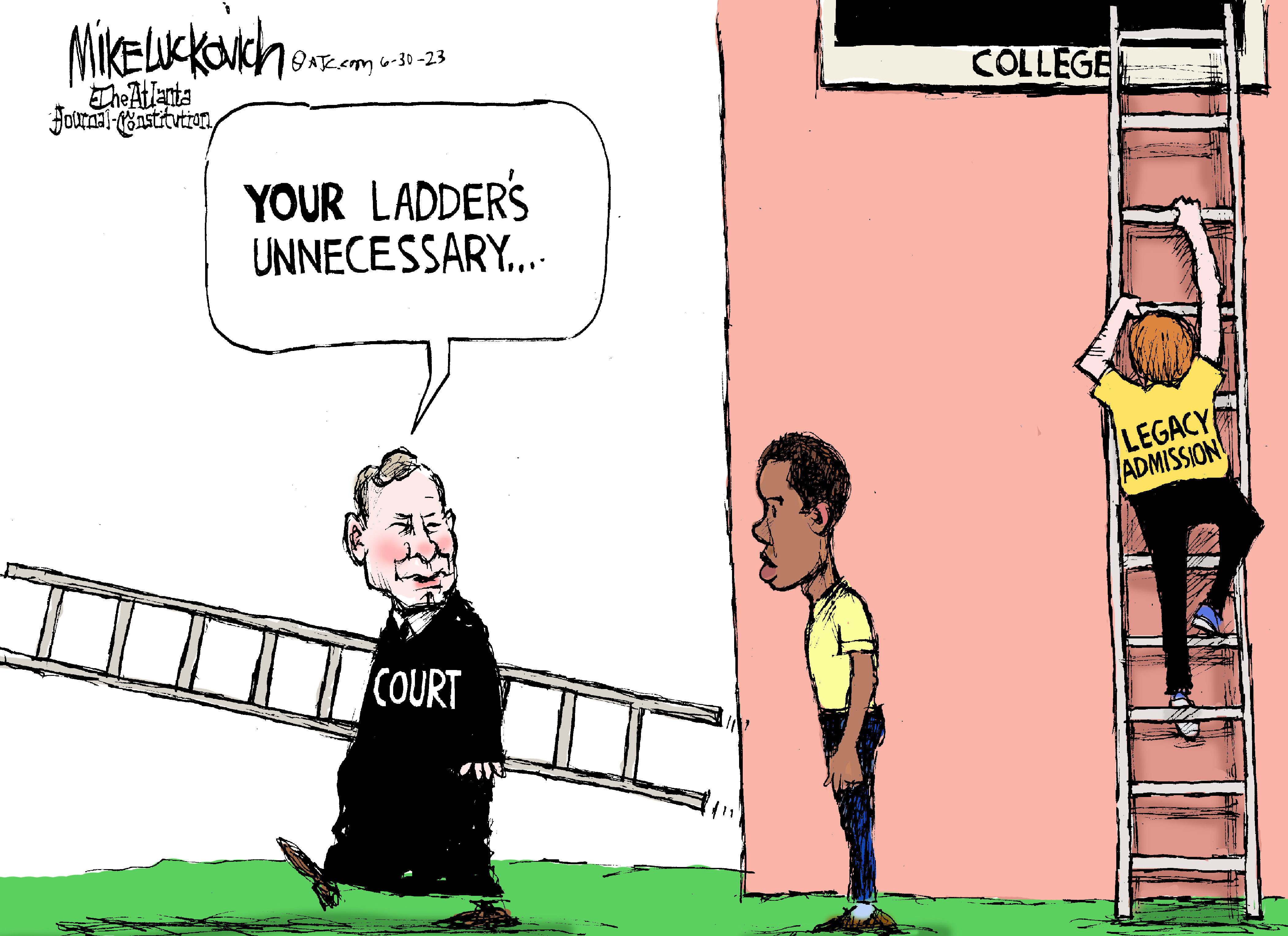
The affirmative action case is immediately consequential if you hope to attend a university in the coming years. The first thing to look for is what each institution's new admission policy is, and whether they try to achieve the goal of a diverse student body in some other way -- say by focusing on class rather than race, or recruiting a more diverse applicant poll, or something else.
Whatever they do, it seems likely that Black and Hispanic enrollment in elite universities and professional schools will drop, at least in the near term.
A few people on my social media feed have suggested an intriguing idea: What if some religion-affiliated university claims that its religious mission requires a diverse student body? How would the Court handle a religious-freedom defense of an affirmative-action admission policy?
“Georgetown, the oldest Catholic and Jesuit university in the nation, was founded on the principle that engagement between people of different faiths, cultures and beliefs promotes intellectual development, an understanding of service and solidarity, and a commitment to the common good,” says Georgetown President John J. DeGioia. “Our Jesuit tradition of education recognizes the value of diversity as necessary to education and in our work to shape future leaders who will make invaluable contributions to our national and global communities.”
At Notre Dame, our Catholic mission compels us to build a class reflecting the diversity of experiences and gifts of the human family. We undertake a comprehensive assessment of applicants, admit talented students with interests and aspirations consonant with our mission, and provide opportunities for a wide range of young people. These commitments are as meaningful today at Notre Dame as they were yesterday. We will study the Supreme Court’s decision and consider any implications for our admissions process as we strive to fulfill our distinctive mission.
In the background of the affirmative action debate is a national sense of disappointment. In the 1960s, it was easy to imagine that our racial caste system needed a legal framework. Once Jim Crow and various other legally enforced discrimination ended, many of us expected things to equalize. In a generation or two, race truly would not matter.
By now it's obvious that didn't happen. So we're seeing a number of possible responses:
Pretend it did happen. This seems to be Chief Justice Roberts' approach: It's been such a long time, racism must be over by now.
Blame Black people: We really did level the playing field, so anybody who can't climb the meritocracy must just lack merit.
Blame White people: Prejudice is so strongly ingrained in Whites that we can't let Blacks succeed.
Look for structural inertia. Once a caste system takes root, it manifests in more places than just the law. It was naive to think that ending blatant legal discrimination would fix everything.
Personally, I'm a structuralist. White prejudice still persists and still matters; I can see it in myself, for example. But I don't think the personal prejudices of individual Whites are the main force keeping Black people down.
Some of the best short-form political satire comes from the NYT Pitchbot, which suggests articles for the New York Times to pursue:
Opinion | Without the burden of affirmative action, Harvard can finally become a true meritocracy by Jared Kushner and Robert F. Kennedy Jr.
and Bidenomics
It goes without saying that the Biden administration doesn't hype itself as often or as well as the Trump administration did. Trump is a natural braggart and showman, while Biden has consistently focused more on governing than on taking credit.
In part, not taking credit is part of Biden's governing strategy: He has gotten a surprising amount of Republican cooperation on stuff like infrastructure and technology precisely because he leaves the focus on infrastructure and technology rather than making it all about himself. Trump, on the other hand, consistently failed to get programs through Congress, even when his party controlled both houses.
The result is that Biden consistently runs behind Trump in polls about managing the economy, in spite of the fact that Biden's record is pretty darn good: Trump handed him a terrible economy in 2021, and yet the predicted recession never comes and jobs continue to be created at record rates. Trump's economic record can be summed up in two lines: Obama left him a growing economy with room to run, and Mitch McConnell let him run big deficits that he would have rejected under a Democratic president. Nothing else about the Trump administration made much economic difference.
But it's nearly impossible to get reelected without claiming credit for things, so Biden has begun to lay claim to a term Republicans have been using as an insult: Bidenomics.
Bidenomics isn't just a slogan and a set of graphs. It actually means something that should be popular if people hear its message. Ever since Reagan, the economy has been run under a trickle-down theory: Make sure rich people have lots of money and hope they invest it in things that create jobs. That was the logic of Trump's tax cut, which went almost entirely to corporations and the rich.
Biden's vision is to build the economy "from the middle out and the bottom up". The three legs Bidenomics stands on are: public investment in infrastructure and future oriented industries like sustainable energy; empowering the workforce through training and unionization; and promoting competition through antitrust enforcement.
Pro-science podcaster Skepchick (Rebecca Watson) lines up on the don't-debate-kooks side of the Peter Hotez/Joe Rogan/RFK Jr. controversy that I discussed last week. In case you imagine RFK Jr. can't really be that bad, Rebecca summarizes what he said on Rogan's show ("to which Joe Rogan responded with a pathetic, open-mouthed gape").
vaccines cause autism, vaccines contain mercury, ivermectin cures COVID, “Big Pharma” “had to destroy” ivermectin to get emergency use authorization for vaccines, all the studies showing no benefit to ivermectin are fake, taking the COVID vaccine makes you “21 percent more likely to die of all causes,” he’s being silenced by “Big Pharma,” and oh yeah, wifi “radiation” ALSO causes autism plus food allergies, asthma, and eczema while “degrad(ing) your mitochondria and (opening) your blood-brain barrier.”
I can understand Democrats worrying about Biden's age, or wishing the liberal worldview had a more charismatic advocate. But seriously, is that what you want in a president?
and let's close with something pop cultural
As the Oppenheimer movie opens, let's flash back to Oppy's previous pop-culture appearance: his rap battle with Thanos.