Monday, January 25, 2016

Expectations

Keep a light, hopeful heart. But ­expect the worst.

-- Joyce Carol Oates

This week's featured post is "Smearing Bernie, a preview". When the right-wing media starts painting Bernie red, will the charge stick? Will it throw him off his game?

This week everybody was talking about the weather

To me, the remarkable thing about Winter Storm Jonas -- other than the fact that New Hampshire was fine place to sit it out -- was how far in advance it was forecast, and how closely it matched those forecasts. Days before the storm hit, I knew it was coming and that the worst of it would be just west of Baltimore. I didn't expect 30 inches of snow at JFK Airport, but otherwise the meteorologists did pretty well.

and the Republican campaign starting to turn nasty

To be fair, if you are Hispanic or Muslim or female or gay, the Republican campaign has been nasty all along. But lately the candidates have started being nasty to each other.

Donald Trump actually used the word nasty to describe his closest rival, Ted Cruz.

He's a nasty guy. Nobody likes him. Nobody in Congress likes him. Nobody likes him anywhere once they get to know him. He's a very –- he's got an edge that's not good. You can't make deals with people like that and it's not a good thing.

Former Republican nominee Bob Dole agreed:

I don’t know how he’s going to deal with Congress. Nobody likes him.

That's an unusual thing to say about a sitting senator. The Senate has clubby aspect to it, and you can always find people in the opposing party to say (of somebody like Joe Biden or Orrin Hatch) "I disagree with him, but he's a good guy." In Cruz' case, it's a challenge to find a senator in his own party who will tell you he's a good guy.

And Cruz' college roommate won't either:

Ted Cruz is a nightmare of a human being. I have plenty of problems with his politics, but truthfully his personality is so awful that 99 percent of why I hate him is just his personality. If he agreed with me on every issue, I would hate him only one percent less.

So something odd is happening: For months, everyone has been predicting that the GOP establishment would unite against Trump. But if Cruz is the alternative, they'd rather unite against Cruz.


The NYT reform-conservative columnist Ross Douthat explains "The Way to Stop Trump". Abstract arguments about his personality or his unfaithfulness to conservative orthodoxy or his ignorance of important issues don't seem to shake Trump's supporters. But Trump's business success has left a trail of victims, many of whom are the white working-class "regular guys" Trump appeals to. Put them on camera, Douthat advises, and get people to empathize with them. Joe Sixpack types who cheer when Trump is nasty to Hispanics and Muslims might have second thoughts if they saw him being nasty to people like them. (Who's the loser now, chump?)

Tell people that he isn’t the incredible self-made genius that he plays on TV. Tell them about all the money he inherited from his daddy. Tell them about the bailouts that saved him from ruin. Tell them about all his cratered companies. Then find people who suffered from those fiascos — workers laid off following his bankruptcies, homeowners who bought through Trump Mortgage, people who ponied up for sham degrees from Trump University.

But Douthat doesn't seem to realize that there's a reason Trump's Republican rivals have been reluctant to go there: Empathy is a liberal emotion. Conservatives see empathy as weakness. (President Obama was ridiculed when he cited empathy as a reason for nominating Sonia Sotomayor to the Supreme Court. "President Obama clearly believes that you measure up to his empathy standard," Senator Grassley said during her confirmation hearing. "That worries me.")

Conversely, Republicans glorify strong leaders who can "make the tough decisions". Those decisions are "tough", not because they require personal risk or sacrifice, but because they require heartlessness: who to fire, whose benefits to cut, who to torture, how many innocent-bystander deaths are acceptable collateral damage, and so on.

One prior assumption of the Fox News Fantasy World is that conservative policies have no victims; anyone who gets hurt had it coming. So it enrages conservatives when you puncture their denial by finding actual victims and putting them on camera: the Sandy Hook parents, refugee kids, families thrown off food stamps, moms of dead soldiers, and so on. They think that's cheating. Ann Coulter once famously denounced the widows of 9-11 first-responders ("I have never seen people enjoying their husband’s death so much.") when they criticized the Bush administration. She saw "using their grief to make a political point" as a low blow.

So while I agree with Douthat that his strategy would work, I wonder if Trump's Republican rivals are willing to break the empathy taboo. Democrats will, though, and that's one reason Trump is a less formidable general-election candidate than current polls indicate.


Carly Fiorina has no chance of winning the nomination or being president, so I'm not going to cover her in any detail. But her talk in Hudson, NH Saturday morning was only a few minutes down the road, so I went. Maybe 125 people showed up, filling the local American Legion hall. The audience was polite and welcoming, but subdued.

I'm always interested to observe how a female candidate navigates the narrow passage between the Weak Little Girl and Cold Heartless Bitch stereotypes. (There's no similar dilemma for men, which is one reason male candidates it easier.) In the debates, Fiorina has tried a little too hard to look like a strong leader and ended up sounding strident to me, so I wondered if she'd seem warmer in person. She does.

Unsurprisingly, her talk assumed the Fox News Fantasy World: ObamaCare is failing, our military has been gutted, capital-G Government is strangling the economy, the world doesn't respect us any more, Christians are persecuted, government spending can be slashed without hurting anybody, Hillary doesn't care about the four Americans who died at Benghazi, climate change is not worth bringing up, and so on.

Here's what I found interesting: Carly is running primarily against Donald Trump and Hillary Clinton. (No other candidates were named.) She yoked them together as the two sides of "crony capitalism": Politicians like Clinton sell favors and businessmen like Trump buy them.


Sarah Palin's Trump endorsement had that unique Palin touch of incoherence, the kind that left Larry Wilmore asking, "Was she drunk?" (I don't think so, but I understand why he wonders.) I believe Sarah envies rappers, so she comes out with stuff like this:

We are mad
and we've been had.
They need to get used to it. ...
We're not gonna chill
In fact, it's time to drill, baby, drill
down and hold these folks accountable.
And we need to stop the self-sabotage and elect
new, independent, a candidate who represents that
and represents America first -- finally.

Pro-constitution.
Common sense solutions
that he brings to the table.
Yes, the status quo
has got to go.
Otherwise we're just going to get more of the same.
And with their failed agenda
it can't be salvaged
it must be savaged.
And Donald Trump is the right one to do that.

Where is William Shatner when you need him? Or Vanilla Ice? Huffington Post's comedy editor published the notes for Sarah's speech. And Tina Fey brought back her Palin immitation.

and the Democratic race more contentious

The main topic of discussion this week was Bernie Sanders' single-payer healthcare plan, which the Clinton campaign presented as a threat to every healthcare advance since Medicare. Chelsea Clinton was the most explicit:

Sen. Sanders wants to dismantle Obamacare, dismantle the CHIP program, dismantle Medicare, and dismantle private insurance. ... I worry if we give Republicans Democratic permission to do that, we'll go back to an era -- before we had the Affordable Care Act -- that would strip millions and millions and millions of people off their health insurance.

Hillary herself said that Sanders would

take Medicare and Medicaid and the Children’s Health Insurance Program and the Affordable Care Act health-care insurance and private employer health insurance and he would take that all together and send health insurance to the states, turning over your and my health insurance to governors.

FactCheck.org and Politifact objected. Here's Politifact's judgment:

Under Sanders’ plan, Americans would lose their current health insurance. However, his proposal would replace their health insurance and cover the currently uninsured. The program would auto-enroll every citizen and legal resident, all of whom would be entitled to benefits. While the plan would give governors authority to administer health insurance within their states, it includes provisions to allow federal authorities to take over if the governors refuse to implement it.

It’s impossible to predict with certainty how Sanders’ plan would play out in real life. But Clinton’s statement makes it sound like Sanders’ plan would leave many people uninsured, which is antithetical to the goal of Sanders’ proposal: universal healthcare.

But while the Clinton campaign's charges are indeed misleading and raise too much fear, they do point to some genuine issues:

  • Allowing the states to implement single-payer gives Republican governors too much room to monkey-wrench the program, as we've seen them do with ObamaCare. It's hard to estimate how much damage a Scott Walker or Sam Brownback could do while still implementing enough of the program to keep the feds from taking over.
  • Sanders' plan still lacks important details. Ezra Klein explored this in "Bernie Sanders' single-payer plan isn't a plan at all", in which he described the proposal as "vague and unrealistic".
  • Politically, it's hard to imagine how the Sanders proposal could survive the FUD campaign the health insurance companies would undoubtedly launch. The central idea -- that the government is going to take away something that may be working well for you (your healthcare coverage, whether it's private or government-sponsored) and replace it with something better -- requires maintaining an unlikely level of public trust in the face of a money-is-no-object opposition campaign.

That last point deserves some elaboration: ObamaCare squeaked through Congress largely because Obama promised: "If you like your healthcare plan you can keep it." And even though that promise was kept for the vast majority (I know I kept my plan and my doctor), he paid a large political price for the cases where things turned out differently. Any new proposal that would force everyone to learn a new system and says "Trust me, it will be better" is going to run into trouble.

Making healthcare a human right is a core Democratic principle and should continue to be. But I don't think we can get there by asking the American people to take a leap of faith-in-government. More likely, progress will be like walking a heavy bookcase across a room: Lift one side and pivot, then rock to the other side and pivot again, always letting the floor bear most of the weight. At each major step towards universal healthcare, the majority should be able to keep what they have while a minority changes; through a series of such steps -- each fulfilling the promise that the changing minority betters its lot -- we can walk the public over to single payer. I wish we were strong enough to lift the bookcase and carry it to its best location, but we're not, and I can't imagine that we will be in my lifetime.

With that in mind, I'd like to see Democrats push to restore the public option that was taken out of ObamaCare, maybe by allowing people of any age to buy into Medicare. Over time, the greater efficiency of the public option might drive private plans out of the market, leaving us with the single-payer system Sanders (and most Democrats) ultimately want. (This is essentially the case Paul Krugman made last Monday.)


Polls were all over the map, and either side could find one to say it was winning. Nate Silver's model currently gives Clinton an 82% chance of winning Iowa and Sanders a 61% chance of winning New Hampshire. Nationally, the RCP national polling average has Clinton 51%, Sanders 38%.

and the Oregon occupation

They're still there, and if the federal government has any plans, it isn't sharing them. Oregon Public Broadcasting continues to be the best place to follow the story.

Oregon Governor Kate Brown seems to be losing patience with the FBI's inaction. She describes the situation as "intolerable" and says "This spectacle of lawlessness must end." We're also starting to hear from the real victims: the federal employees who can't do their jobs and may feel physically in danger. Also, the people who use the wildlife refuge for its intended purposes, like Oregon resident (and novelist) Ursula Le Guin.

The militia folks have started a "common law grand jury" to decide whether to indict local government officials for "multiple constitutional crimes". As with everything else they do, they're taking themselves incredibly seriously, warning reporters that it's a "felony" to pry into the grand jury's deliberative process.

OPB also offers a psychological analysis of the possible fault lines between the various leaders of the occupation.

My pure speculation about the federal strategy is that when they finally move, they want the public reaction to be "What took you so long?" Meanwhile, the occupiers keep posting evidence of their crimes online, making a prosecutor's job pretty easy.

and you might also be interested in

This week's guns-make-us-safer story comes from The Seattle Times: Thursday night, a man got drunk and took his (legal) concealed weapon to a showing of the Benghazi movie 13 Hours. He fumbled with it and it fired accidentally, wounding a woman he didn't know. But of course, think of all the terrorists who were prevented from attacking the theater that night, for fear of meeting such a formidable patriot.

A second story comes from Mississippi, where on Saturday the wife of the owner of a gun store got into an argument (over a $25 fee) with a customer picking up a repaired gun. One thing led to another, and then led to a shootout. The owner and his son are dead. The customer and his son were taken to the hospital with life-threatening injuries.


Here's a local view of the Flint water crisis.


The scientists at NOAA and NASA make it official: 2015 broke 2014's record as the hottest year on record. By a lot.


The LA Times talks to some white Republicans in an Iowa diner: They think immigration's a problem, but they don't want to round up and deport the local Hispanic immigrants, even if they're here illegally.

That rings with my memories of growing up in the rural Midwest: Folks are more extreme when they talk about abstractions than when they talk about people. There's how you feel about "homosexuality", and then there's how you feel about your lesbian niece. I'm not surprised something similar happens with immigrants.


Here's an insightful video about race, and the difference between being non-racist (easy) and anti-racist (hard).

and let's close with something cool

The Swincar E-Spider, a different kind of all-terrain vehicle.

Monday, January 18, 2016

Standing Up

Our collective futures depend on your willingness to uphold your duties as a citizen. To vote. To speak out. To stand up for others, especially the weak, especially the vulnerable, knowing that each of us is only here because somebody, somewhere, stood up for us.

-- President Barack Obama, the 2016 State of the Union address

This week's featured posts are "The Positive Republican Message, Annotated" and "There's a Lot to Know about the Militia Takeover". As always on MLK Monday, I want to flash back to my attempt to guard the radical career of Martin Luther King against those who would reduce it one over-simplified quote: "MLK: Sanitized for Their Protection".

This week everybody was talking about the State of the Union

Tuesday, President Obama gave his final State of the Union address. [video, text] I see it as the beginning of his victory lap: No matter what you may hear from the Republican presidential candidates, the United States is much better off than it was when he took office. Other than ObamaCare or the Iran nuclear deal, his accomplishments haven't been flashy. But he came into office telling his administration "Don't do stupid stuff" -- like invading Iraq, say, or passing another huge tax cut for the rich -- and for the most part they haven't. It's amazing how well America can do if the president isn't doing stupid stuff.

No doubt the victory lap will peak with an appearance at the Democratic convention this summer. I expect the delegates to clap for a long, long time.


Another recent Obama broadcast is his "Guns in America" townhall conversation on CNN January 7. [video, transcript]

and Iran

This week President Obama frustrated yet again everyone who wants a war with Iran. Tuesday, Iran seized two American patrol boats and the ten sailors aboard them, claiming they had entered Iranian waters (which seems to be true). The next day the boats and the sailors were released without anyone needing to "unleash the full force and fury of the United States" as Ted Cruz pledged to do at Thursday night's presidential debate.

At the time the nuclear deal with Iran was being debated in Congress, critics objected that the Obama administration was "leaving behind" several Americans held in Iran, including Christian minister Saeed Abedini and Washington Post reporter Jason Rezaian. The administration argued that those negotiations were better handled separately rather than putting everything together in an omnibus package. Well, Saturday, the United States and Iran completed a prisoner swap that included Abedini and Rezaian. They weren't left behind.

It's probably not a coincidence that Saturday also marked the end of economic sanctions against Iran, as the International Atomic Energy Agency verified that Iran had complied with its part of the nuclear deal. The sanctions had frozen Iran's deposits in the international banking system, which have been estimated anywhere from $50-$150 billion.

Republican candidates try to make this sound like a U.S. payoff to the Iranians. For example, Donald Trump characterized the deal as: "They get $150 billion, plus seven [prisoners] and we get four [prisoners]." But the money was always theirs; we were simply holding it hostage. Obama "gave" the Iranians nothing.

What the end of sanctions will do is let Iran return to the international oil market. The anticipation of Iranian oil coming onto the market is part of why oil prices have been collapsing lately. So yes, President Obama does deserve some credit for gas prices falling below $2 a gallon.

and the continuing Oregon militia stand-off

I cover that in "There's a Lot to Know about the Militia Takeover".

and deaths of cultural icons

If you're my age, chances are David Bowie meant something special to you. It was always hard to separate his life from his art, and now it is hard to separate his death from his art, as in the "Lazarus" video from his final album Blackstar.


Alan Rickman also died this week. For most people he's Professor Snape, but I'll always remember him as the Metatron in Dogma. Oh, that voice. Or maybe that voice up a few octaves.


I feel remiss in not having noted the death of Meadowlark Lemon when it happened at the end of 2015. Like all athletes who make it into their 80s, Meadowlark long outlived his glory days. Many young people probably know nothing about him, and possibly nothing about the Harlem Globetrotters in general, who still exist but aren't the cultural force they once were.

The Globetrotters began in an era when American professional sports leagues were still segregated, and black athleticism was only safe for whites if it came wrapped in comedy. (In baseball, Satchel Paige was a similar package of athletic skill and comedic showmanship.)

In Meadowlark's lifetime the NBA was open to blacks, but for working-class white boys of my generation it still was chancy to openly imitate black stars like Bill Russell or Oscar Robertson. (I never told anybody that my reverse lay-up was styled after a photo of Elgin Baylor. That's one reason the "Be Like Mike" series of Gatorade commercials in the 90s -- with kids of all races pretending to be Michael Jordan -- could sometimes make me tear up.) But imitating a funny stunt by Meadowlark or his wild-dribbling teammate Curly Neal was OK.

[embed]https://www.youtube.com/watch?v=5iTy3gHhtAo[/embed]

and the Episcopal Church

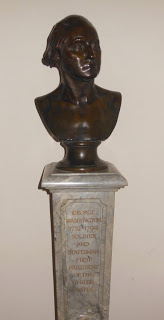
The Episcopal Church is one of the oldest religious organizations in America, going back to the Church of England's extension to the North American colonies. George Washington attended the Church of Virginia, which why a bust of him has been in the crypt of St. Paul's in London since 1921. (I've seen it.)

Thursday, that centuries-old connection frayed, as a convocation of primates from the Anglican churches of 44 countries met in Canterbury, and suspended the Episcopal Church from participation in governance of the Anglican Communion. The primates' official statement says:

we formally acknowledge this distance by requiring that for a period of three years The Episcopal Church no longer represent us on ecumenical and interfaith bodies, should not be appointed or elected to an internal standing committee and that while participating in the internal bodies of the Anglican Communion, they will not take part in decision making on any issues pertaining to doctrine or polity.

The "distance" arises from the Episcopalians' increasing tolerance of homosexuality, which is particularly odious to the African Anglican leaders. An openly gay Episcopal bishop was elected in 2003, and same-sex marriages were officially recognized in July. The role of women is also an issue, though many other Anglican churches ordain women as priests. Katharine Jefferts Schori was presiding bishop of the Episcopal Church from 2006-2014.

Such issues have led to the formation of a rival Anglican Church in North America, which is not officially recognized by the Anglican Communion, but is recognized by numerous African Anglican churches.

It's hard to see how this issue resolves in three years, or in anything other than a permanent separation, since Episcopalians don't seem likely to back down. "We're committed to being a house of prayer for all," said current Presiding Bishop Michael Curry. The most eloquent expression of that position came from Jim Naughton, the former head of the archdiocese of Washington, D.C.: "We can't repent what is not sin."

The Daily Beast's Jay Michaelson sees the Anglican/Episcopal rift as

just the surface of a much deeper division, reflecting the polarization of Christian life in the 21st century.

and you might also be interested in

This week's guns-make-us-safer story concerns an Ohio man who killed his son. The 14-year-old's skipping-school plan involved sneaking back into the basement after apparently going out to catch the bus. His father heard a noise downstairs and shot at what he believed to be an intruder.


Sociologist Victor Tan Chen elaborates on the recent study showing declining life expectancy for working-class whites, predominately due to despair-related health problems (like suicide and addiction) in middle age. Chen focuses not just on the declining economic opportunities for less-educated whites (a problem they share with less-educated non-whites, whose life expectancy is still increasing), but the simultaneous decline in sources of community (like church or union membership), and in long-term marriages. When economic disaster strikes, a go-it-alone attitude and an ideal of rugged individualism may leave a person more vulnerable to despair than a better-connected person who is even worse off financially.


Charles Alan Martin tells how his thinking about Black Lives Matter has changed:

Up until this point, I’ve stubbornly held onto the presumption that BLM needed to somehow deliver their message in a way I could find palatable when, in reality, I wasn’t owed a damned thing.

I had a similar realization just before I wrote "Why BLM Protesters Can't Behave".


The debate over whether Ted Cruz is a "natural born citizen" of the United States -- which the Constitution mentions as a requirement for the presidency -- has heated up.

I admit, it's satisfying to watch Cruz have to deal with this after all the completely baseless noise he and his fellow conservatives (like his Dad, for example) made about President Obama's citizenship. I think this is a bullshit issue, but Cruz has made a career out of bullshit.

Even so, my position is simple: We have to respect the clear constitutional requirements (like being at least 35 years old), but any ambiguity should be interpreted to maximize voter choice. I will be very sad (and worried) if the American people elect Ted Cruz as our next president. But the place to stop him is at the ballot box; I don't want to disqualify him on a technicality.

Cruz is also dealing with the revelation that he funded his Senate campaign with loans from Goldman Sachs, where his wife works, and didn't report it properly. NPR explains the possible ramifications.

And I question how much influence David Brooks has on the Republican electorate, but the conservative NYT columnist wasn't pulling any punches in "The Brutalism of Ted Cruz":

Ted Cruz is now running strongly among evangelical voters, especially in Iowa. But in his career and public presentation Cruz is a stranger to most of what would generally be considered the Christian virtues: humility, mercy, compassion and grace. ... He sows bitterness, influences his followers to lose all sense of proportion and teaches them to answer hate with hate. This Trump-Cruz conservatism looks more like tribal, blood and soil European conservatism than the pluralistic American kind.

BTW, "tribal, blood and soil European conservatism" sounds to me like a roundabout way of saying "fascism".


And while I'm on that subject (again), here's a fascinating historical tidbit from Robert O. Paxton's The Anatomy of Fascism:

The term national socialism seems to have been invented by the French nationalist author Maurice Barrès, who described the aristocratic adventurer the Marquis de Morès in 1896 as "the first national socialist." Morès, after failing as a cattle rancher in North Dakota, returned to Paris in the early 1890s and organized a band of anti-Semitic toughs who attacked Jewish shops and offices. As a cattleman, Morès found his recruits among the slaughterhouse workers in Paris, to whom he appealed with a mixture of anticapitalism and anti-Semitic nationalism. His squads wore the cowboy garb and ten-gallon hats that the marquis had discovered in the American West, which thus predate black and brown shirts (by a modest stretch of the imagination) as the first fascist uniform.

Keep that in mind as you watch Ammon Bundy and his fellow militia yahoos in Oregon.


Some insight into Trump supporters from a Muslim woman who attended a rally in a hijab.


Now that Michael Bay's Benghazi movie 13 Hours is out, the long-debunked myths about Benghazi are likely to be trotted out again. Fortunately, Media Matters has put together a convenient video debunking yet again the four biggest Benghazi myths. Bookmark it, and use as needed in Facebook arguments.


Sky Palma@DeadStateTweets:

If you vote for a party that's against government regulation, don't be surprised if your tap water ends up poisoning you.

and let's close with something you can start watching tonight

War and Peace, the miniseries.

Monday, January 4, 2016

Breaking Barriers

I am tired of the stranglehold that women have had on the job of presidential spouse.

Bill Clinton

No Sift next week. The next new posts will appear on January 18.

This week's featured post is "Trump Supporters and Liberals: Why aren't we on the same side?".

This week everybody was talking about the old and new years

The New Yorker's John Cassidy picked out "Six Bits of Good News from 2015", starting with how international cooperation stopped the Ebola epidemic in West Africa. And the long-term downward trend in global poverty continued.


I find all those best-books-of-the-year lists intimidating, not to mention depressing: If the list has 100 books on it, I've usually read about one, and if it's just a top-ten list, I probably haven't read any. That's why I much prefer lists of what literate people (who aren't all book critics) actually read and liked this year, even if it wasn't new. Here are lists from the staff at Vox , The Week, and The Guardian.

My personal best reads of the year: The Half Has Never Been Told by Edward Baptist (nonfiction) and Forever by Pete Hamill (fiction). In teen/tween fiction, I'd pick Zombie Baseball Beatdown by Paolo Bacigalupi. Graphic novel: I agree with Alex Abad-Santos at Vox: Ms. Marvel. Best continuing comic-book series: Astro City. I also discovered the action/suspense novels of Greg Iles this year, and saw some surprising similarities between his old Southern riverport hometown of Natchez, Mississippi and my old Midwestern riverport hometown of Quincy, Illinois.


I saw so few movies this year that I can't judge best-movie lists. But Cinema Blend's list is an intriguing mix of indie-art-house stuff and blockbusters.


TPM has announced the winners of 2015's Golden Dukes, the annual awards given to "the year's best purveyors of public corruption, outlandish behavior, The Crazy and betrayals of the public trust". The grand prize winner is Dennis Hastert, for the revelation that all the while he was presiding over the House's impeachment of President Clinton, he was paying hush money to a male student he molested when he was a wrestling coach. Says one contest judge:

But the sheer depravity, the utter lack of a moral compass, and the misuse of moral authority of Hastert's pre-Congressional illegal acts, coupled with the hypocrisy of his work to end a presidency over consensual sex with an of-age partner and his efforts to deny rights to consensual partners of age who happen to be of the same sex, Hastert's your guy, apparently.


More pundits should follow Steve Benen's example: He rounds up his biggest mistakes of the year.


Science picks its top ten science images of 2015, including this shot of a new species of sea slug found on a reef in the Philippines.


Who can imagine, at this point, what wonders and blunders we'll see in 2016?

and Bill Cosby and the affluenza teen

CNN has been obsessing over these two cases, but you shouldn't. It's good that prosecutors are finally listening to women (at least in this one case). It's sad that a beloved cultural icon was such a sleaze in real life. But the Cosby case has very little impact on your life. The legal issues are kind of interesting, though.

The original affluenza defense was ridiculous; Ethan Couch was stupid to break the probation he was lucky to have in the first place; and what was his mom thinking in helping him run away to Mexico? But there are stories more deserving of your attention, like the next one:

and Tamir Rice

The Cleveland policeman who killed a 12-year-old boy playing with a pellet gun will face no charges. ThinkProgress identifies seven things everyone should know about the case.


Ta-Nehisi Coates discusses how police who kill citizens delegitimize police in general. If calling the police means that someone could wind up dead (with no one held accountable), then calling the police escalates conflict rather than leading to a resolution.

It will not do to note that 99 percent of the time the police mediate conflicts without killing people anymore than it will do for a restaurant to note that 99 percent of the time rats don’t run through the dining room. Nor will it do to point out that most black citizens are killed by other black citizens, not police officers, anymore than it will do to point out that most American citizens are killed by other American citizens, not terrorists. If officers cannot be expected to act any better than ordinary citizens, why call them in the first place? Why invest them with any more power?


I have a hard time apportioning the individual and collective responsibility in the Rice case. Obviously, Tamir Rice should not be dead and probably would not be dead if he were white. The officer who shot him at the very minimum should not be a cop any more, and probably should be convicted of something.

But I don't want to pin the whole responsibility on the individual cop who pulled the trigger. There is the larger cultural problem of a police department that doesn't value black lives. And beyond that, there's the structural racism in our whole society, which casts black males as inherently dangerous. To most American whites, things just look different when blacks do them, a problem I illustrated with a collection of reactions to President Obama and his family in "What Should 'Racism' Mean?".

I don't doubt that when Officer Loehman looked at Rice, he saw a dangerous thug with a gun, and believed that he had a shoot immediately to defend himself. But why did he see and believe that? Why didn't the possibility of a 12-year-old with a toy cross his mind? Or even the possibility that the "armed thug" might be talked down without violence?

Independent of what (if anything) happens to Loehman, Cleveland needs to take a hard look at how it trains its cops. All cities need to look at the us-against-them attitude within their police departments. (Why did Loehman's partner back his story of giving Rice multiple warnings, when the video shows only two seconds between opening the car door and the first shot?) And we all need to examine our perceptual filters, to understand how we see blacks and whites differently.

and the Oregon militia stand-off

The Bundy militia is back in the news. Bundy's son and some other armed yahoos have seized the headquarters of a national wildlife refuge in rural Oregon to protest something-or-other about land use. They have no hostages, but say they're willing to use violence if the government tries to evict them by force.

“We are not hurting anybody or damaging any property.,” Ammon Bundy told [Oregon Public Broadcasting]. “We would expect that they understand that we have given them no reason to use lethal force upon us or any other force.”

Yeah, that can work sometimes if you're white.


That Vox summary article includes the goodbye-to-my-family video of militiaman Jon Ritzheimer, who seems to think he's going to his death. To me, it resembles the videos that Palestinian suicide bombers record. I'm not the only one who sees the similarities between our homegrown extremists and foreign terrorists: the nickname "Y'all Qaeda" is catching on, though it seems a little unfair to non-terrorist Southerners. #yallqaeda

Ritzheimer waves a pocket edition of the Constitution around as if it were sacred writ, but doesn't say what it has to do with the issue at hand. I've read the Constitution too, and I don't see the connection. Part of the constitutional system is that we have courts where we resolve such questions. I don't recall any of the Founders saying that if my interpretation of the Constitution doesn't win out, I'll have to start shooting people.


Tempting as it is to imagine the government taking these guys by force, I'm applying the same frame I do to Al Qaeda or ISIS terrorism: The terrorists have a narrative, and we don't want to play into it. I want them punished in a really boring and bureaucratic way that allows them no moment of glory whatsoever.

and the presidential campaign

Now that Donald Trump is promising to make Bill Clinton's infidelities an issue in his campaign against Hillary, the next question is: What ever happened to Monica Lewinsky? Well, she's become an activist against cyber-bullying, using her own experience to identify with young people who are being humiliated online. Here's a TED talk she gave in March.

A marketplace has emerged where public humiliation is a commodity and shame is an industry. ... The more shame, the more clicks. The more clicks, the more advertising dollars.


OK, maybe that's the second-to-next question. The next question ought to be: How is this a reason to vote against Hillary? That's what has Paul Waldman scratching his head:

What's much harder to figure out is why Bill Clinton's behavior provides a reason to vote against his wife. That's the substance of the question, which still awaits an explanation.

I'm with Josh Marshall:

At the risk of stating the obvious, this is a tactic that may work great for Trump in a Republican primary - particularly with the people who make up Trump's core constituency. But in a general election, with an electorate not driven by the things that drive Trump supporters, having a thrice married, philandering blowhard like Trump trying to beat up on a woman over her husband's philandering, about which she is if anything the victim rather than the perpetrator, is almost comically self-destructive on Trump's part.


Hillary's charge that terrorist groups were using Trump's anti-Muslim statements as recruiting tools apparently was based more on intuition than evidence (unless the testimony of these experts counts). Consequently, it was premature: At that time she said it, no one could find any examples of Trump appearing in terrorist recruiting videos (which isn't exactly what Clinton charged anyway). But now they can.

It stands to reason. ISIS' main message to Muslim youth is: There is no place for you in a world dominated by the West. Who makes that point better than Donald Trump?

and you might also be interested in

This week's guns-make-us-safer story: Wednesday night, a Florida woman killed her 27-year-old daughter after mistaking her for an intruder. Now apply the guns-everywhere theory and imagine that the daughter had been armed and ready to shoot back when she saw a muzzle-flash in the dark. (She wasn't.)


The Oregon bakers (the ones who think that discriminating against gays is part of their religious freedom) have finally paid their $135K fine plus interest. It wasn't hard, because fans have sent them $515K, and the money is still coming in. Fox News' Todd Starnes calls this "the price the Kleins had to pay for following the teachings of Jesus Christ." I'm still searching for whatever teaching that is and where in the Bible Jesus taught it. If you know, please comment.


Steve Benen shares my view of the spying-on-Israel flap. Israel had somehow acquired inside information about our nuclear-weapons-development negotiations with Iran, and was feeding them to Republican congressmen to undermine the chances of reaching an agreement. You can say that we shouldn't spy on our allies, but Israel wasn't acting as an ally in this situation.

Netanyahu and his team tried and failed to derail the diplomatic efforts, but they still had hopes of sabotaging American foreign policy through Congress. For intelligence agencies, this created a real dilemma. On the one hand, the very idea of U.S. intelligence agencies spying on members of the U.S. Congress is a major problem. On the other hand, U.S. intelligence agencies spying on a foreign government actively trying to subvert American policy is about as common as a sunrise.

The tricky part, obviously, is the challenge facing intelligence officials when it’s American members of Congress who are coordinating – and to a degree, partnering – with a foreign government to undermine the foreign policy of the United States. Such a dynamic has no real precedent in the American tradition, but in the Obama era, radicalized congressional Republicans have made this rather commonplace.


BTW: about that agreement. Monday, Iran took one of the major steps towards implementation when it shipped 25,000 pounds of low-enriched uranium to Russia. According to Secretary Kerry, the "breakout time" Iran would need to construct a nuclear weapon has already tripled, from 2-3 months to 6-9 months.

As I pointed out at the time, we gave up nothing of ours to get that result. After it jumps through a few more hoops, Iran will get some of its own money back.


Paul Krugman points out that Obama's re-election had other important consequences: Rich people paid more tax and more people had health insurance.

and let's close with some New Year's resolutions

AJ+ offers ten resolutions to actually make America great. She starts in a good place: If you want to "make America great again", you should define great and again. Are we talking about when black people couldn't vote? When women weren't in the workforce? When?

Monday, December 28, 2015

The Yearly Sift: 2015

The past is what you remember, imagine you remember, convince yourself you remember, or pretend you remember.
-- Harold Pinter
review all the Sift quotes of 2015

Ordinarily, The Weekly Sift lives in the moment and comes together week by week. But at the end of every year, I look back to see if there's any pattern in what I've been doing.

The themes

Looking back at the 48 Sifts between this one and the last Yearly Sift, several themes stand out. I've pulled three out into their own articles: the presidential race; the religion/morality/law complex that resulted from the Supreme Court's same-sex marriage decision and continued in the "religious freedom" debate that followed; and the year-long debate over Black Lives Matter.

The books

Over the last few years, the number of book reviews has gone down, in favor of longer posts that pull together a larger reading program ("Not a Tea Party" is the model there.), or short recommendations that don't stretch into a full article.

The full-fledged reviews this year were Islam Without Extremes by Mustafa Akyol, Creditocracy by Andrew Ross, The Half has Never Been Told by Edward Baptist, and How Propaganda Works by Jason Stanley. Ta-Nehisi Coates' book Between the World in Me got reviewed in a segment of a weekly summary; I'm not sure why I didn't break that out into its own article.

Posts that leaned heavily on particular books include "Small-government Freedom vs. Big-government Rights", which leaned on After Appomattox by Gregory Downs. "What Just Happened?", my discussion of Benjamin Netanyahu's re-election in Israel, leaned on two books: My Promised Land by Ari Shavit and Goliath by Max Blumenthal. "You Don't Have to Hate Anybody to be a Bigot" leaned on Almighty God Created the Races by Fay Botham

My analysis of Hillary Clinton's campaign speeches was actually a report on a much larger reading project: Hillary's It Takes a Village, Living History, and Hard Choices, as well as David Brock's The Seduction of Hillary Rodham and Blinded By the Right.

Well-worth-reading books that I mentioned in weekly summaries but never worked into a larger article include: The Doubt Factory by Paolo Bacigalupi, Dallas 1963 by Bill Minutablio and Steven Davis, Why I am a Salafi by Michael Muhammad Knight 12-14, and What is Islam? by Shahab Ahmed 12-14

The mosts

Most popular posts. By far the most popular post, for the second year in a row, was "Not a Tea Party, a Confederate Party". It had settled down from its original run last year, but then the Charleston shooting and the subsequent controversy over the Confederate flag set it off on an even bigger run. It got 300K hits this year, building its total to 485K. Whenever "Not a Tea Party" goes on a run, it carries along two posts it links to: "A Short History of White Racism in the Two Party System" (17K new hits/ 32K total) and "Slavery Lasted Until Pearl Harbor" (6K/11K). Each is worthwhile on its own.

The most popular new post (second overall) was another deep dive into American history: "You Don't Have to Hate Anybody to be a Bigot" got 101K hits. All-time, it moved into third place behind "Not a Tea Party" and "The Distress of the Privileged" (52K new hits/ 394K total). "You Don't Have to Hate Anybody" looks at how religion has been used to justify discrimination all through American history; the "religious freedom" argument currently being used to justify discrimination against gays and same-sex couples is virtually identical to religious arguments that justified discrimination against blacks and against interracial couples; there are also parallels with the religious justifications for slavery.

Two other popular posts this year were "Slurs: Who can say them, when, and why" about the proper usage (and non-usage) of words like nigger and bitch; (13K hits); and "The Political F-word" (10K hits), which compared Donald Trump's campaign and following to various models of fascism.
Most prescient comments. The most prescient comment actually is from July of 2014, when I predicted not only the result of this year's ObamaCare decision, but the 6-3 split:
I don’t think they’ll overturn the subsidies. ... I can imagine Thomas, Alito, and Scalia going that way, but Roberts and Kennedy will be reluctant.
When Charleston-church-shooter Dylann Roof was characterized as a "lone wolf" despite his online contacts with white supremacist groups and his manifesto being full of standard white-supremacist rhetoric, I speculated:
Make the parallel to Muslim terrorists and ISIS. If a Muslim shooter had been browsing ISIS web sites and wrote a manifesto full of ISIS rhetoric, would we see him as a loner, or think of him as part of ISIS?
Well, we found out the answer to that after the San Bernardino shooting.
I also feel good about refusing to jump on the Jeb-Bush-inevitability bandwagon. I won't claim to have seen Donald Trump coming, but back in June (when Jeb announced) I was skeptical:
What issues will he run on? His positions on immigration and education are unpopular with the Republican base. I have heard no specific suggestions for how he would fight ISIS or terrorism in general differently than President Obama. I really don’t think his blaming Obama for “the biggest debt ever” will stick, given that Obama has drastically reduced the deficit he inherited from Jeb’s brother.
Just before Hillary's Benghazi Committee testimony, I predicted:
Republicans will browbeat her in order to look tough for their base, but Clinton will maintain her composure and look like the winner to most of the country.
Least prescient comments. Hands down, the least was my underestimation of the Trump threat. In July I wrote:
He really has no interest in being president, and when the campaign gets serious he won’t be there. So if his candidacy is getting you either excited or riled, don’t waste your energy. ... [T]his campaign is a more elaborate bluff than he’s run in previous years, but it’s still a bluff. Look for him to find an exit sometime in December.
In October, I was still waiting for the bluff to unravel. I noted that Bush had started to put major money into New Hampshire, which would force Trump to do the same. "We’ll soon know whether Trump is serious or just running as a publicity stunt." Well, Trump didn't put serious money in then and still hasn't.

Also, I consistently over-estimated how close we'd come to a government shutdown this year. No particular quote stands out, but there's a general pattern.

I usually pick out a Best Post Nobody Read, but this year the good posts all did pretty well. I may have to change my definition of nobody.

The numbers

Since the last Yearly Sift, I put out 48 weekly sifts (49 if you include this one) and took three weeks off.

2015 continued 2014's upward trend in the Sift's readership. The most straightforward measurement of that growth is in the annual page-views:
2013: 215K
2014: 415K
2015: 777K (as of this morning)
As I comment every year, though, page-views is a deceptive measure, because it depends so heavily on the timing of viral posts, which can't be scheduled or projected into the future. About 300K of 2015's page-views came from the second run of 2014's "Not a Tea Party, a Confederate Party".

But other statistics support the growth story told by the page-views: The hits on the home page, weeklysift.com, come mostly from people who have it bookmarked, and so are at least semi-regular readers. That trend looks like this: 15.5K in 2012; 22.6K in 2013; 44.1K in 2014; and 98.3K in 2015.
WordPress tells me the blog has 3820 followers, up from 2281 last year. The number of comments is also up: 531 in 2013, 879 in 2014, and 1407 in 2015. Qualitatively, I feel like the commenting community is starting to move to another level. In previous years, the comment section was mostly a back-and-forth between me and individual readers. But this year the commenters often had interesting discussions completely on their own, without me needing to say much beyond what was in the original post.

Something really unusual happened in November: The blog got nearly 60K hits, but the home page was the only thing that got 10K or more. Ten different posts got at least a thousand views. That had never happened before.

and let's close with something amusing

Monday, December 21, 2015

Making It Real

Government, despite its many sins, remains the only institution that can make our freedom real.
-- Gregory Downs, After Appomattox


This week everybody was talking about Baltimore

Jurors were unable to reach a verdict on any of the four charges against police officer  William Porter in the death of Freddie Gray.

Porter is one of six officers charged in Gray's death, and Porter was tried first because prosecutors hoped to use his testimony in the subsequent cases. It's not clear where the prosecution goes from here.

and Chicago police corruption

The Laquan McDonald story just keeps getting worse. It isn't just that we have video that shows a police officer blasting away at McDonald for no apparent reason, contradicting all the official reports. It's that lots of other police officers lied to cover for the killer.

Mayor Rahm Emanuel has already fired Police Superintendent Garry McCarthy, and many are calling for Emanuel's own resignation or for a recall election. But just changing faces won't solve this. The Mayor -- whoever that turns out to be when the dust settles -- needs to make it a priority to change the culture of the Chicago Police Department. What Emanuel has said so far, that he takes responsibility "because it happened on my watch" makes him sound like an innocent bystander, and just doesn't cut it.

Neil Sternberg of the Chicago Sun Times raises the key issue:
The motto on Chicago squad cars, “We Serve and Protect,” is a phrase without an object. “We serve and protect whom?” The implication is the people of the city of Chicago, and to be fair, much serving and protecting goes on, all the time, all day, every day. ... But the ooze from the bad apples spatters [the good police officers], big time. The routine competence and occasional excellence of the department is undercut by a general atmosphere that could be emblazoned on their cars as “We serve and protect ourselves.” The attitude is that their job is so dangerous that their first duty is to each other, and it fosters an insular world of corruption and cronyism.

and that the government will stay open

A budget deal got done. Ezra Klein has a good summary. The bill includes money for the medical bills of the 9-11 first responders. There's no defunding of Planned Parenthood or blocking of Syrian refugees.

and wild over-reactions to Islam

A world-religions teacher in a Virginia high school assigned students to draw the Islamic statement of faith, the shahada, as an exercise in Arabic calligraphy.
Students were not asked to translate the statement or to recite it. The lesson was found to be in line with Virginia Standards of Learning for the study of monotheistic world religions.
It was similar to a previous assignment that involved drawing Chinese characters, and came out of a standard text.

Well, maybe it was predictable that some Christian parents would object, but who could have predicted how far out of control the situation would spiral? Due to "a deluge of 'profane' and 'hateful' messages from around the country" the school operated under lockdown on Wednesday and Thursday. Thursday evening, extra-curricular activities were cancelled. Friday, following the advice of local law enforcement, all the district's schools and offices were closed.

Remind me: Which side are the terrorists supposed to be on?

At Wheaton College in Illinois, tenured political-science professor Larycia Hawkins posted on Facebook that part of her Advent worship this year would be to "stand in human solidarity with my Muslim neighbor" by wearing the Muslim headscarf, the hijab. She said that, as a Christian, she saw Muslims as fellow "people of the book", and quoted Pope Francis saying that "we worship the same God".

That was too much for the Wheaton administration, who suspended her indefinitely, commenting:
Some recent faculty statements have generated confusion about complex theological matters, and could be interpreted as failing to reflect the distinctively Christian theological identity of Wheaton College.
Yale theologian Miroslav Wolf, whose book Hawkins had referenced, isn't buying that the motives behind her suspension are "theological".
Hawkins asserted that Muslims and Christians worship the same God. She did not insist that Christians and Muslims believe the same things about that one God. ... There isn’t any theological justification for Hawkins’s forced administrative leave. Her suspension is not about theology and orthodoxy. It is about enmity toward Muslims.
... When Hawkins justified her solidarity with Muslims by noting that as a Christian she worships the same God as Muslims, she committed the unpardonable sin of removing the enemy from the category of “alien” and “purely evil” other.
It seems to me that once you declare that there's only one God, you lose the option of claiming that other people worship a different God. You can claim that they have crazy beliefs about God and worship God all wrong, but you can't claim their omnipotent Creator of the Universe is a different being from your omnipotent Creator of the Universe.

BTW: I wonder if the administration's unwillingness to interpret away their differences with Hawkins has anything to do with the fact she is the only tenured black woman on the Wheaton faculty. One of the ways unconscious racism and sexism plays out is in the presumption that "he must have had a good reason to do or say that", while women and blacks are likely to be seen as radical or irrational.

No idea whether there's any connection or not, but a dozen or so girls at Vernon Hills High School in Illinois have also started wearing a hijab in solidarity with Muslims suffering discrimination.

While we're talking religion: Fontbonne Academy, a Catholic prep school for girls in Milton, Massachusetts, hired a guy to be director of food services. When he filled out his employment form, though, he listed his husband as his emergency contact. The school rescinded the job offer "because his marriage was inconsistent with the teachings of the Catholic Church."

Since being Catholic or having a lifestyle consistent with Catholic teachings had never previously been a requirement for directing food services, the guy sued. The school tried to argue that this wasn't discrimination against gays. (You can be gay, you just can't get married.) But courts aren't that stupid, so they lost.

This pattern shows up a lot among people who think they aren't prejudiced against anybody: I don't have anything against you or your people, I just object to your attempt to live a normal life. (Go ahead a be transgendered. Just don't use public bathrooms.)

Franklin Graham, heir to his father Billy's evangelistic empire, is calling for an end to Muslim immigration "until the war with Islam is over".
Graham also said Islam is not compatible with American values and therefore the U.S. might have to shut down mosques.
This is precisely why the Founders wanted to separate church and state: Graham's version of Christianity may see itself at war with Islam, and think that Islam is incompatible with its values, but that crusade has nothing to do with the United States of America.

And before we leave religion entirely, Vox has a great article about the dilemma of Western imams when they see young people getting radicalized. You don't want them learning Islam with only radical internet chatter for guidance. But
if they do and try [to help] these young people, and for whatever reason it doesn't work, then they get in trouble. [Police] come knocking at the door saying, "You were in touch with this person and they went overseas. What did you tell them?"
One of the article's most important observations comes early:
Mosques are where radicalization is stopped: They provide vulnerable Muslims with a sense of community, thus overcoming the isolation that can allow online extremist propaganda to seep in, and they give imams an opportunity to intervene in troubled lives and counteract extremist ideas.
Unfortunately, that kind of social work isn't what imams are trained for.

There's also the story of the New Jersey teacher who claims she was fired mostly for being a Muslim; not in so many words, of course, but because she did things (like show a Malala video) that would have been no problem for a non-Muslim teacher. I'm not making a bigger deal out of this because so far all we have is the teacher's version of events.

but more people should be talking about Flint

Other than Rachel Maddow, national news media hasn't shown much interest in the Michigan Emergency Manager Law, which allows the governor to appoint a manager for cities and towns that get into financial trouble. The manager essentially replaces the local government, and has the power to do just about anything but raise taxes. (Because taxation without representation would be tyranny, but having your union contract voided without representation is OK.)

As Rachel points out, though, this is a very radical notion: that democracy gets in the way when you're trying to pay your debts, so it just makes good sense to install what is essentially a dictator. (In practice, the Michigan cities that get in trouble tend to be overwhelmingly black, so to the extent that this law is in the American tradition at all, it's the American tradition of disenfranchising black people.)

In Flint, one way the emergency manager tried to save money was to start using water from the Flint River rather than continuing to buy lake water from Detroit. Lots of other cities use river water without any problems, but there is an issue: River water is more corrosive than lake water, so (unless treated) it has a tendency to dissolve lead out of pipes, raising the amount of lead in the water.

Well, Flint didn't take proper precautions, so the lead level in Flint water has spiked, a fact that is likely to lead to permanent neurological damage in Flint's children, ranging from lower IQs to mood disorders. Friday night, Rachel devoted most of her show to this story, starting with a very enraged reporting of the facts, and followed by an interview with the doctor who found elevated lead in Flint children's blood.

and you might also be interested in

ProPublica's "An Unbelievable Story of Rape" is both important and heart-breaking. An 18-year-old woman said she was raped. But when police and her former foster mothers started to doubt her story, she admitted that she made it all up. Then they caught a serial rapist who had her in his notebook, and found the pictures he took.

The reporters do a good job of not demonizing the police involved in the case, most of whom are women. Figuring out what to make of the testimony of someone who has been traumatized is genuinely difficult, and the detectives' training didn't adequately prepare them for a case like this.

In the middle of an otherwise serious poll, PPP asked 532 Republican primary voters whether they would favor or oppose bombing Agrabah. 30% said yes and only 13% no. 41% of Trump voters favored bombing Agrabah.

Agrabah is fictional; it appears in the Disney movie Aladdin. You have to wonder what results they'd have gotten if they'd asked about bombing a real city in a Middle Eastern country our government is on good terms with, like say Riyadh or Abu Dhabi. A similar question in a poll of 532 Democratic primary voters found only 19% willing to bomb Agrabah, with 36% opposed.

The Republican responses to reality-based questions were pretty remarkable as well. 34% support Trump. Combined with Ted Cruz' 18%, that's a majority. 54% support Trump's call for a ban on Muslims entering the country. 46% support a national database of Muslims. 36% believe the totally baseless claim that thousands of Muslims in New Jersey cheered when the Twin Towers fell on 9-11.
Interestingly, 55% of the Republicans support raising the minimum wage to $10 or higher.

Fareed Zakaria debunks the "mystical powers" Republicans assign to the phrase "radical Islamic terrorism". (Read his WaPo column or watch him present it on CNN.) Zakaria has been using the phrase himself since 9-11, so he can testify that "it gives absolutely nothing in the way of an answer or strategy to deal with terrorist attacks."
The best proof that calling radical Islam by its name provides no solutions is that the Republican candidates had none at Tuesday’s debate. After all the huffing and puffing, the most aggressive among them proposed more bombing, no-fly zones and arming the Kurds.
These are modest additions to Obama’s current strategy, each with its own problems. ... judgment calls, not no-brainers.
... Strangely, after the GOP candidates boldly and correctly described the enemy as an ideology — which is much broader than one group — they spoke almost entirely about fighting that one group. Even if the Islamic State were defeated tomorrow, would that stop the next lone-wolf jihadist in New York or Paris or London?
Zakaria calls attention to a great line by Seth Meyers:
So [Obama] used the words ‘radical,’ ‘Islam,’ and ‘terrorism,’ he just didn’t use them in the right order. Which would be a problem if it was a spell and he was Harry Potter, but he’s not, so it isn’t.

I'm way behind in my debate watching. Let me say, though, that I'm pleased to see Clinton and Sanders continue to take the high road. Sanders famously refused to make an issue of Clinton's emails in the first debate. In Saturday's, Sanders apologized for the data-theft incident that made such a flap this week; Clinton accepted and said they should move on.

and let's close with something topical

Bad Lip Reading does Star Wars.