Monday, September 21, 2015

Scary and Unscary

NO SIFT NEXT WEEK. The next set of articles will appear on October 5.

It’s not hard to scare people, but it’s extremely difficult to unscare them.

-- Dr. Paul Offit, on vaccines

This week's featured post covers Wednesday's Republican debate: "Three Hours in Bizarro World".

This week everybody was talking about Ahmed Mohamed

I'm assuming you've heard the basics of the story of Ahmed Mohamed and his clock-that-wasn't-a-bomb. Now that social media has brought national attention to the story and given Ahmed a happy ending -- despite a recent backlash -- the narrative has taken on a fairy-tale quality. So let me draw the moral: When you're young and relatively powerless, the small-minded people who control your immediate environment may seem to define reality, but they don't. There's a larger world out there, and sometimes it may come in on your side.

There's another lesson to learn from the self-congratulating response the local officials had. For example, the letter to parents sent out by the high school principal acknowledges no mistakes, makes no apologies, and implies that Ahmed did something against the school's code of conduct. It goes on to suggest:

this is a good time to remind your child how important it is to immediately report any suspicious items and/or suspicious behavior they observe to any school employee so we can address it right away.

Such policies are sometimes called "see something, say something" -- the PopeHat blog refers to them as "willful paranoia" -- and Ahmed's story underlines how they are inherently discriminatory. What people think they "see" -- a Muslim kid with a bomb, for example -- depends on what they expect to see. And that, in turn, depends on the stereotypes in their heads. So see-something-say-something is a paved road that runs directly from the unspoken bigotry from our collective unconscious to bigoted action in the physical world.

For a completely different example of how this works, consider the death of John Crawford III. Crawford was a 22-year-old black man shopping in a Walmart near Dayton, Ohio. The store video shows him pick up a toy gun and then wander around talking on his cellphone, doing nothing particularly threatening or out of the ordinary. But a white shopper "saw something" -- a thug with a gun -- and "said something" by calling 911. The police showed up expecting to face armed resistance, "saw" Crawford with a rifle, and gunned him down before he had a chance to understand what was happening.

Maybe the scariest part of Ahmed's story is the way that Islamophobes -- Bill Maher, Sarah and Bristol Palin, Fox News -- still want to support the school and police response, or at least blunt the sympathy Ahmed has received.

The most satisfying part? That's easy: The fact that Ahmed gets to move to a school that wants him, while officials at his former school get no chance for a no-hard-feelings reconciliation scene in front of cameras. So Mr. Principal, Ms. Mayor, and all the rest of the Irving, Texas power structure -- guess what? Sometimes when you screw up, you don't get to define it away. You know what you did? You reinforced the country's negative stereotypes, not of Muslims, but of white Texans.

and the continuing backlash against Black Lives Matter

Capitalizing on the success of its mythical War on Christmas, Fox News has invented a War on Cops and blamed BLM for it -- ignoring a decades-long decline in police deaths that has made it safer to be a policeman now than at any time since the 1960s.

Also, none of the violence-against-cops incidents that are supposed to be part of the War on Cops has been credibly linked to BLM. No one at BLM has endorsed them or taken credit for them. So both aspects of the "BLM is fighting a war on cops" meme are false: There is no War on Cops, and BLM isn't trying to start one.

One effect of the War on Cops meme is to justify aggressive actions against BLM and its allies, one of which hit home for me this weekend. My church (First Parish in Bedford, Massachusetts) has been displaying a Black Lives Matter banner on the side of our colonial-style building. Saturday night it was vandalized, as shown below. The church has a predominantly white professional class membership and sits in the middle of politically blue New England. But that didn't protect our banner.

It turns out such vandalism is fairly common. If you google "church black lives matter banner vandalized", you'll find a bunch of them -- including a church in Bethesda, Maryland whose banner was vandalized twice and then stolen.

This kind of thing may seem like a harmless prank if you haven't thought about it much, but when it happens to you it feels like a warning shot: People don't like what you're saying, and they know where you live. They're not afraid to break the law to shut you up.

banner
My church yesterday.

and the Republican debate

This is how dedicated I am to staying on top of the news: I watched the whole effing three hours of it. (If you have done something bad recently and need to punish yourself, you can too: Here's the video and transcript.) My horror at the more-or-less complete denial of reality is covered in "Three Hours in Bizarro World".

My general impressions about the horse-race aspects of the debate pretty much tracked everyone else's: If I turned off my internal fact-checker, Fiorina looked impressive. She was confident and authoritative; she handled the men well. Rubio also looked strong.

Trump was Trump; if you liked him before, you probably still like him. But he did seem to shrink as the debate got more wonky. So if I were the RNC, I'd push for wonkier questions in future debates, and hope that makes him look like the short kid in a game of keep-away.

I can't judge Ben Carson, probably because I have so little in common with his target audience. I thought he was unimpressive in this debate, but that's what I thought about the last debate, and his support jumped afterward.

If I had to pick out a loser, I'd choose Scott Walker. Nothing he said was memorable. He has mastered boilerplate conservative rhetoric, but can't put any zing into it. I couldn't tell whether Bush did himself any good or not.


The first post-debate poll more-or-less validated everybody's first impressions: Fiorina up, Trump still leading, but with less support, Carson slipping, Rubio up a little, and Walker crashing.

and Bernie Sanders at Liberty University

I want to write about this speech, but the story got crowded out by the Republican debate. I'll get to it. In the meantime, you can watch for yourself.

One comment I will make: Liberals need to do more of this. We shouldn't write people off just because they happen to live in a conservative stronghold or belong to a conservative demographic.


One way you can tell that Bernie Sanders is becoming a more credible candidate is that the Right has begun trying to take him down. Up until now, they've been expressing a grudging respect for him, because they saw him as damaging the candidate they were really worried about, Clinton.

But last Monday the WSJ printed a scary headline about the $18 trillion price tag for Sanders' proposals over the next decade. The Nation looked at that a little closer: Most of that $18 trillion is the $15 trillion that creates a Medicare-for-all single-payer healthcare system. So that's not a new expense for the American people, it's just a shift of resources from private insurance to public insurance.

Then you get to figure in the fact that Medicare has proven to be more efficient than private insurance.

According to Gerald Friedman, an economist at the University of Massachusetts at Amherst who authored the analysis cited by the Journal, that transition would reduce American healthcare costs by almost $10 trillion over 10 years through economies of scale, better control of pharmaceutical costs, and savings on administrative bloat. ... Sanders’s Medicare expansion would cost $15 trillion, but without it American businesses and taxpayers would spend $20 trillion over the same period, while still leaving millions uninsured.

So, not that scary after all.


I mean, I couldn't really be so shallow as to choose a candidate based on who has the coolest t-shirt, or advise you to do the same, but ... isn't this a seriously cool t-shirt?

and Republican candidates and Muslims

Donald Trump raised eyebrows by not challenging a questioner at a New Hampshire rally who said that Muslims are "a problem in this country" and that "we know our current president is one". Further, President Obama is "not even an American". The guy asked "when can we get rid of them?" Them in this case seems to refer to training camps where Muslims learn to "kill us", though some people have interpreted them to mean American Muslims. It's also a little vague whether the questioner intended to say that such camps are here in America.

Trump gave an evasive answer about how "We're going to be looking into that and plenty of other things". Sunday on ABC's This Week, Trump refused to answer questions about the incident.

But other Republicans did answer questions. Ben Carson said he believes President Obama is a Christian and said "I certainly would not have accepted the premise of a question like that." But he went on to say that a candidate's faith should matter to voters "if it’s inconsistent with the values of America. ... But if it fits within the realm of America and [is] consistent with the Constitution, no problem."

In a subsequent interview, he was more explicit: "I do not believe Sharia is consistent with the Constitution of this country." He added that if a Muslim candidate "publicly rejected all the tenants of Sharia and lived a life consistent with that, then I wouldn’t have any problem."

Nobody ever asks the follow-up questions I'd like to hear: Are some versions of Christianity -- Dominionism, say? -- also inconsistent with the Constitution? If not, what's principle distinguishes Dominionism from Sharia?

but only liberals were talking about Jade Helm 15

which ended Tuesday without establishing martial law in Texas or any other state. Or at least that's what they want us to think. Maybe martial law was established, but we all don't notice because of mind-control beams from the cell towers or something.

My Google search of Alex Jones' Infowars site didn't turn up anything about the Jade Helm 15 military exercise since mid-July, but back in March he was warning: "This is in preparation for financial collapse, or maybe Obama not leaving office."

JH-15 exemplifies how the extreme right wing keeps its followers in perpetual fear: Instead of a Jade Helm retrospective admitting that none of the wild predictions had panned out, Tuesday's Infowars was full of new warnings about the dangers of taking in Syrian refugees, who might be jihadi infiltrators.

Same pattern for the NRA: You never see a retrospective about how Obama will be out of office in a year and a half, but he still hasn't taken away anybody's guns. No, no -- the gun seizure is going to start any minute now. It's been any-minute-now for six and a half years.

The Right is like an apocalyptic cult. No such cult ever throws a party to celebrate the fact that the world didn't end when it was supposed to -- next Monday, by some accounts -- much less reviews what they got wrong and or draws the lesson that everybody should be more skeptical the next time somebody thinks he sees signs of the End. There's never any time for that, because there's always a new apocalypse to worry about, and its countdown clock is getting dangerously close to zero.

and you also might be interested in ...

Arnold Schwarzenegger has been named as the new host of Celebrity Apprentice. The punch line to that story is so obvious I can't even figure out who said it first: Donald Trump has lost his job to an immigrant!


August numbers are in: 2015 is still on pace to be the hottest year on record. If trends continue, it will break 2014's mark by a considerable margin.


How climate-change deniers sound to normal people.


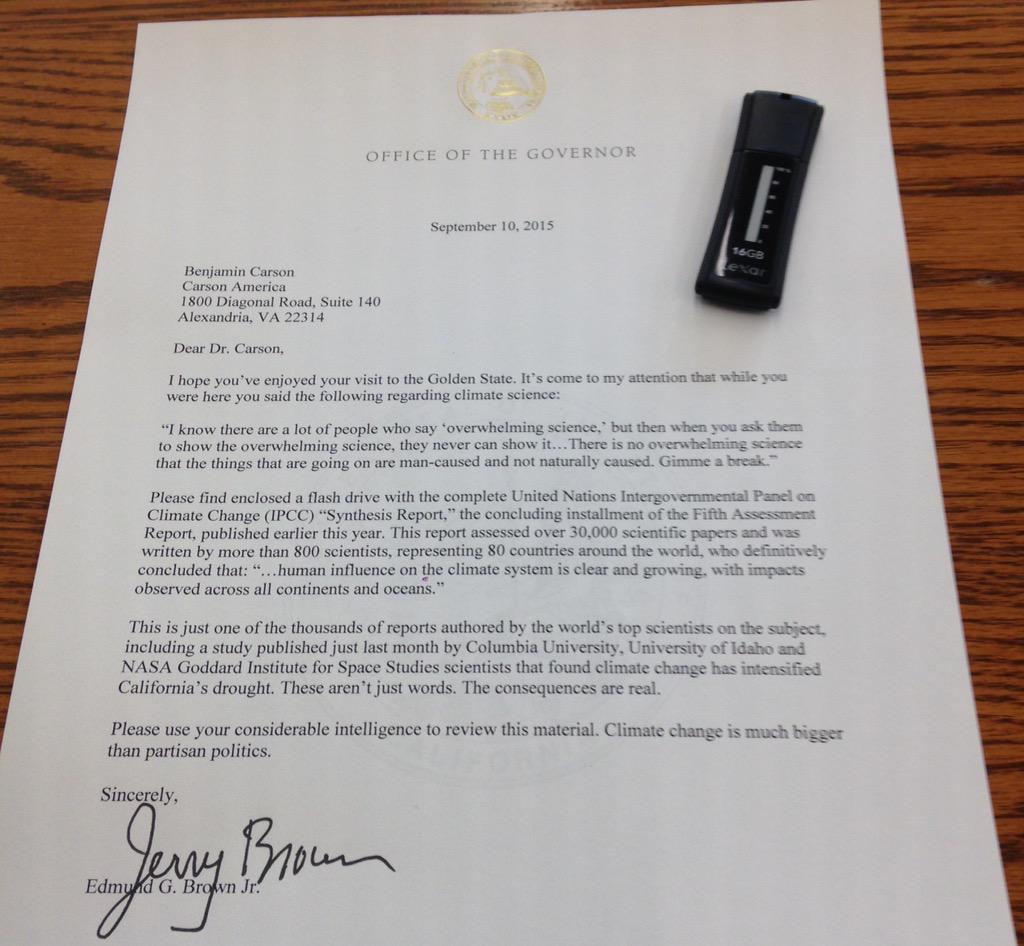
While I'm talking climate change, you have to love Jerry Brown's response to Ben Carson's statement: "I know there are a lot of people who say 'overwhelming science', but then when you ask them to show the overwhelming science, they can never show it."

Brown wrote Carson a letter on official Governor of California stationery, and enclosed a thumbdrive containing the most recent report of the UN's Intergovernmental Panel on Climate Change.


AP points out the obvious: Republican rhetoric about inequality doesn't influence the tax plans they propose, in which tax cuts overwhelmingly go to the richest. Citizens for Tax Justice does the numbers on Jeb Bush's proposal: The poorest 20% of taxpayers would see an average cut of $227, while the richest 1% would get an average cut of $82,392.


Vox connects the media's credulousness at Jeb's tax claims with its hyperfocus on Clinton's emails, and recalls what happened in 2000: Every little wardrobe choice by Al Gore got dissected for evidence of inauthenticity, while W's absurd claims that his tax cuts were fair and wouldn't wreck the budget went unanalyzed.


National Review's current disgust with Donald Trump's followers prompts Jeet Heer at The New Republic to look at the history of the "snobs vs. slobs" struggle inside the conservative movement. The often-repeated story that William F. Buckley excommunicated the John Birchers (I think I've repeated that one myself) is a little more complicated.

and let's close with something

A horror becomes an adventure if you live to post the video. Here, a driver escapes the fires in Anderson Springs, California.

Monday, September 14, 2015

Invoking 9-11

Invoking 9/11 to attack diplomacy with Iran would be like criticizing Nixon going to China because of Pearl Harbor.

-- Chris Hayes

This week's featured post continues the 2016 Stump Speech Series with Ben Carson.

This week everybody was talking about the Iran deal

which is going to go into effect, now that Senate Democrats have stuck together to block a resolution of disapproval. Meanwhile, the House defeated a resolution of approval, which seemed mostly a moot point after the Republican leadership decided not to bring a resolution of disapproval to the floor. Even if a disapproval resolution could pass the House, the vote on the approval resolution indicated that Democrats had enough votes to sustain a veto.


Ted Cruz organized a rally against the Iran deal, but was upstaged by Donald Trump. I agree with TPM contributor Jason Stanford's assessment:

The pity of this all [i.e., Trump's rhetoric about "winning"] is that the Iran deal shows how America can lead (and win!) in an increasingly disorganized world. We negotiated with Iran from a position of strength. We had support from our European allies. We had Iran’s billions in our banks. Behind door number one was Iran giving up their nuclear weapons program. Behind door number two was Iran becoming the next destination for Drone Airlines. The United States gave up nothing in this deal. In exchange for their own money, Iran gave us what we wanted: an Iran without The Bomb.

This is what winning looks like. This is our enemy surrendering their weapons without a fight not because they love us but because they know they would not survive the fight.

As I said.


The White House couldn't resist pointing out that Dick Cheney is the last person we should be listening to about diplomacy or the Middle East.

and Kim Davis getting out of jail

at least until she starts refusing marriage licenses to gay couples again. She appears to be walking a fine line: She won't issue such licenses herself, but she won't prevent deputies from doing so, as long as the licenses are attributed to a court order rather than her authority as county clerk. She doubts whether such licenses are valid, but I'm not sure who would have both the standing and the inclination to test that in court. So it looks like same-sex couples in Rowan County, Kentucky will indeed get the equal protection of the laws.


Mike Huckabee made a political spectacle out of Davis release (and managed to shut Ted Cruz out). Watching the rally outside the jail, or the clips from it shown on the news networks, you might have imagined that Huckabee played some role in freeing her. But no, he was just cashing in on her publicity stunt.

An amazing amount of nonsense is being repeated about the Davis story, and you can find almost all of it in Huckabee's comments. For example, he emphasized the unfairness of Davis being held without bail.

Jeffery Dahmer got bail, the Boston Stranger got bail, John Wayne Gacy got bail. Kim Davis, because of her convictions, was not given bail.

But bail is for people who are still innocent until proven guilty, even if what they're charged with is horrible. Contempt of court is a finding of the judge, who has already ruled, so the comparison to Dahmer is silly -- Dahmer didn't get bail after he was found guilty.

In general, bail for contempt of court would be nonsensical, because sitting in jail until you comply with the court's order is the whole point.

And then there's this Huckabee gem:

If somebody needs to go to jail, I’m willing to go in her place and I mean that because I’m tired of watching people being just harassed because they believe something of their faith.

Of course, jailing Huckabee would make absolutely no sense, since he wasn't the one defying a court order. Punishing one person for the deeds of another is substitutionary atonement, which doesn't even make sense in religion, much less in law.


Nobody who defends Davis wants to answer questions about how far their religious-freedom principle applies. On MSNBC's Morning Joe, co-host Mika Brzezinski asked the same question I raised last week: Can a clerk who takes Jesus' denunciation of divorce seriously refuse to issue marriage licenses to divorced people? Huckabee danced and dodged and never did answer.

Ben Carson was asked the same question by Fox News' Megyn Kelly, and also danced, but not quite as well:

This is a Judeo-Christian nation, in the sense that a lot of our values are based on a Judeo-Christian faith. And when there are substantial numbers of people who actually believe in the traditional definition of marriage -- I'm one of them, doesn't mean that I don't think other people can do whatever they want to do, but I don't actually believe that they have a right to force their way of life upon everybody else, nor would I try to force my way of life upon everybody else.

To the extent that response means anything at all, Carson seems to be claiming special rights for conservative Christians, because there are "substantial numbers" of them and because he believes that their faith defines the nation. I think that's what just about all of Davis' supporters believe, but most don't want to admit it.


Apparently this billboard just went up in Davis' home town.

I made a similar point once:

You can accurately describe American marriage after 1981 in a lot of ways, but “traditional marriage” is not one of them. I don’t know of any traditional society where husbands and wives have been equal under the law.

or maybe twice:

In the case of same-sex marriage, the main thing that has changed since the Founding era isn’t the Supreme Court, it’s opposite-sex marriage. In 1789, any gay or lesbian couple claiming they had a right to marry would have been laughed out of John Jay’s Supreme Court, and rightfully so. That's because in a truly “traditional” marriage husband and wife are legally distinct roles that can only be filled by people of the appropriate gender.


One proposed solution to Kim Davis' problem is the First Amendment Defense Act. Walter Olson explains what's wrong with it: The FADA explicitly grants rights to anyone who "believes or acts in accordance with a religious belief or moral conviction that marriage is or should be recognized as the union of one man and one woman, or that sexual relations are properly reserved to such a marriage."

In other words, your rights under FADA depend on whether you have the proper beliefs.

Astoundingly, the protection would run in one direction only: It would cover those who favor traditional definitions of marriage, while leaving those who might see merit in same-sex marriage or cohabitation or non-marital sex perfectly exposed to being fired, audited or cut off from public funds in retaliatory ways.

In real-life governance, of course, there is no reason to think that wrongful pressure on dissenters cuts only one way: Some federal employees get targeted by their bosses for leaning right, others for leaning left. Under FADA, however, only one side gets to run to court complaining of ill treatment.

Olson concludes:

FADA as currently drafted isn’t really an accommodation law. It’s an our-guys-win law.


It looks like a shoot-out over Kim Davis will be avoided, but right-wing crazies are coming closer and closer to insurrection. Oath Keepers -- one of the groups of armed wackos that intimidated federal agents out of enforcing the law on public-land-moocher Cliven Bundy -- announced that it was sending armed guards to protect Kim Davis from being arrested again, if she went back to defying the court. What could possibly go wrong with that plan?

Fortunately, Davis rejected the offer and seems to be trying to avoid giving the court grounds for re-arrest rather than angling to go out in a hail of gunfire. So this time we were just one lunatic short of that scenario.

One aspect of the armed-patriot movement that never gets enough attention is its white privilege. Imagine Black Lives Matter defying a court order and the New Black Panthers sending armed guards to protect BLM leaders from arrest by U.S. marshals. Is there any chance that wouldn't end in a bloodbath? And wouldn't the same people who support Oath Keepers and Kim Davis now be cheering when it did?


While we're talking about insurrection, a poll finds that 43% of Republicans could imagine supporting a military coup in the United States.

but not enough people are talking about Republican attempts to sabotage the next climate-change agreement

The Paris Climate Conference starts in November. Wikipedia says

The conference objective is to achieve a legally binding and universal agreement on climate, from all the nations of the world.

If you've been listening to the campaign speeches of Republican candidates, one of the biggest objection they make to the United States taking any action against climate change is that one nation acting along can't accomplish anything.

Carly Fiorina:

What all the scientists also tell us is that a single state, or single nation acting alone can make no difference acting alone. ... California can be the most onerous regulatory regime in the world, which they are, and it won’t make a bit of difference in climate change.

Rick Santorum:

Is there anything the United States can do about it? Clearly, no. Even folks who accept all of the science by the alarmists on the other side, recognize that everything that's being considered by the United States will have almost - well, not almost, will have zero impact on it given what's going on in the rest of the world.

Marco Rubio:

America is a country, it’s not a planet. So we can pass a bunch of laws or executive orders that will do nothing to change the climate or the weather but will devastate our economy.

So you might expect Republicans to applaud the prospect of getting the rest of the world to act in concert. I mean, you could imagine U.S. climate rules driving jobs away to India, but new world rules aren't going to send jobs to Mars.

Well, guess again. Politico reports:

Top Republican lawmakers are planning a wide-ranging offensive — including outreach to foreign officials by Senate Majority Leader Mitch McConnell's office — to undermine President Barack Obama's hopes of reaching an international climate change agreement

Jonathan Chait asks and answers the obvious question:

Why would Republicans try to persuade the rest of the world to keep pumping carbon dioxide into the atmosphere? One reason is that, while other countries transitioning to low-emission fuels may not cost American consumers anything, it definitely costs American fossil-fuel companies. People who own large deposits of coal and oil want to sell it abroad. The Republican climate-change strategy has been hatched by a group of Republican politicians and fossil-fuel lobbyists so tightly intermingled there seems to be no distinction between the interests of the two.

... In any case, the old conservative line, with its explicit or implicit promise that international agreement to reduce emissions might justify domestic emissions cuts, has suddenly become inoperative. The speed at which Republicans have changed from insisting other countries would never reduce their greenhouse-gas emissions to warning other countries not to do so — without a peep of protest from within the party or the conservative movement — says everything you need to know about the party’s stance on climate change.


I haven't figured out a good way to research the question I'm asking, so I'm mainly just trusting my own (possibly nostalgic) impressions. But didn't politics used to stop "at the water's edge"? In the Obama Era, congressional efforts to torpedo American diplomacy have become normal. But I can't remember anything similar in past administrations, certainly not supported by the leadership of the party out of power.

and you also might be interested in ...

Today's Great Moment in Irony:


Jon Chait has turned optimistic on climate change.


Surprise! "Jeb Bush's Tax Plan is Mostly a Giveaway to the Rich". Who could have predicted?

While the full details are still vague, the basic outline lowers the corporate tax rate, offers a reduced tax rate on money corporations have stashed overseas, cuts the top individual rate from 39.6% to 28%, and ends the estate tax altogether, so that dynasties of inherited wealth can dominate America even more than they do now.

You might wonder what will replace that revenue and prevent the kind of massive deficits his brother's tax cuts caused. Growth! It didn't work for W, but Jeb's tax cuts will boost GDP growth to 4% per year. Because he says so.


The New Yorker's Amy Davidson did the research I only fantasized about, and answered the conservatives who have been comparing the Supreme Court's same-sex marriage decision to Dred Scott.

In fact they have backwards "which side in the marriage debate has inherited the Dred Scott legacy": In the 7-2 decision saying that blacks could never be citizens and had "no rights which the white man was bound to respect", the majority 7 were interpreting the law the way today's conservatives do, and the dissenting 2 were making the arguments of today's liberals.

In particular, the Dred Scot 7 invoked original intent, arguing that since the man who wrote "all men are created equal" was a slave-owner, clearly the Founders did not intend the so-called "rights of man" to extend to blacks. Chief Justice Taney wrote that

No “change in public opinion” about the races “should induce the court to give to the words of the Constitution a more liberal construction.”

Today's conservatives argue that letting same-sex couples marry degrades the institution of marriage. In 1857, Justice Daniel made the same argument about blacks and the institution of citizenship.

Justice Kennedy's rhetoric about the "dignity" of same-sex relationships is often mocked as his own moral invention rather than a strictly legal argument. Justice McLean's Dred Scott dissent had similarly lofty rhetoric:

A slave is not a mere chattel. He bears the impress of his Maker, and is amenable to the laws of God and man, and he is destined to an endless existence.

McLean made a living-Constitution argument that would be familiar to today's liberals:

McLean acknowledged both the sorry racial views of the Founders’ time and the allowance for slavery in the Constitution, but he suggested that the language used could have a better meaning in a freer era. Madison, he noted, was careful to keep out of the Constitution words that “convey the idea that there could be property in man.” (Indeed, the Constitution never refers to a “slave” but to a “person held to service or labor.”) There was always more of a debate about slavery, and a consciousness of wrong, than Taney let on. The Constitution has, built into it, a hope for change.

This is a rich article and has much more to it. Go read it.

and let's close with something sentimental

Namely, a celebration of Dads.

Monday, September 7, 2015

Where to Begin

It is painful to accept fully the simple fact that one begins from where one is, that one must break free of the web of illusions one spins about life. Most of us view the world not as it is but as we would like it to be.

-- Saul Alinsky, Rules for Radicals (1971)

This week's featured posts are "Is Kim Davis a Martyr?" and "Damned Lies and Employment Statistics".

This week everybody was talking about that clerk in Kentucky

which I cover in "Is Kim Davis a Martyr?" Meanwhile, a liberal Christian imagines having the same kind of "religious freedom" conservative Christians claim.

and a big mountain

Republicans (except the ones in Alaska) are up in arms that President Obama has recognized Alaska's name for its tallest mountain, which was also the mountain's traditional name prior to colonization by Europeans. This shows just how irrational the urge to condemn whatever Obama does has gotten.

and refugees in Europe

Vox does its usual good job of providing context. One thing I'll add is that those fleeing the Syrian civil war are giving us a preview of coming events. As climate change continues and sea levels rise, millions will be forced to migrate, most of them poor people who have no obvious place to go.

and another good-but-unspectacular jobs report

According to the Bureau of Labor Statistics, the economy added 173,000 jobs in August, dropping the unemployment rate to 5.1%. As usual, this led to a chorus of denials that things are really that good, which I examine in "Damned Lies and Employment Statistics".

and backlash against Black Lives Matter

Inside the conservative news bubble, two events are all it takes to establish a narrative. And here they are:

The Houston sheriff connected the two, and it was off to the races. Sean Hannity and Bill O'Reilly were quick to join the chorus. And then there's a whole subterranean layer of conservative media most liberals don't even know about, like Infowars.

So now, as far as your crazy uncle is concerned, it's an established fact that BLM is a hate group that advocates assassinating cops: He's heard the chant and he can name the deputy. So even if no further events fit that narrative, we'll continue hearing it for years.


Not that it matters to the conservative narrative, but here's what an actual BLM activist, Shaun King, has to say:

Both the official Black Lives Matter organization, its representatives, and its loosely connected friends and partners actually have real agendas, real goals, real plans, and none of them, explicit or inferred, has ever suggested violence against police.

... Twelve-year-old Tamir Rice was killed by police nine months ago and police and prosecutors claim to still be investigating, but days after a criminal kills a white officer, the sheriff is already making declarative statements about motive and inspiration. The double standard is thick.


This cartoon gets to the heart of what's wrong with the "all lives matter" response: The implication is that there's nothing special about the lack of value American society puts on black lives. Analogously, imagine that a girl goes missing, and her mother makes a request at her church that people pray for the safety of her child. And then someone else stands up and says dismissively, "We should pray for the safety of all children."

More clueless yet are the people pushing the "Blue Lives Matter" meme. Consider, for example, the recent shooting of a policeman in Fox Lake, Illinois. The response to that shooting -- national news updates, a manhunt involving hundreds of people -- is the virtual definition of what it means for a life to matter.

Compare that to the initial response to Trayvon Martin's death: Police believed the shooter's story, gave him back his gun, and let him go home. Black teen-agers get shot every day; what's the big deal?

After protests and news coverage forced local officials to begin taking Trayvon's death seriously, he was as much on trial as his killer. A large portion of our news media wanted to focus on whether he was a thug, whether he might have been on drugs, what he did to deserve to be shot, and so on.

That doesn't happen when a police officer dies. We don't have a national conversation about whether the victim was a dirty cop or what past mistakes he might have made. We don't concoct speculative scenarios to justify the shooting, and make the officer's family prove them wrong. Not that we should, but cop deaths are the gold standard for what it means for a life to matter. What if the lives of young black men mattered like that?


A South Carolina policeman recently got a one-year-house-arrest plea deal for killing a middle-aged black father. What's that say about the relative value of their lives?


It's worthwhile for white people to spend some time thinking about how whiteness affects their relationship with the police. Here are 20 specific ways.

and you also might be interested in ...

The Iran deal is going to survive Congress. 37 senators have announced support for it so far, with four Democrats still undecided. If all four support it, a congressional rejection of the deal can be filibustered and won't pass. But if it does pass, the 34 senators would be enough to sustain President Obama's veto.


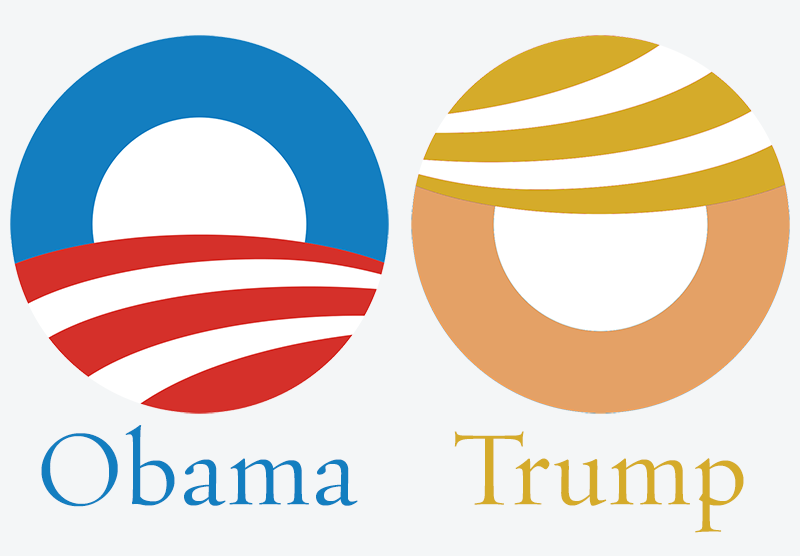
Matthew Gordon suggests a simple color-and-orientation change to make Obama's logo work for Trump.


The saga continues in the Tea Party Utopia that is Governor Brownback's Kansas:

Ever since the state Supreme Court in 2014 ordered the legislature to increase funding for education, Governor Sam Brownback and his allies in Topeka have sought to wrest power over appointments from the Supreme Court and make it easier to replace judges.

The legislature tried to strong-arm the judicial branch like this:

The judicial budget includes a self-destruct button that would wipe out all funding for the state courts if any court halts the 2014 law reducing the Supreme Court's authority or finds it unconstitutional.

What could possibly go wrong? Well, last week a judge did strike down the law. The ruling is on hold pending appeal, so for now the Kansas courts remain open. Meanwhile, Kansas continues to have real problems, in addition to the ones created by the dysfunction of its government.


John Oliver reports on the joys of lying about history.


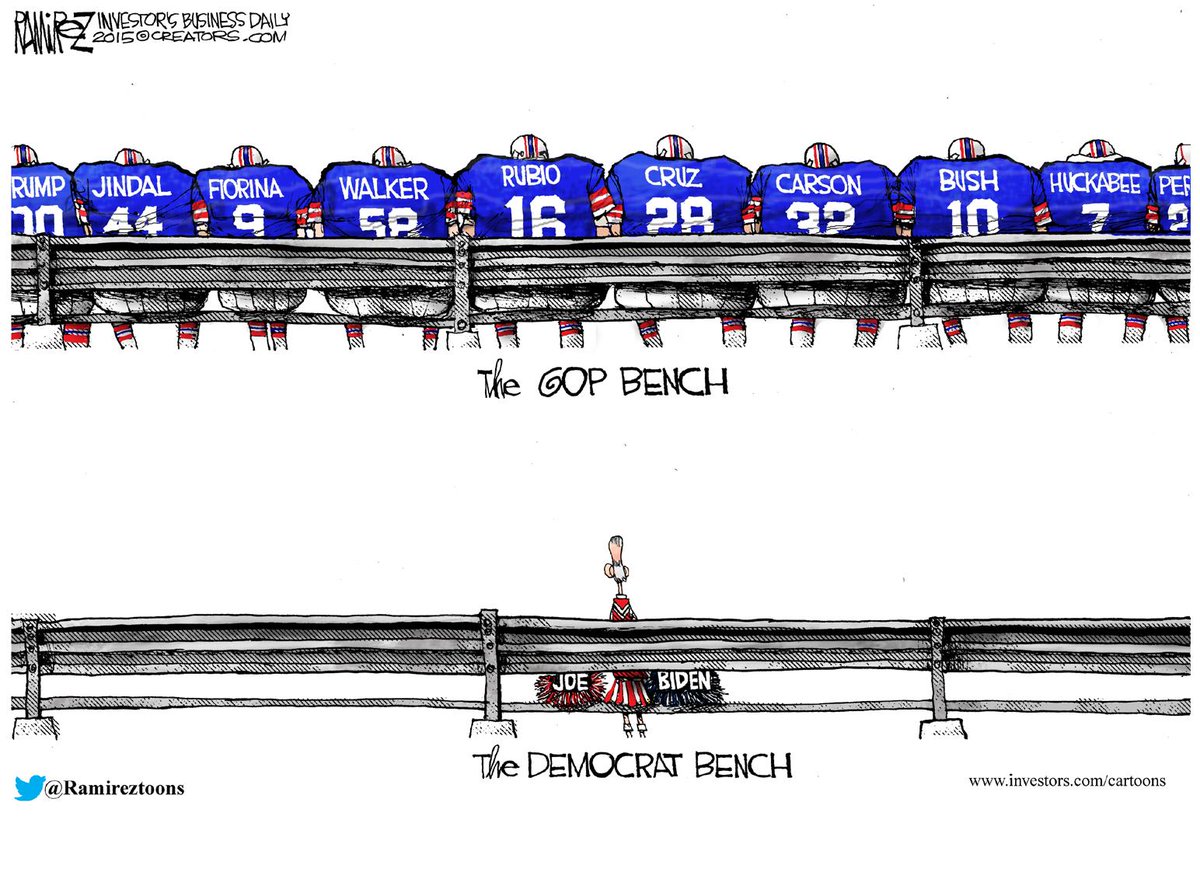
This is where Republicans have gotten: For a long time, they were bragging about their "deep bench" of 2016 candidates, as in this cartoon from just a month ago.

Now, some are looking to Mitt Romney to save the Party.

and let's close with something I should have realized on my own

Willy Wonka must be one of the re-generations of Dr. Who. I mean, the Great Glass Elevator should have tipped me off: How many people have little boxes that can take them into space?

Monday, August 31, 2015

What Goes Around

Conservative media and Fox News in particular have spent years - decades, if you count talk radio - training their audiences to believe that exhortations against sexism and racism are nothing but the “political correctness” police trying to kill your good time. ... You can’t tell people, day in and day out, that nothing is more fun than putting some mouthy broad in her place and then get upset when they continue to think it’s fun, even when the mouthy broad is one of yours.

-- Amanda Marcotte "Why Fox News' Defense of Megyn Kelly is Going to Backfire"

This week's featured articles are "Hey, Nerds! Politics is a System. Figure it out." and "Protesting in Your Dreams".

This week everybody was talking about Hurricane Katrina

which hit New Orleans ten years ago Saturday. A bunch of interesting retrospectives have appeared.

Slate posted "The Myths of Katrina", including the notion that "no one could have predicted" what happened. In fact, the gist of the disaster appeared in a local newspaper article three years earlier: the levee failures, and what would happen next:

Amid this maelstrom, the estimated 200,000 or more people left behind in an evacuation will be struggling to survive. Some will be housed at the Superdome, the designated shelter in New Orleans for people too sick or infirm to leave the city. Others will end up in last-minute emergency refuges that will offer minimal safety. But many will simply be on their own, in homes or looking for high ground.

... Hundreds of thousands would be left homeless, and it would take months to dry out the area and begin to make it livable. But there wouldn’t be much for residents to come home to. The local economy would be in ruins

The anniversary is an ambivalent moment. New Orleans is a viable city again, so that's worth celebrating. But the recovery has been uneven, with upscale neighborhoods rebuilding quickly and many poorer areas still full of abandoned homes.

The new New Orleans is a smaller, somewhat wealthier, and definitely whiter city; about 100,000 of its black Katrina-refugees never returned. As 538 elucidates, these losses were concentrated among middle-income and upper-income blacks, particularly the young professionals. Among whites it's the reverse: young white professionals and entrepreneurs are flocking in. Jacobin comments about one gentrifying neighborhood:

The declining poverty rate does not speak to some miraculous redistribution of wealth to working-class families, but rather to their forced exit amid a corresponding influx of high-income residents.

and another shooting

This one happened on live television.

With every new shooting, we go through the motions of trying to put gun control back on the agenda. But (as Dan Hodges summed up in a tweet) Newtown really kicked the life out of that movement. If massacres of white professional-class school children are acceptable, requiring not even a smidgen of change, it's hard to raise energy to try again.

If you do decide to try again, Vox has collected data for you and presented it well. Two things stood out for me:

  • We're averaging about one mass shooting (i.e., 4+ victims) per day. So if the aftermath of a mass shooting is not an appropriate time to talk about gun control (because that would "politicize tragedy"), then there will never be an appropriate time.
  • States with a lot of guns have about the same number of suicides-by-other-means as states with fewer guns, but quadruple the number of firearm-suicides. It's hard to escape the conclusion that guns cause suicides. Remember that the next time you think about buying a gun. Someday you'll be depressed, and you'll know that gun is sitting there.

and 2016

A second poll confirms that Bernie Sanders really is ahead in New Hampshire. Another poll suggests he's making serious gains in Iowa.


I'm getting increasingly annoyed at the media coverage of both Sanders and Clinton.

You know which 2016 candidate is consistently drawing the biggest crowds? Not Donald Trump, Bernie Sanders. (BTW, Sanders beats Trump 45%-37% in a head-to-head match-up. So which one is the more serious candidate?)

And yet Bernie's ability to draw a crowd is not news. Whether Trump's recent rally in Alabama was bigger or smaller than Sanders' rallies Portland and Los Angeles is open to interpretation. (Some estimates of Trump's crowd were marginally larger than Sanders'.) But what's not open to interpretation is the coverage: The news networks hyped Trump's rally before it happened and treated it like a major event afterwards. But the sizes of Sanders' crowds, when they get mentioned at all, are presented as weird little factoids.

When Sanders gets encouraging poll numbers, like the recent NH and Iowa ones I just mentioned, nobody says, "Wow! People really like this guy." Nobody focuses on what he's saying or why it's inspiring so much enthusiasm. Instead, the story is about Clinton's weakness: Democrats are so dissatisfied with Hillary that even Bernie Sanders might beat her in New Hampshire and Iowa.

And that brings me to the Clinton coverage, which has been even worse. The only stories you hear about Clinton consist of something-might-be-wrong-somewhere speculation about her emails. And yet, if you stick to the facts, it's hard to justify the claim that anything actually is wrong. I've had a hard time finding a clear statement of what might be wrong, or a clear accusation whose truth or falsehood could be established. Quite likely this is Benghazi or Filegate or Vince Foster all over again.

I don't see the media applying this maybe-something-somewhere-might-turn-out-to-be-bad standard to any other candidate. Rick Perry is under indictment. Scott Walker had an election-fraud investigation quashed under questionable circumstances by Wisconsin's partisan Supreme Court. Like Clinton, Jeb Bush used a private email account while governor, and decided for himself which emails to release to the public. Marco Rubio has received "hundreds of thousands of dollars" of personal assistance from a billionaire he's done political favors for.

Is any of that getting Clinton-style coverage? Coverage based on imagining what might turn out to be wrong (if new incriminating evidence somehow appears) rather than restricting attention to what we actually know? I'm not saying those stories should get that kind of attention, but why is the Clinton-email story getting it?


Frank Bruni explores the mystery of why Donald Trump seems to be the choice of the GOP's Evangelical Christian wing:

Let me get this straight. If I want the admiration and blessings of the most flamboyant, judgmental Christians in America, I should marry three times, do a queasy-making amount of sexual boasting, verbally degrade women, talk trash about pretty much everyone else while I’m at it, encourage gamblers to hemorrhage their savings in casinos bearing my name and crow incessantly about how much money I’ve amassed?

Has anybody seen a camel pass through the eye of a needle lately? That would explain it. Crooks and Liars compares Trump's indifference to religion in his own life to Dick Cheney's draft-dodging:

Right-wingers ... don't really care about whether a candidate or elected official has lived in accordance with their values. What they want is a candidate or elected official who will use their values (or, frankly, use anything) as a club to beat the people they don't like -- Democrats, liberals, immigrants, Muslims.


A standard applause line at Trump rallies is when he says the Bible is his favorite book, but when pressed in an interview to pick out one or two favorite verses, he had no answer. In her recent interview with Trump, Sarah Palin referred to this as a "gotcha" question -- I suppose because you can't expect a good Christian to remember phrases like "the 23rd Psalm" or "the Sermon on the Mount" off the top of his head.


Trump hasn't produced any TV ads yet. (Whether or not he'll spend the serious money necessary to buy TV time is my main criterion for determining whether he's seriously running for president or just using his campaign to build his brand.) So Jimmy Kimmel made one for him.

Kimmel satirizes of the vagueness of Trump's message, but that's precisely what makes it dangerous: Trump's vaguely targeted anger allows his audiences to imagine him railing against whatever makes them angry. Hence the calls of "white power" from his Alabama supporters.

The New Yorker has more:

On June 28th, twelve days after Trump’s announcement, the Daily Stormer, America’s most popular neo-Nazi news site, endorsed him for President: “Trump is willing to say what most Americans think: it’s time to deport these people.” The Daily Stormer urged white men to “vote for the first time in our lives for the one man who actually represents our interests.” ...

Jared Taylor, the editor of American Renaissance, a white-nationalist magazine and Web site based in Oakton, Virginia, told me, in regard to Trump, “I’m sure he would repudiate any association with people like me, but his support comes from people who are more like me than he might like to admit.”

Trump also has earned the support of David Duke and various other white nationalists. He hasn't sought their endorsements, but he doesn't have to. He's angry at a lot of the same people they hate. The exact why doesn't matter.

Another implication of vagueness is even scarier: Without a lot of specific policy ideas, or a coherent political philosophy, or a political viewpoint expressed consistently through the years, the Trump campaign by default becomes a cult of personality. Trump's America will be "great again" not because of any specific thing it will do, but because of him. Our greatness will follow from the greatness of our leader.

I think that's why words like fascist are starting to crop up, and comparisons to Europe's far-right movements.

and you also might be interested in ...

When talking about the poor, it helps to have data about who they are.


Here's the scariest thing I saw this week. A front page contributor on Red State comments:

There is no vocal advocate of Donald Trump’s GOP candidacy in 2016 that would tell you this publically, but I’ll bet $20 that a significant plurality of Trump’s backers feel what the women in this Youtube video below feel on a daily basis. They would only demur because they are sick and tired of being accused of racism for feeling the way they feel.


and let's close with some reassurance

Whatever you did this week, you didn't screw up this badly.

Monday, August 24, 2015

Prepared

I just thought I had a few weeks left. But I was surprisingly at ease. I've had a wonderful life and thousands of friends, and I've had an exciting, adventurous, and gratifying existence. ... Now I feel that it's in the hands of God, whom I worship, and I'll be prepared for it when it comes.

-- Jimmy Carter, on the prospect of dying of cancer

This week's featured post is "The Do-Something-Else Principle".

This week everybody is talking about the stock market

The Dow fell more than 3% on Friday and has continued falling this morning. It's down more than 10% from its highs. This could mean one of three things:
  • A normal market correction of the type that happens periodically. The market comes back over the next six months or so with no appreciable effect on the economy. An extreme example was the Crash of 1987, which looked like the start of another Great Depression, but wasn't. The next recession didn't hit until 1990. AP writes: "Corrections are natural in a bull market, a pause in the market's march higher, and this one is long overdue. They usually come about once every 18 months. The last one was four years ago."
  • A signal that a normal recession is starting. The economy is depressed for about a year and then starts growing again. It's a little early for a normal recession, but not that early: The business cycle has been running at around 7-9 years, and it's only been six since the end of the last recession. Also, growth has been sluggish during the expansion, which usually would point to a longer cycle. But the economy isn't a clock, so maybe the business cycle is running faster this time around.
  • A signal that a global economic catastrophe is beginning, like the Great Recession that began with the market collapse of 2008. A global catastrophe happens when the market realizes that everyone's economic projections have been built on sand, and so all plans need to be re-evaluated. For example, the real estate bubble, which was based on the idea that people with no money and no prospects would make good on the mortgages they should never have been given. Financial "innovation" had over-leveraged the economy, so that once the dominoes started falling they fell faster and faster.
Everybody's concern is focused on China: Maybe they're having their first real recession since their economy grew large enough to affect the world economy. Maybe the long-term China growth story is an illusion; if that's the case, that would be reason to expect a catastrophe. Personally, while I could easily believe we've all mis-estimated China's growth rate (given the opacity of its economy), I still believe the underlying story that China is growing spectacularly over the long term. So I'm picturing either a market correction or a normal recession. The disturbing thing about the prospect of a recession is that governments around the world -- not just ours -- are still stuck in an austerity mindset, so they're unlikely to do the kind of stimulus spending that would shorten the recession. Only the Chinese and Japanese governments look philosophically prepared to do the right thing.

and Jimmy Carter

People can argue about whether Carter was a good president. (I think a lot of his decisions and proposals look better in retrospect than they did at the time.) But to me it's beyond all argument that Carter has been the best ex-president ever. Humble, caring, active for human rights and democracy, and never just cashing in on his fame and former influence ... he's consistently been out there trying to do the right thing as he saw it, without a lot of ego getting in the way. All in all, I think Carter makes a better advertisement for Christianity than just about any of the high-profile Christian leaders I can think of. That came through once again in the press conference he gave Thursday about his cancer diagnosis. One of the selling points of Christianity is that the prospect of salvation should allow a believer to face death with equanimity. Well, here's Jimmy Carter, facing death with equanimity.

and the Iran nuclear deal

Somebody must be putting big money behind the following ad urging Congress to reject the agreement, because I've been seeing it over and over. The speaker is a former Iranian political prisoner, and he tells a story of being tortured, even though Iran has signed a treaty against torture. He draws the parallel:
Now they have signed a deal promising no nuclear weapons, but they keep their nuclear facilities and ballistic missiles. What do you think they'll be doing?
It's an effective ad if you don't think about it too hard. If you do think about it, though, its argument starts to fall apart. First, Iranians who want their government to reject the deal could make the same commercial about us. We also signed a treaty against torture and tortured people anyway. Why should they trust us to keep our side of the agreement? The reason the United States has been so cavalier about violating the Convention Against Torture (and Iran in violating whatever treaty it is supposed to have signed; it isn't party to the CAT, so I'm not sure what agreement the ad is referring to) is that its enforcement mechanisms are weak. The U.N.'s Committee Against Torture is supposed to monitor the agreement, but it has no power to punish violators. (That's why members of the Bush-Cheney Gang are still at large.) By contrast, the nuclear deal contains provisions for detecting and punishing any Iranian cheating, and insures that the economic sanctions against Iran would "snap back" into effect. You can, of course, imagine some magical way Iran could evade this detection or interfere with the snapback process, but you could similarly imagine a loophole to any agreement. If vague fears were enough to derail a treaty, there would be no treaties. The people who do arms control for a living are satisfied with the enforcement provisions. So are numerous retired American generals and admirals, as well as former Israeli security officials. (Current military or intelligence officials in either country are usually reticent to make public statements opposing the position of their government -- and may be fired if they do -- so former officials play a larger role in such discussions.) However, as Josh Marshall points out
that's only the opinion of people who actually know what they're talking about.
When the issue is detecting hidden nuclear facilities, those people are so far from a majority that they barely matter politically.
And that brings us to the Associated Press' "scoop" that Iran will do the inspecting itself, under a secret agreement with the International Atomic Energy Agency. That sounds very shocking and makes the whole deal seem like a sham. But again, that's only if you are an AP reporter who is fed a leak by an interested party and doesn't bother to check the story with anybody who has real expertise. Vox' Max Fisher consulted an actual arms control expert (Jeffrey Lewis at Middlebury College's Monterey Institute of International Studies), who has been following the agreement as it developed. He was neither surprised nor appalled by AP's "discovery".
The bottom line here is that this is all over a mild and widely anticipated compromise on a single set of inspections to a single, long-dormant site. The AP, deliberately or not, has distorted that into something that sounds much worse, but actually isn't. The whole incident is a fascinating, if disturbing, example of how misleading reporting on technical issues can play into the politics of foreign policy.

Econ blogger Noah Smith punctures the myth of Iran's growing regional dominance. His argument for Iran's weakness has four main points: Iran is committed to proxy wars it can't win; it has many rivals and no allies; the outlook for its oil-dominated economy is bleak; and its low fertility rate will keep its population from growing.

and 2016

This seemed to be the week when everybody started asking "What if the Trump candidacy isn't a joke?" It was supposed to collapse after he characterized Mexican immigrants as rapists, and again after he insulted John McCain's war record, and again after he had to debate the professional politicians, and again when his post-debate comments insulted Fox News' Megyn Kelly. But none of that dented his popularity among the Republican electorate, so this week Rolling Stone's Matt Taibbi wrote "Donald Trump Just Stopped Being Funny" and The Atlantic started looking seriously at why people support him. Vox' Lee Drutman offers the most sensible explanation of the Trump phenomenon I've seen yet: The Republican donor class wants to increase immigration and decrease Social Security. But rank-and-file Republicans want the opposite. Trump is speaking for them. This also makes sense of the attraction of a self-financing billionaire candidate: He seems outside the power of the donor class.
Vox points out the horrifying truth contained in a recent Fox News poll: Collectively, the crazy Republican candidates are out-polling the supposedly rational ones. If you add up the totals of Donald Trump, Ben Carson, Ted Cruz, and Mike Huckabee, you get 53%. Support for the "establishment" candidates that the voters are expected to get in line behind eventually (Jeb Bush, Scott Walker, Marco Rubio, John Kasich, and Chris Christie) adds up to a mere 26% -- barely more than Trump polls by himself.
Simply consolidating everyone behind one of the candidates who is acceptable to elites isn't going to get the job done. Party leaders need to find a way to actually pry support away from one of the candidates who's unacceptable to them. So far, they have no idea how to do that.
Things look a little better (but still bad) for the establishment in the latest CNN poll: Trump-Carson-Cruz-Huckabee is at 40% and Bush-Walker-Rubio-Kasich-Christie at 36%.
Jeb Bush explained away his unexpected single-digit poll numbers by saying, "I'm the tortoise in the race." Jay Leno then quipped that the race was "between the Tortoise and the Bad Hair".
Carly Fiorina's recently expressed views: against mandatory vaccinations ("when in doubt, it is always the parents' choice"), against doing anything about climate change ("All the scientists that tell us that climate change is real and man made also tell us this: a single nation acting alone will make no difference at all. So we can destroy every job in this nation, we can destroy the coal industry, we can destroy the agriculture industry … But here’s the truth, ladies and gentlemen: those livelihoods and lives are being destroyed not at the altar of science, but at the altar of ideology. ... This is about ideology — it is not about science."), and against having any federal minimum wage ("minimum wage should be a state decision, not a federal decision"). On that "no single nation" point about climate change: A candidate who is serious about that view would push for international agreements on climate change. But in April Fiorina told the Christian Science Monitor that any international deal on greenhouse gases "would not be effective". So in any practical sense, Fiorina wants to do nothing to cut greenhouse gas emissions.
Fiorina has never held elective office, but her claim to fame is from the business world, where she was CEO of Hewlett-Packard. However, she wasn't a particularly good CEO. David Nir assembles the evidence; to me the most striking detail is that HP stock soared when the board announced it had forced her out, at one point getting 10.5% ahead of the previous day's closing price.
"The stock is up a bit on the fact that nobody liked Carly's leadership all that much," said Robert Cihra, an analyst with Fulcrum Global Partners. "The Street had lost all faith in her and the market's hope is that anyone will be better."

If another Republican president (not to mention another Bush) is such a great idea, you have wonder why the GOP has dropped the last one down the memory hole. If you only listen to the GOP presidential candidates, you might imagine that Ronald Reagan was the last Republican president. Historian Aurin Squire observes:
Under normal circumstances, [George W.] Bush would take his place along other ex-presidents as a national figurehead of some influence, especially with his brother as a presidential candidate. Yet, his deafening silence is indicative of not only his disastrous administration, but the GOP’s attempt to erase him from the country’s memory. This upcoming election marks the latest great GOP purge of history. ... The RNC solution to a mountain of damning evidence is a campaign to erase and displace—that is, erasing Bush from the public memory and displacing as many disasters on to Obama. This is a test of the RNC propaganda machine to see how many people they can get to believe whatever they want. Case in point: Almost as many people blame President Obama for the Hurricane Katrina fiasco as the president in office at the time. Anyone with a smart phone and opposable thumbs could figure out that Obama was not president during Katrina and had nothing to do with the aftermath. But if you can alter the memories of 40 to 45 percent of Louisiana Republicans through constant propaganda, the whole country can’t be far behind. It’s a great way of being wrong, and therefore never learning from bad decisions.

Rolling Stone's Tim Dickinson points out a disturbing intersection of harsh policies: five Republican candidates (Cruz, Paul, Walker, Jindal, and Huckabee) are against both rape exceptions on abortion bans and against birthright citizenship. That produces the following result:
It's not difficult to imagine a scenario in which an undocumented woman in America is raped by a man (perhaps a relative) who is also not a citizen. GOP politicians holding both views would force this woman to give birth to her rapist's baby — and then deny that child citizenship.

The best version of the Republican debate comes from Bad Lip Reading. If you want to understand how the magic of BLR works, ThinkProgress explains.

and you also might be interested in ...

A touching story about end-of-life care.
OK, I admit this is kind of geeky, but I think it's fascinating: Mathematicians have discovered a new tessellating pentagon. In other words, you could tile an infinite plane using only that one pentagonal shape, leaving no gaps. (To grasp what's special about that, make yourself a few identical regular pentagons, and see how far you get before you start leaving gaps.)
It's said to be only the fifteenth such pentagon ever found and the first new one to be found in 30 years. Finding one is a bit like discovering a new atomic particle, Dr. Casey Mann, associate professor of mathematics at the University of Washington in Bothell and a member of the team, said in a written statement.
Even if the sheer mathematical wonder of that escapes you, you have to admit it's kind of pretty.

and let's close with something I'll never do

I've never written down a formal Bucket List, but if I did I'm pretty sure "jump off the Princess Tower in Dubai" would not be on it. Not even with a zip line or a pretty girl.

Monday, August 17, 2015

Discomforting Urgency

In this movement exists a kind of urgency that only proximity to terror can produce, and yes, that urgency can be extreme and discomforting, because it must be. The sedative of all normalcies and niceties are the enemies so long as lives are in danger.
-- Charles Blow, "Activists 'Feel the Bern'?"
This week's featured post is "Why BLM Protesters Can't Behave".

This week everybody was talking about China

for two reasons: the massive chemical explosion in Tianjin (which was visible from orbit) and the devaluation of the yuan.

Tianjin is a port 75 miles from Beijing, and it contains the kinds of warehouses typical of a port, but on a Chinese scale. Something blew up there early Wednesday morning, killing over 100 people and injuring hundreds more. Thousands have had to leave their homes as sodium cyanide has been scattered widely.

The currency devaluation is one of those technical issues whose effects are anything but technical. The Guardian does a good job laying out various implications. A factor that complicates everybody's thinking (and makes it more likely that somebody will over-react in a stupid way) is the Chinese government's lack of transparency. We're all trying to read tea leaves because we can't get trustworthy data.

and Iraq

Jeb Bush knows why Iraq is such a mess: Even though the Surge totally worked and everything was fine when his brother left office, Obama and Hillary screwed it all up.

The saddest thing about this fantasy (contained in a "foreign policy speech" he gave Tuesday) is how predictable it was. The day before Obama was inaugurated, I wrote:
It's just a matter of time before we hear: Bush had the war won, but then Obama came in and threw it all away.
The most direct parallel to Bush's Iraq revisionism is Vietnam revisionism. Listen to Bruce Herschensohn tell the Vietnam story for Prager "University":
Decades back, in late 1972, South Vietnam and the United States were winning the Vietnam War decisively by every conceivable measure. ... On January the 23rd, 1973, President Nixon gave a speech to the nation on primetime television announcing that the Paris Peace Accords had been initialed by the United States, South Vietnam, North Vietnam, the Viet Cong, and the Accords would be signed on the 27th. What the United States and South Vietnam received in those accords was victory. At the White House, it was called "VV Day," "Victory in Vietnam Day." ... The advance of communist tyranny had been halted by those accords.
Then it all came apart. And It happened this way: In August of the following year, 1974, President Nixon resigned his office as a result of what became known as "Watergate." Three months after his resignation came the November congressional elections and within them the Democrats won a landslide victory for the new Congress and many of the members used their new majority to de-fund the military aid the U.S. had promised, piece for piece, breaking the commitment that we made to the South Vietnamese in Paris to provide whatever military hardware the South Vietnamese needed in case of aggression from the North. Put simply and accurately, a majority of Democrats of the 94th Congress did not keep the word of the United States. ... Many of them had an investment in America's failure in Vietnam. They had participated in demonstrations against the war for many years. They wouldn't give the aid.
So there you have it: Hundreds of thousands of American troops fought for almost a decade without a clear result. But just a few more billion in aid to a famously corrupt South Vietnamese government would have finished the job.

That is so much more credible than the other story: that Nixon was a crook thrown out of office for good reasons, and that he was just lying when he declared victory. We could have kept our troops there for another decade, and when we left South Vietnam still would have fallen.

Or, if not more credible, Herschensohn's version at least makes better wishful thinking for the people who started our intervention in Vietnam or continued it beyond all sense.

The same process is at work in Iraq revisionism: If you don't want to admit you were wrong (because you want to apply all the same ideas to Iran and ISIS), then Jeb's story is much more comforting.
I stand by what I wrote in 2005:
We can leave Iraq now, or we can leave after our losses have grown. That is the only choice we have.
America's key mistake in Iraq was invading in the first place, not getting our troops (mostly) out of harm's way.

BTW: My Facebook feed has been full of links to the Prager U video by West Point historian Colonel Ty Seidule, making a clear case that the Civil War really was about slavery rather than states rights or tariffs or any of the other excuses Southern whites have invented for denying that their great-grandfathers fought on the wrong side.

I love the message, but the video itself is a Trojan Horse. Here's a tip: Before sharing something from an institution, take a look at the other stuff it puts out. Prager U is a project of conservative talk-radio host Dennis Prager, who stars in some of the videos. You really don't want to encourage your friends to wander its "campus" and imbibe its point of view.

The Vietnam revisionism piece quoted above is much more typical of PU than the Civil War video. Other PU videos feature  climate-change denial, anti-feminism, a reduction of the Israeli/Palestine problem to "one side [Palestinians] wants the other side [Israelis] dead", blaming all the problems of America's public schools on teachers, and claiming that liberals are more racist than conservatives.

Do you really want to lend credibility to all that?

and 2016

Numbers about the GOP debate are in, so I have to correct a few of my initial responses from last week. First, I was wrong to say that nobody watched the kids-table debate among the candidates who didn't poll high enough to get into the main event. It turns out six million people did, which would be a big number for any debate this early. I don't know why they watched, but they did.
Second, I identified the losers of the debate as
Walker, Bush, and Carson. Not because they made any major gaffes, but because they seemed to fade into the background.
Post-debate polls agree with me about Walker and Bush, but not Carson. Ben Carson moved up to second in Iowa. 538 says his national poll numbers have moved up by an average of 2.4% and credits his performance:
Depending on which poll you look at, he was rated as either the most impressive or the second most impressive candidate in the varsity debate.
Again, not sure why.

538 identifies Carly Fiorina (from the kids' table) as the big winner, going from nowhere to the high single digits, and Scott Walker as the big loser.

Speaking of Fiorina, according to the NYT:
Now, many Republicans, preparing to potentially confront Mrs. Clinton in a general election, are looking anew at Mrs. Fiorina, who rose from being a secretary to running the giant technology company HP, as the party’s weapon to counter the perception that it is waging a “war on women.”
Republicans who hold that hope really need to take a look at the exit polls from 2010, when Fiorina lost the California Senate race to Barbara Boxer. In a year when Republicans actually won the women's vote nationally (51%-49%), Fiorina lost the women's vote by a wide margin (55%-39%, with 6% going to "Other").

If your policies appeal to a group, then nominating a member of that group will boost their turnout, as black turnout increased for Obama in 2008 and 2012. But identity politics won't save you if your policies suck. If Marco Rubio runs on a platform that calls for building a wall on the Mexican border and tossing all the undocumented immigrants over it, and if his campaign panders to the working-class whites who believe they'd still be making big money on the assembly line if not for all those brown people -- then Hispanics will decisively reject him. Ditto for Fiorina and women or Carson and blacks, if they just put a one-of-us face on the anti-woman, anti-black Republican consensus.

Ask your black friends how much pride they take in having Clarence Thomas on the Supreme Court, or whether his race makes up for him providing the decisive fifth vote to gut the Voting Rights Act.

Or think about this: The last time the Democrats nominated a white man, John Kerry lost the white male vote 62%-37%.

Bernie Sanders shocked everybody by taking the lead in a New Hampshire poll. Polls are noisy this far away from the election, so it could be a blip. Or maybe not.

I'm sure it's not a coincidence that we're starting to hear rumblings about Joe Biden and Al Gore (though unidentified "close advisers" to Gore deny it) getting into the race. But the NYT's Nate Cohn doesn't think Clinton has much to worry about yet.

New evidence that this election cycle is unique: The negative ads have already started. Here's Rand Paul's attack on Donald Trump.

Contrast the bickering and name-calling on the Republican side with what's going on among the Democrats: They're competing to produce the best policy proposals. Clinton announced a plan to make college affordable, and Sanders produced a racial-justice platform.

To be fair, Scott Walker is due to unveil his ObamaCare replacement plan tomorrow. Salon's Simon Malloy is not optimistic about it, given the op-ed Walker published Friday, in which he seems unprepared to recognize any of the real-life trade-offs involved in healthcare policy.
Also, the Trump immigration program is out. I'll have more to say about it next week.

Trump is an example in the latest phrase I've added to the "Conservative-to-English Lexicon"
Telling it like it is. Pandering to people who resemble the speaker.  Usage: Middle-aged white guy Wayne Allyn Root: “Donald Trump tells it like it is.” Alternate form: Calling it like he sees it. Usage: Ted Nugent writing, “Donald Trump … calls them like he sees them.”

and Cuba

John Kerry dedicated an American embassy in Havana, a big step towards more neighborly relations with one of our nearest neighbors. Maybe the embargo can end soon.

The embargo made sense for about a year. Castro's new regime seemed fragile, and it was not unreasonable to think that the extra economic pressure of the embargo might push it over the edge, producing a more friendly government in Havana. Half a century later, it's still here, because we can't admit a mistake. (Marco Rubio makes pig-headedness sound like a virtue: "a half-century worth of policy toward the Castro regime that was agreed upon by presidents of both parties.")

In America, the fundamental political divide on these issues comes down to this: Conservatives believe we are doing other countries a favor when we talk to them. So why are we "giving" Cuba an embassy? (Rubio: "President Obama has rewarded the Castro regime.") Liberals believe talking to your enemies is just what you do, because you can't kill everybody you don't like.

The Atlantic asked the question Americans so often ignore: How does all this look from the other side? It published a column by a Cuban blogger, who imagines telling his grandchildren he was there at this powerful "inflection point" in Cuban history. When he writes about "a collision between two countries", he's not talking about the U.S. and Cuba, but the new Cuba and the old Cuba.

and you also might be interested in ...

This year might see the most powerful El Niño on record.

36 retired generals and admirals published an open letter titled "The Iran Deal Benefits U.S. National Security". It says the deal is "the most effective means currently available to prevent Iran from obtaining nuclear weapons".

We just had the hottest July on record, keeping 2015 on pace to be the hottest year ever, breaking 2014's record.

Well worth reading: "How the NRA Rewrote the Second Amendment". One interesting tidbit is how bogus some of the pro-gun quotes from the Founders are.
“‘One loves to possess arms’ wrote Thomas Jefferson, the premier intellectual of his day, to George Washington on June 19, 1796.” What a find! Oops: Jefferson was not talking about guns. He was writing to Washington asking for copies of some old letters, to have handy so he could issue a rebuttal in case he got attacked for a decision he made as secretary of state. The NRA website still includes the quote. You can go online to buy a T-shirt emblazoned with Jefferson’s mangled words.

Computer programmer Byron Clark has set up his web browser to automatically replace the phrase political correctness with treating people with respect. So here's how one Donald Trump quote appears:
I think the big problem this country has is treating people with respect. I've been challenged by so many people, and I don't frankly have time for treating people with respect. And to be honest with you, this country doesn't have time either.
Vox writer Amanda Taub comments:
The meaning hasn't really changed, but it has been made clearer: Trump was asked about his disrespectful treatment of women, and his response was that the very idea of treating women respectfully was a problem for the country as a whole. That's nonsense. Kudos to Clark for showing us why.

A Michigan math teacher explains "Why I Can No Longer Teach in Public Education":
I have been forced to comply with mandates that are not in the best interest of kids. ... The amount of time lost to standardized tests that are of no use to me as a classroom teacher is mind-boggling. And when you add in mandatory quarterly district-wide tests, which are used to collect data that nothing is ever done with, it's beyond ridiculous.
... my take-home pay has been frozen or decreased for the past five years, and I don't see the situation getting any better in the near future. ... As a 10th-year teacher in my district, I would be making 16 percent less than a 10th-year was when I was hired in 2006.
... If I were poorly compensated but didn't have to comply with asinine mandates and a lack of respect, that would be one thing.
And if I were continuing my way up the pay scale but had to deal with asinine mandates, that would be one thing. But having to comply with asinine mandates and watching my income, in the form of real dollars, decline every year?

The fervor to fight ObamaCare is getting wacky in some places. Wheaton College is cancelling its student health insurance. Not because ObamaCare forces them to cover birth control -- it doesn't; the college qualifies for the religious non-profit organization exemption. But it has to notify the government that it is claiming its exemption. Then the government can instruct the appropriate insurance companies to cover students' contraception by a separate policy Wheaton doesn't pay for.

That's too much for them; the notification makes them "complicit" in the great evil of birth control. Much better just to let its students go without health care entirely.

More proof ObamaCare is working: Gallup says the number of people without health insurance continues to go down, and it goes down faster in states that implemented the Medicaid expansion portion of the law.

and let's close with something big

Like the elephant swimming pool at the Fuji Safari Park in Japan.