Monday, August 8, 2016

Non-interference

Never interfere with an enemy while he's in the process of destroying himself. 

- attributed to Napoleon

This week's featured post is "Sexism and the Clinton Candidacy". Short version: A man can misbehave and be an endearing rogue, but there's no stereotypic loophole for a woman's mistakes.

Last week the Sift had its two millionth page view since I moved the blog to weeklysift.com in 2011. The push over the line came from "Why Bernie Backed Hillary", which got over 16K hits.

This week everybody was talking about Trump's downward spiral

Up until this week, Republicans were willing to rationalize Donald Trump's rhetorical excesses: It was a strategy, an act, a way to manipulate the media, and so on. He could turn it off and on as necessary to control the news cycle.

But when he went into a full-bore multi-day attack on gold-star parents Khizr and Ghazala Khan, raising stereotypes about Muslim women, describing his own wealthy lifestyle as "sacrifice", and even connecting the Khans to terrorism, it became hard to ignore what's really been going on: Trump has a character flaw that borders on a personality disorder. 

There is no strategy here: He kept his self-destructive argument with the Khans going because he simply cannot control himself. If he feels disrespected, he must strike back and keep striking back until he can convince himself that he has won.

In other words, he proved the truth of what Clinton said about him in her acceptance speech:

A man you can bait with a tweet is not a man we can trust with nuclear weapons.

Combined with Clinton's convention bounce, that put Trump's poll numbers into free fall. Between the conventions, the race was either tied or Trump might even have been a point or two ahead. But this morning both Nate Silver and the RCP average have Clinton up 7 points. BTW, Nate has a great graphic of how the national and state-by-state polling fits together. (If you find this a little hard to read, click it and scroll down.)

Here's how bad things are for Trump: He's already making plans for how he's going to soothe his ego after he loses: He's going to claim Clinton cheated. More and more, this campaign is reminding me of third grade.

and I thought I was on vacation when ...

... I was in Portland, Maine on Friday. I was on my way to my favorite Portland tea shop to read a book I hope to tell you about soon (Hillbilly Elegy by J. D. Vance), when I noticed a big crowd in front of city hall about a block away.

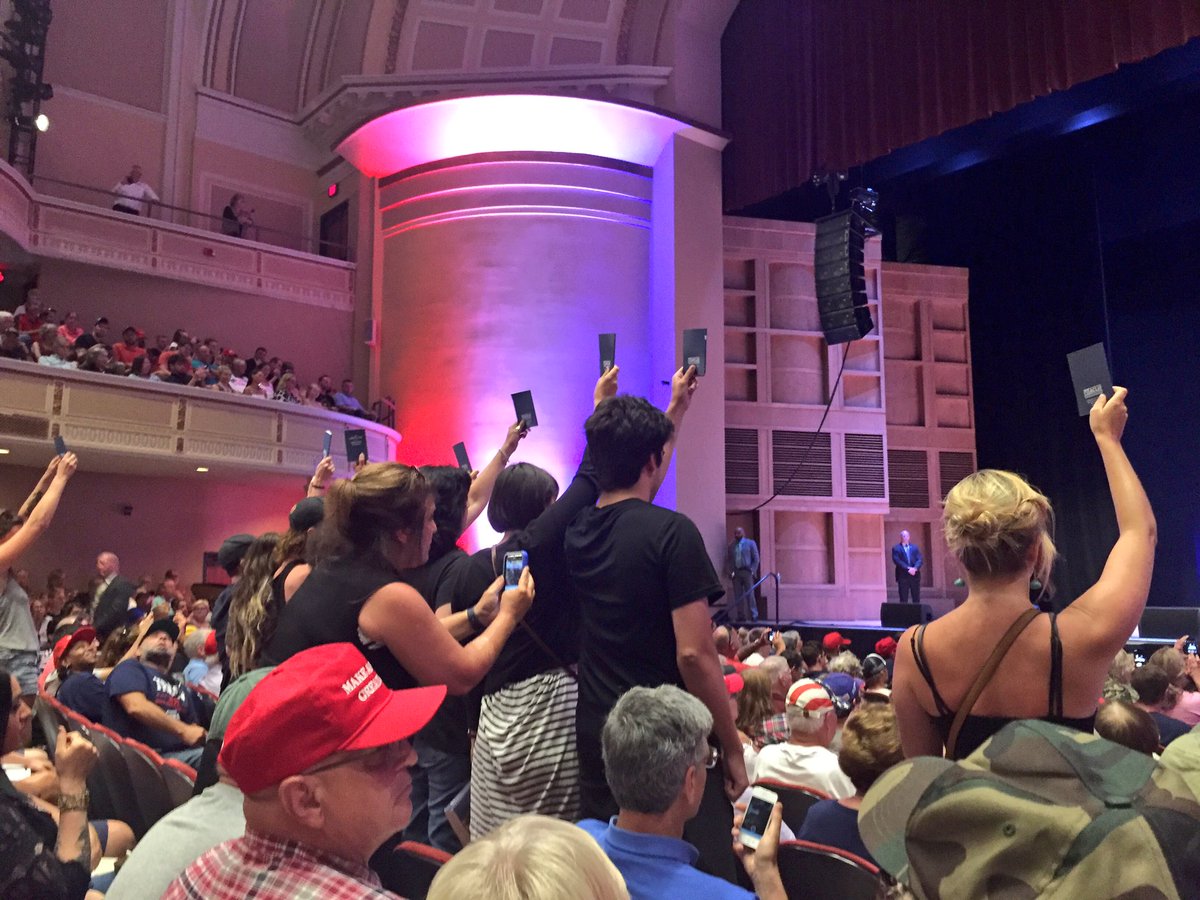
I knew Trump had been in Portland on Thursday, and I had seen on TV that protesters silently holding up pocket copies of the Constitution had been removed from his rally.
In that rally, Trump promoted a local version of the immigrant-crime-wave lie I pointed out in his convention speech.

We’ve just seen many, many crimes, getting worse all the time. And as Maine knows – a major destination for Somali refugees. They’re coming from among the most dangerous territories or countries anywhere in the world. We have no idea of who they are … this could be the great Trojan horse of all time!

To which the Portland Press Herald responded:

Mr. Trump can relax. We know who they are. They are our neighbors and our friends. Some of them work in our schools and hospitals. Some are students. Some own businesses. They pay taxes, which are used for, among other things, maintaining the stage from which he spoke.

What I had stumbled into Friday afternoon was originally supposed to be the Portland Somali community's counter-demonstration, and it included some of the same Constitution-waving protesters. But when they had asked the mayor if they could hold their rally on the steps of City Hall, he asked if he could spread the word around, because "maybe some other people will want to join in."

By the time I got there, there were about 400 of us, of all races. (My estimate on the spot matched the one in the newspaper the next morning.) It was not a partisan thing; I didn't see any Clinton signs. People were there to support their neighbors and the unity of their city against outsiders peddling hate. The Press Herald quoted the police chiefs of Portland and nearby Lewiston, where many Somali refugees have settled. Both made the same points:

  • Crime is down, not up.
  • There is no special Somali-refugee crime problem.
  • Nobody from the Trump campaign had talked to them.

That third point is the one that most enrages me. Anybody can get a fact wrong. But Trump is not trying to get his facts right. He's going to American cities and raising fear against the immigrants who have settled there without even checking that those fears are based on anything real.


BTW, the Constitution thing is a big deal. Khizr Khan started it at the Democratic Convention when he offered to give Donald Trump his copy of the Constitution. And Trump made a huge blunder when his people ejected the silent protesters in Portland. They weren't disrupting anything, they were just holding up the Constitution, which Trump's people saw as a hostile act. The crowd booed them (and their Constitutions) as they were led away.

Up until now, waving the Constitution has been a conservative thing. I imagine Ted Cruz pulling his hair out and yelling at Trump as he watched this on TV: "You let the Democrats take the Constitution away from us?"

and my church is also in the news

First Parish Unitarian Universalist in Bedford, Massachusetts -- I know, I live in New Hampshire, but I go to a church 25 miles away in Massachusetts; it's a long story -- is in the middle of an expensive project to bring our carbon footprint as close to zero as we can. After new insulation and HVAC equipment, the last piece of that plan is to put solar panels on the roof of our early-19th-century building, carefully positioned so as not to be too striking from the road.

The local historical commission blocked that, and now we're going to court. ThinkProgress picked up the story this week, noting that we're using the kind of religious-freedom legal argument that "is more often used by conservative faith groups". We're arguing that publicly fighting climate change is part of living our faith. It'll be interesting to see what a court does with that reasoning.

and you might also be interested in

No matter who wins in November, or what kind of Congress she gets, the new President will have to face the problem of slow growth. It's not just an American problem, so it probably doesn't have a purely American solution.

Both parties have been talking around that. There's a certain amount of genuine mystery about global growth, so the idea that we can ramp up growth locally by cutting taxes or building infrastructure is a little iffy.


For Obama's 55th birthday, USA Today put together this compilation of his most endearing moments.


There's Liberal vs. Conservative, and then there's Reality vs. Fantasy. Incumbent Wisconsin Senator Ron Johnson made it clear which side he's on in an interview on a local radio show:

First of all, the climate hasn't warmed in quite a few years. I mean, that is proven scientifically.

After 2014 turned out to be the hottest year on record (until 2015 was hotter), the government's real scientists published this graph, showing that global warming has actually accelerated in recent years.

Senator Johnson went on to explain what really motivates climate change activists:

The reason they're doing it is it's such a great opportunity to control, you know, pretty much, government, and control your lives.

Yep, that's why I drive a hybrid and why my church is going to court for the right to put solar panels on its roof: It's all part of a nefarious plan to control everybody's lives. I can't remember exactly how the plot is supposed to work, but I'm sure somebody explained it to me once.

and let's close with some Trump songs

Here a busker redoes "The Boxer":


And Dennis Leary and James Corden put a Trump twist into Leary's "I'm an Asshole".


Monday, August 1, 2016

Resolve over Fear

At its core, discrimination is the result of fear. Those who think Americans scare easily enough to abandon our country’s ideals in exchange for a false sense of security underestimate our resolve.

- Kareem Abdul-Jabar at the 2016 Democratic Convention

This week's featured posts are "Why Bernie Backed Hillary" and "Disbanding NATO: Why Vlad Loves Donnie".

This week everybody was talking about the Democratic Convention

Nate Silver summarized it pretty well:

Each day of the Democratic National Convention had an overarching strategic goal. Monday was about uniting the party. Tuesday was about telling Hillary Clinton’s life story (and, by extension, improving her dismal favorability ratings). Wednesday was about articulating forceful contrasts for swing voters and reminding them of the consequences of a potential President Trump. Thursday, with a lot of flag-waving and representation from the military, along with Clinton’s own remarks, was about establishing her credentials as commander in chief.

Headliners. Each day's headliners came through with amazing speeches, which you should watch if you haven't already. Monday: In what some have called "a speech for the ages",  Michelle Obama subtly talked about the First Family as role models for children, reminded us of the class and dignity with which the Obamas have carried that responsibility, and left us imagining Donald Trump in that role. She also began what became a drumbeat in later speeches: defining a uniquely Democratic message of patriotism and optimism -- not that America has always been right, but that we constantly get better.

Bernie Sanders gave Clinton everything she could have wanted in an endorsement. (Details in the featured article.)

Tuesday's highlight was Bill Clinton playing a new role: the spouse who humanizes the candidate. This was an important moment in the convention. One comment I frequently see from Bernie-or-bust posters on Facebook is that no one is actually for Clinton, but we're just supposed to vote against Trump. Bill's 45-year love story (beginning with "In the spring of 1971, I met a girl.") set her in a context that many voters (especially younger ones) have probably never seen. Yes, there are a large number of people who have loved and admired Hillary Clinton for many years.

Wednesday was Joe Biden and Tim Kaine and President Obama. As Nate Silver said, this was the night for convincing swing voters, and they did it by claiming a lot of the up-with-America themes that usually belong to Republicans, but which Trump's convention abandoned. President Obama:

Look, we Democrats have always had plenty of differences with the Republican Party, and there’s nothing wrong with that. It’s precisely this contest of idea that pushes our country forward. But what we heard in Cleveland last week wasn’t particularly Republican -- and it sure wasn’t conservative. What we heard was a deeply pessimistic vision of a country where we turn against each other, and turn away from the rest of the world. There were no serious solutions to pressing problems -- just the fanning of resentment, and blame, and anger, and hate.

And that is not the America I know. The America I know is full of courage, and optimism, and ingenuity. The America I know is decent and generous.

Thursday was Clinton herself, whose major challenge was not to be overshadowed by all the excellent oratory that had come before. She didn't attempt to compete with President Obama in terms of vision and inspiration, but presented herself as a steady hand with a lifelong record of public service and a progressive agenda. She left a very deft trap for Trump, which he proved unable to avoid blundering into:

He loses his cool at the slightest provocation – when he’s gotten a tough question from a reporter, when he’s challenged in a debate, when he sees a protestor at a rally. Imagine, if you dare imagine, imagine him in the Oval Office facing a real crisis. A man you can bait with a tweet is not a man we can trust with nuclear weapons.

Surprises. Wednesday also had an unusual endorsement from former New York Mayor Michael Bloomberg, who had mulled his own third-party presidential run. Bloomberg is also the kind of business success Trump only pretends to be.

Throughout his career, Trump has left behind a well-documented record of bankruptcies, thousands of lawsuits, angry shareholders and contractors who feel cheated, and disillusioned customers who feel ripped off. Trump says he wants to run the nation like he's run his business. God help us. I'm a New Yorker, and New Yorkers know a con when we see one!

584274482-khizr-khan-father-of-deceased-muslim-u-s-soldier-crop-promo-xlarge2

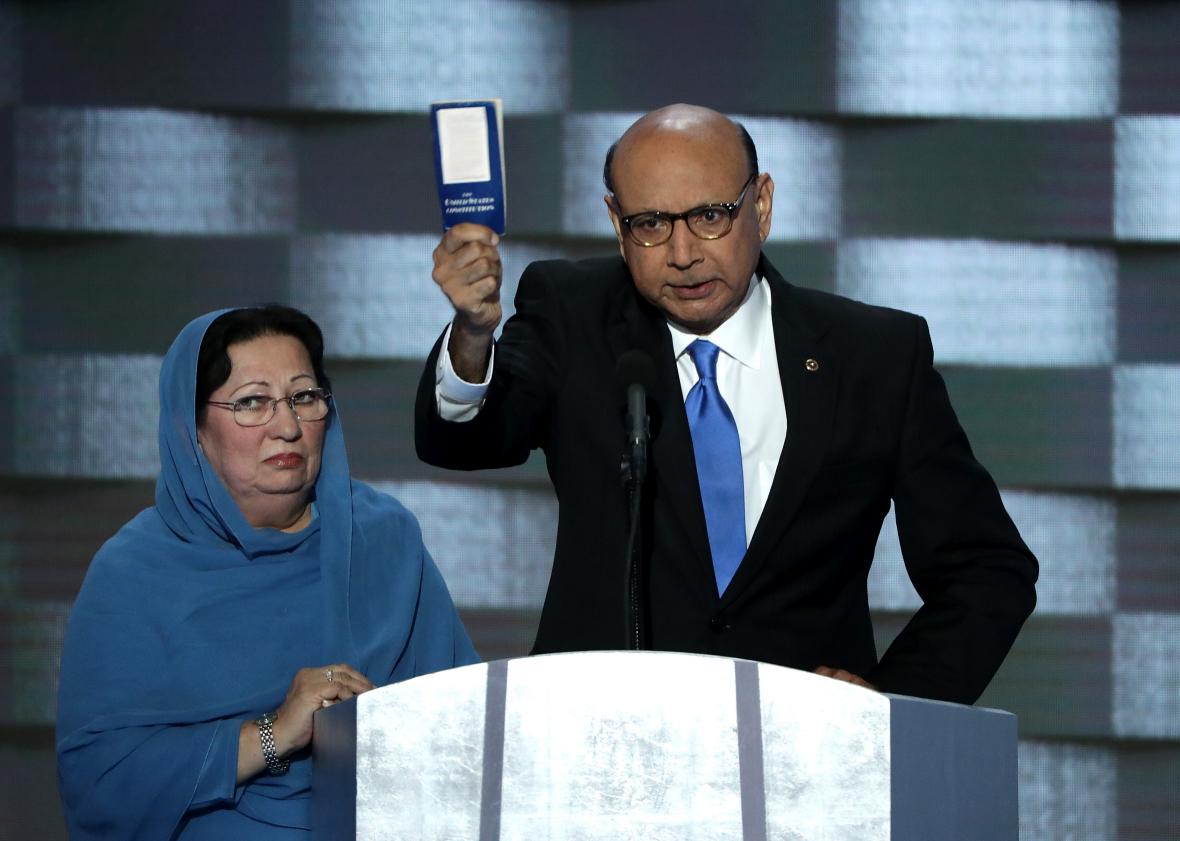
But the big surprise came Thursday, with the speech by Khizr Khan (accompanied by his wife Ghazala), about his son Captain Humayun Khan, who died saving his soldiers in Iraq in 2004.

If it was up to Donald Trump, he never would have been in America. Donald Trump consistently smears the character of Muslims. He disrespects other minorities, women, judges, even his own party leadership. He vows to build walls and ban us from this country.

Donald Trump, you are asking Americans to trust you with our future. Let me ask you: Have you even read the U.S. Constitution? I will gladly lend you my copy. In this document, look for the words "liberty" and "equal protection of law."

Have you ever been to Arlington Cemetery? Go look at the graves of the brave patriots who died defending America — you will see all faiths, genders, and ethnicities.

You have sacrificed nothing and no one.

As Hillary had predicted, Trump couldn't just let that go. He couldn't say something like "While I disagree with much of what Khizr Khan had to say about me, I respect his family's sacrifice." Instead, he asked why Ghazala didn't say anything, invoking another stereotype of Muslims:

She had nothing to say. She probably, maybe she wasn't allowed to have anything to say. You tell me.

And he defended his own "sacrifices".

I think I've made a lot of sacrifices. I work very, very hard. I've created thousands and thousands of jobs, tens of thousands of jobs, built great structures. I've had tremendous success. I think I've done a lot.

Ghazala Khan replied in The Washington Post:

When Donald Trump is talking about Islam, he is ignorant. If he studied the real Islam and Koran, all the ideas he gets from terrorists would change, because terrorism is a different religion.

Donald Trump said he has made a lot of sacrifices. He doesn’t know what the word sacrifice means.

Like so many of the damaging spats Trump gets into, this could have been over in a day. Fox News didn't even show the original speech, so many conservatives would never have noticed it. Instead, it's a multi-day story and could turn into one of the defining moments of the campaign.


Now that even conservatives are saying that the Democrats put on a much better convention, Donald Trump is ducking responsibility for the Republican Convention: "I didn’t produce our show — I just showed up for the final speech on Thursday." Though Trump's speech did get slightly more viewers than Hillary's -- 34.9 million compared to 33.7 -- overall the four-day Democratic Convention had a 16-million viewer lead in the ratings.

I guess viewers would rather hear from Meryl Streep and Katy Perry than Scott Baio and Willie Robertson, and would rather watch Kareem Abdul-Jabar than wonder why Tim Tebow decided not to come. In a rather pointed reference to the Melania plagiarism story, Trevor Noah observed that Republicans “don’t have a Michelle Obama. They just have a Michelle Obama tribute act."

and its result

Polls that came out last week showed Trump getting a bounce from his convention and pulling into the lead. There are still a number of polls to hear from, but the early ones indicate that the Democratic Convention has undone that bounce and then some.

Since Trump's own blunders are turning the post-convention news cycle against him, Clinton's convention bounce may solidify into a lasting advantage.

and the Trump/Putin connection

which I discuss in the other featured post.

but you should notice the victories against voter suppression

The Fourth Circuit Court of Appeals annihilated North Carolina's voter-suppression law:

Although the new provisions target African Americans with almost surgical precision, they constitute inapt remedies for the problems assertedly justifying them and, in fact, impose cures for problems that did not exist.

... Using race as a proxy for party may be an effective way to win an election. But intentionally targeting a particular race’s access to the franchise because its members vote for a particular party, in a predictable manner, constitutes discriminatory purpose. This is so even absent any evidence of race-based hatred and despite the obvious political dynamics. A state legislature acting on such a motivation engages in intentional racial discrimination in violation of the Fourteenth Amendment and the Voting Rights Act.

ThinkProgress called this opinion "a beat-down" and chose to illustrate it with a GIF of Hulk pounding Loki into the pavement in the first Avengers movie.


In a separate case, a federal judge struck down a string of voter-suppression provisions of Wisconsin law, writing:

The Wisconsin experience demonstrates that a preoccupation with mostly phantom election fraud leads to real incidents of disenfranchisement, which undermine rather than enhance confidence in elections, particularly in minority communities.

and you might also be interested in

The legal process against the yahoos who took over the Malheur Wildlife Refuge for more than a month last winter is continuing to churn. Ryan Bundy is defending himself in court, which must be entertaining for the press, if frustrating for the judge. Ryan is claiming to be a sovereign citizen who is not subject to federal law, and is making a number of absurd motions that follow from that assumption. Meanwhile, the government is asserting that the armed occupation is not a legitimate assertion of First and Second Amendment rights: "Taking a gun into a government office is not First Amendment protected activity."


The Obama Presidential Library is going to be on the Chicago lakefront, about a mile from where I lived when I was a student at the University of Chicago.

and let's close with somebody who has far too much time

If you're feeling withdrawal during the Game of Thrones off-season, and you have hopelessly nerdy tendencies anyway, I've got a guy to introduce you to. Just as the Baker Street Irregulars take Sherlock Holmes way too seriously, Lyman Stone gives that kind of attention to Westeros. In particular, how big is it? In what ways do the demographic details in the novels fail basic rules of world-building? And how could you make it as realistic as any dragon-inhabited medieval world threatened by the undead could possibly be?

Monday, July 25, 2016

Better in Russian

I’ve heard this sort of speech a lot in the last 15 years and trust me, it doesn’t sound any better in Russian.

- Garry Kasparov, former Putin challenger and world chess champion
7-21-2016

America was not built on fear. It was built on courage, on imagination, and an unbeatable determination to do the job at hand.

Tim Kaine, quoting Harry Truman
7-23-2016

This week's featured posts are "You Have to Laugh", where I (mostly) ignore the ominous implications of the Republican Convention and focus on the all the great comedy it inspired, and "The Big Lie in Trump's Speech", where I lay out the unspoken falsehoods that hold the speech together.

This week everybody was talking about the Republican Convention

It was hard to think about anything else this week. Both featured posts center on it, one on its humorous aspects and the other on the disturbing ones.

One of the more interesting perspectives on Trump's acceptance speech Thursday night comes from Garry Kasparov, the former chess champion who (until he had to leave the country) was a leader in the movement against Russian strongman Vladimir Putin. In a WaPo op-ed, Kasparov writes:

I saw an Americanized version of the brutally effective propaganda of fear and hatred that Vladimir Putin blankets Russia with today. ...

In both cases, the intent of the speaker is to elicit the visceral emotions of fear and disgust before relieving them with a cleansing anger that overwhelms everything else. Only the leader can make the fear and disgust go away. The leader will channel your hatred and frustration and make everything better. How, exactly? Well, that’s not important right now. ...

It is painful to admit, but Putin was elected in a relatively fair election in 2000. He steadily dismantled Russia’s fragile democracy and succeeded in turning Russians against each other and against the world. It turns out you can go quite far in a democracy by convincing a majority that they are threatened by a minority, and that only you can protect them.


In that speech, Trump brought up his father, from whom he inherited his real estate empire:

My dad, Fred Trump, was the smartest and hardest working man I ever knew. I wonder sometimes what he'd say if he were here to see this tonight. It's because of him that I learned, from my youngest age, to respect the dignity of work and the dignity of working people.

Folk-music legend Woody Guthrie was one of Fred's tenants for two years. He had a different view of who Fred respected, writing (what look to be lyrics) in his notebooks about "Old Man Trump" and the "racial hatred he stirred up" by imposing a color line that kept blacks from becoming Guthrie's neighbors. Years later, The Village Voice reported:

According to court records, four superintendents or rental agents confirmed that applications sent to the central office for acceptance or rejection were coded by race. Three doormen were told to discourage blacks who came seeking apartments when the manager was out, either by claiming no vacancies or hiking up the rents. A super said he was instructed to send black applicants to the central office but to accept white applications on site. Another rental agent said that Fred Trump had instructed him not to rent to blacks. Further, the agent said Trump wanted "to decrease the number of black tenants" already in the development "by encouraging them to locate housing elsewhere."


Charles Pierce:

These were not people begging to govern. These were not even people begging to be governed. These were people begging to be ruled. For all the palaver about freedom and liberty, and all the appeals to the Founders and the American experiment, this whole convention was shot through with an overwhelming lust for authority.

This was a gathering of subjects thirsting for a king.


Trump appears to have gotten a small-to-medium-sized bounce out of the convention, which has (for the moment) put him narrowly in the lead in most polls. Between the conventions is often a skewed time to poll, so Nate Silver's NowCast (if the election were held today) model favors Trump, while his more sophisticated PollsPlus model still favors Clinton. Both currently project a close election.

and Tim Kaine

I admit it: I didn't expect to like Tim Kaine. I'd never watched or listened to him, but his picture looks like some grey-haired vanilla white guy. (And speaking as a grey-haired vanilla white guy myself, I think we have enough representation in the halls of power.) As a senator, he has a generic-Democrat voting record, and when he wanders off the reservation, he tends to wander right rather than left.

I'd been hoping for somebody with better progressive credentials, like Elizabeth Warren or Sherrod Brown. (I'd really been hoping for Al Franken, who I think would do the best job of getting under Trump's skin.) Some new face who could energize young people would be great too, though (not being an excitable young person myself) I have a hard time figuring out who that would be.

Like Digby, I was willing to give Clinton the benefit of the doubt on having done the political calculation right: Maybe the first female president, like the first black president, needs a running mate who calms everybody down. Her people have done the focus groups and I haven't, so maybe they know more than I do.

Then I watched Kaine's introductory appearance with Clinton at Florida International University. My first impression is that Tim Kaine is one of the most likable politicians out there. He seems spontaneous, even when you know he has to be using a prepared text. He somehow manages to sound light without sacrificing seriousness. (Having done some public speaking myself, I envy that.) He can talk about his faith without either pandering or getting preachy. He can put forward a positive vision rather than just tear down Trump. His facility with Spanish -- which comes from leaving law school for a year to be a missionary in Honduras -- is a bonus in an election that depends so much on Hispanic turnout.

And then there's a moment in his speech (around the 46-minute mark in the video) that really does look spontaneous. He's talking about immigration reform, and is starting a story about watching new citizens get sworn in, when he asks for a show of hands from all the naturalized citizens in the audience. Apparently there are a lot of them because Kaine seems surprised: "Yeah. Wow. Thanks for choosing us!"

I was charmed. So often the immigration discussion happens in a judgmental frame: Are these people good enough to be Americans? Kaine turned that around by appreciating the compliment they pay us by wanting to join our country.

So I still expect to hear about issues where I disagree with him, and I've already heard a few. But I'm going to listen to what he has to say.


Jonathan Chait has an interesting perspective on Kaine, beginning with the idea that he was considered acceptably progressive eight years ago when he was on Obama's VP short list.

The left does have reality-based reasons for its dismay. There are aspects of Kaine’s record and beliefs it has reason not to like. At the same time, the complaints about Kaine suffer from a certain myopia that seems to be symptomatic of the hothouse atmosphere that has developed on the left during the Obama era. Emphasis on doctrinal purity have blotted out broader assessments of personal fitness, the absence of ideological dissent overwhelming the presence of positive qualities. The prevailing definition of a perfect leader has become a perfect follower.

and the Democratic Convention

which starts tonight with speeches by Bernie Sanders and Michelle Obama. Tuesday night's headliners are Bill Clinton (who has spoken at every Democratic Convention since 1988) and Elizabeth Warren. Wednesday is basically the retirement party for President Obama and Vice President Biden, as well as Kaine's acceptance speech. Naturally, Hillary will speak on the final night, Thursday.

I am hoping that the Democrats don't fall into the trap of answering Trump's 100%-negative convention with an all-negative convention of their own. (The Kaine speech I linked to above makes me hopeful.) I want to hear that Democrats are working on the real problems that face Americans, and that we're even willing to tell you how we plan to attack those problems. It doesn't need to be a seminar on public policy, but people need to hear that the Democrats have thought things through on a level deeper than "I'm going to build a wall."

The tricky piece of messaging will be how to attack the Republican Congress, rather than just Trump. As I spelled out a few weeks ago: Obama is and for eight years has been a powerful voice for change in America; what maintains the status quo is the logjam in Congress.


The ever-present background story as the Convention begins is the leak of DNC emails, leading to the resignation of Party Chair Debbie Wasserman Schultz.

There are 20,000 of these emails, and I have not even attempted to go through them myself. How serious you think the revelations are seems to depend on what you previously thought about the DNC and the Sanders campaign. Vox (which has generally supported Clinton over Sanders) finds no bombshell:

The emails seem to confirm Bernie supporters’ general impression that many DNC officials liked Hillary Clinton more than Sanders. What the emails don’t seem to prove, at least so far, is that they used DNC resources to help Clinton or hurt Sanders.

But more Bernie-leaning The Intercept has a harsher take on the story.

What makes the issue hard for me to judge (without more research than I've been willing to do so far) is that at some point the Sanders campaign began attacking the DNC fairly aggressively. So when internal DNC emails express anger at the Sanders campaign, it's hard to tell whether the writers are angry at Bernie for running against Hillary, or for attacking the DNC. It would be understandable for people who feel under unfair attack to express anger among themselves against the source of those attacks. It would be still be wrong for them to take action on those feelings, but so far it's not clear to me that they did.

On the fringes of the pro-Bernie left, there have long been conspiracy theories about vote fraud in the primaries and various other offenses far more serious than just rooting for Hillary when you're supposed to be impartial. Nothing I've seen in the published snippets of the emails validates those claims, and it would be a shame if the DNC-email story perpetuates such talk.

On the Clinton side, there's talk about a Russian role in the email hack, and accusations that Putin wants to influence the election in Trump's favor. So far that's also still mostly a conspiracy theory: You can tell a plausible story, and there is some evidence for each of the individual links, but the theory as a whole is still pretty speculative.

and you might also be interested in

One year in, the Iranian nuclear deal still looks pretty good from the American side. But Iranians who thought their economy would instantly rebound have been disappointed.


One of the featured posts focuses on political humor, but this piece didn't quite fit and is too good to leave out: The Liberal Redneck tells us what he thinks about Black Lives Matter.

Responding to that sentiment with "All Lives Matter" would be sorta like telling Susan G. Komen to chill it with all the pink shit on account of all cancer sucks. That last part's true, but it ain't really the fucking point.


Things have taken a turn for the worse in Turkey, after President Erdogan survived a coup attempt last week. Erdogan has declared a three-month state of emergency, and struck back against a large swath of people he believes to be his enemies.

Some 60,000 bureaucrats, soldiers, policemen, prosecutors and academic staff have come under the government’s spotlight, many of them facing detention or suspension over alleged links to the Gülenist movement and the coup plotters.

Earlier on Wednesday, the government had imposed a work travel ban on academics, which, a senior Turkish official said, was a temporary measure as accomplices of the coup plotters in universities were a potential flight risk.

All 1,577 deans of public and private universities in Turkey submitted their resignations at the government’s urging. This came after 20,000 teachers and administrators were suspended from their jobs as a result of the coup, along with 6,000 soldiers and more than 2,700 judges and prosecutors, and dozens of senior generals accused of involvement in the coup.


Roger Ailes is out at Fox News, after Gretchen Carlson's complaints of sexual harassment were echoed by other women who have worked at Fox, including current star Megyn Kelly. But don't cry for Roger, he gets a $40 million dollar parachute.

And apparently the problem is bigger than just Ailes.

The investigation by Fox News’s parent company, 21st Century Fox, focused narrowly on Mr. Ailes. But in interviews with The New York Times, current and former employees described instances of harassment and intimidation that went beyond Mr. Ailes and suggested a broader problem in the workplace.

The Times spoke with about a dozen women who said they had experienced some form of sexual harassment or intimidation at Fox News or the Fox Business Network, and half a dozen more who said they had witnessed it. Two of them cited Mr. Ailes and the rest cited other supervisors. ...

They told of strikingly similar experiences at Fox News. Several said that inappropriate comments about a woman’s appearance and sex life were frequent. Managers tried to set up their employees on dates with superiors.

Here's a longer article devoted to a single case: former Fox reporter Rudi Bakhtiar, who says she was fired after she complained.

Donald Trump's comment is classic male chauvinism: "I can tell you that some of the women that are complaining, I know how much he's helped them." Dean Obeidallah of The Daily Beast responded:

Think about that comment for a moment. Trump is basically saying that since Ailes had helped these women with their careers, the alleged sexual harassment was okay because it was the price to pay for his help.

Larry Wilmore of The Nightly Show referred to this idea that you can harass women you've helped as "the Skeazy Pass".


This is the third or fourth time I've seen a small businessman tell the same story about dealing with Trump. You've got to wonder how often this happened.


 [embed]https://www.youtube.com/watch?v=ln3wAdRAim4[/embed] 

and let's close with something awesome

The Late, Late Show's James Corden spends 15 minutes with the First Lady. When the Obamas return to private life, I'm going to miss Michelle.

Monday, July 18, 2016

The Call Remains

The movement began as a call to end violence. That call remains. … My prayers are with the victims of all violence.

- DeRay McKesson, a Black Lives Matter activist

This week's featured posts are "A Real Pro-Police Agenda is Liberal" and "Mike Pence. I've heard that name before."

Recently everybody has been talking about the police officers killed in Baton Rouge and Dallas

As I often note, a weekly blog is not a good place to cover breaking news. We're still figuring out what happened yesterday in Baton Rouge, and the first details that come out in such situations often have to be revised later. Watch the Wikipedia page for developments.

In both Baton Rouge and Dallas, though, it looks like the shooters are black veterans of the Iraq or Afghanistan wars. Who knows if this was really their thought process, but it's not hard to imagine one: If you've been trained to solve problems with violence, what are you going to do when you see your people being killed and the system failing to call anyone to account?

The important thing at a moment like this, I believe, is to avoid assessing collective guilt and assigning it to individuals who merely resemble the wrong-doers you feel threatened by. That was one of the two big mistakes Dallas shooter Micah Johnson made: The police he murdered had nothing to do with killing Alton Sterling or Philandro Castile. (The other mistake was taking the law into his own hands.)

Assigning Johnson's or Gavin Long's guilt to the entire Black Lives Matter movement would a similar mistake. BLM is not about killing police or killing whites; it never has been. BLM is a response to a society that seems not to value black lives. Police killings are only a piece of that story: Across the board, problems are taken less seriously if they mainly affect blacks. The egregious cases we've been seeing, of police killing black men on video and facing no consequences -- matching stories that have been told in the black community for decades, but which were discounted by whites because there was no evidence (beyond the testimony of other blacks) -- are simply the clearest examples of that larger issue.

Refusing to assign and punish collective guilt, though, doesn't mean that we have to ignore systemic problems. Individual police around the country are not responsible for killing Alton Sterling, and anyone who attempts to punish them for it is expanding the problem rather than solving it. But there is a systemic problem in the way that American police departments deal with blacks, particularly young black men. There is also a problem with the tendency of police to cover up the wrong-doing of other police rather than uphold high standards.

Pressure to reform the way police departments work from coast to coast should not stop just because two individuals carried out collective vengeance.


The post-Dallas attacks on Black Lives Matter caused me to look back at the various BLM-themed posts I've written over the last year. I think they hold up pretty well; or at least I don't see anything major I want to change. The main BLM-related Sift posts are

  • Samaritan Lives Matter, where the example of Jesus's most famous parable illustrates why "All lives matter" isn't the right slogan.
  • Rich Lowry's False Choice, the false choice being that black communities can either have the current overly violent, racially biased kind of policing, or no policing at all.
  • Why BLM protesters can't behave, the answer being that the rest of us ignore them when they make their case politely.
  • Justice in Ferguson, about the Justice Department's report on policing in Ferguson

A post that doesn't specifically mention BLM, but is still relevant, is "My Racial Blind Spots".

and the Nice attack

Hard to believe this attack, where 85 people were killed and 303 injured by a man driving a truck, happened on Thursday. So much has happened since.

Am I the only one who sees the similarity between this and Stephen King's novel Mr. Mercedes?

and Hillary and Bernie

It finally happened on Tuesday in Portsmouth, NH. Senator Sanders didn't embrace Clinton's candidacy with the enthusiasm of Elizabeth Warren, but he appeared on a platform with her and said the important words:

I have come here to make it as clear as possible why I am endorsing Hillary Clinton and why she must become our next president. Secretary Clinton has won the Democratic nomination and I congratulate her for that. ... I intend to do everything I can to make certain she will be the next president of the United States.

The preliminary schedule for next week's Democratic Convention has Bernie speaking on Monday.

and reactions to the FBI's recommendation not to prosecute Hillary Clinton

FBI Director James Comey's statement about the Clinton email investigation should not have surprised anybody who read my article "About Those Emails" last month. Comey concluded:

In looking back at our investigations into mishandling or removal of classified information, we cannot find a case that would support bringing criminal charges on these facts. All the cases prosecuted involved some combination of: clearly intentional and willful mishandling of classified information; or vast quantities of materials exposed in such a way as to support an inference of intentional misconduct; or indications of disloyalty to the United States; or efforts to obstruct justice. We do not see those things here.

To be clear, this is not to suggest that in similar circumstances, a person who engaged in this activity would face no consequences. To the contrary, those individuals are often subject to security or administrative sanctions. But that is not what we are deciding now.

Since that's more or less what I predicted -- not because I'm so brilliant, but because the experts I've been reading had already reached similar conclusions months ago -- I am not scrambling to explain how Comey could possibly have made this decision.

However, pundits inside the conservative bubble (and many Sanders supporters who had latched onto conservative-bubble accounts to feed a desperate hope that Clinton might not be nominated) were shocked by this outcome, because they had concluded long ago that Clinton should be in jail and that Comey was exactly the kind of upright investigator to put her there. Unable to say, "I guess I had that wrong", they came up with a number of creative theories about the corruption of Comey and Attorney General Loretta Lynch and President Obama, or about what other considerations could have motivated Comey's actions.

This kind of thing has happened before: In the closing weeks of the 2012 election, dwellers inside the conservative bubble decided that the polls were all skewed, and so a Romney victory -- nay, a landslide -- was at hand. When reality reared its ugly head, conspiratorial explanations were required, like massive vote fraud in multiple swing states (most of which had Republican governors) that somehow produced no evidence other than Obama's victory.

But instead of stretching to explain the failure of reality to live up to their expectations, surprised people might do better to consider the question raised by Ollie Garky on Daily Kos (later picked up by AlterNet): If events keep surprising me, shouldn't I change my news sources? Back in 2013, Conor Friedersdorf suggested this criterion for comparing news sources: Who best equipped readers to anticipate the outcome that actually happened?


The Comey announcement does seem to have knocked Clinton down in the polls, so that in some polls the race is even now. (538's weighted average still has her with a 3.6% lead.) I'm expecting that dip to be temporary, but we'll see.

and Trump's upcoming convention

My comments about Mike Pence have been spun off into a separate article.

A related topic is the ill-fated TP logo, which was inserted into the public discussion and then prematurely withdrawn about 24 hours later. Not only does the TP bring toilet paper to mind, but the penetration imagery was a little too suggestive. As she so often does, Samantha Bee took it all the way with an animated breaking-the-mattress GIF.

More seriously, there is the Republican platform, which TPM describes as defining "the party of Kris Kobach". McCain and Romney tried to soften the hard-right positions of the base in order to make a better appeal to the general electorate, but the Trump campaign has gone all-in on the red-meat issues.

but we should pay more attention to the coup attempt in Turkey

which apparently failed. Most Americans think of Turkey as a country way over there that has little to do with us. But if Islam is going to find a synthesis between its religious traditions and Western secular values of democracy and human rights, Turkey is the most likely place for it to happen. If democracy is not going well there, it's a very bad sign for the world.

It's also hard to say whether the failure of the coup is good or bad for Turkish democracy in the long run. President Erdogan has been getting increasingly autocratic, but a military junta might have been worse.

Juan Cole sees both angles: He is encouraged that the people came into the streets to oppose the army, yet he recognizes that "President Erdogan looks at the system as an elective dictatorship." In a later post he says:

President Tayyip Erdogan is taking advantage of the failed coup against him to purge the judiciary and security forces of anyone who is lukewarm toward or actively critical of him.

and the UK's assessment of the Iraq War

Unlike us, the United Kingdom decided to take an official look back at its involvement in the Iraq War, assess what went wrong, and see what could be learned. The result is the massive Chilcot Report, which I have not read. The best summary I have run across is in The Guardian. It paints an ugly picture. For example

the intelligence community worked from the start on the misguided assumption that Saddam had WMDs and made no attempt to consider the possibility that he had got rid of them, which he had.

The report finds that there was no imminent threat from Saddam Hussein, and that Prime Minister Tony Blair intentionally exaggerated the evidence that there was. Eight months before the invasion, when there were still many options other than war, Blair promised President Bush "I will be with you, whatever." The invasion began with essentially no plan for putting Iraq back together.

We can only wonder what a similar investigation into the Bush administration would find. But Congress has been unable to squeeze such a probe into its tightly packed schedule of eight Benghazi investigations.

and one thing Trump said

I know, it seems impossible. The media hangs on his every word, so how could something he said deserve even more attention? But this does. In the aftermath of the Dallas shooting (discussed above) Trump told Fox News' Bill O'Reilly:

When somebody called for a moment of silence to this maniac that shot the five police, you just see what's going on. It's a very, very sad situation.

It wasn't a slip of the tongue. He repeated the claim at a rally in Indiana:

The other night you had 11 cities potentially in a blow-up stage,” he said. “Marches all over the United States—and tough marches. Anger. Hatred. Hatred! Started by a maniac! And some people ask for a moment of silence for him. For the killer!

Given Trump's record, it probably won't shock you to learn that the event he is talking about never happened: No one called for a moment of silence to honor Dallas cop-killer Micah Johnson. But it's worse than that: No one -- including his campaign -- can even explain where he got the idea. To all appearances, he just made it up.

Why would somebody do that? And then to imply that the BLM marches were "started by a maniac", as if Johnson were a central figure in the Black Lives Matter movement, or the post-Dallas marches were intended to carry on his work (when in fact all public statements by march organizers denounced the killings) ... why would anybody make up a Big Lie that incendiary?

Josh Marshall comments:

These are the words - the big lies rumbling the ground for some sort of apocalyptic race war - of a dangerous authoritarian personality who is either personally deeply imbued with racist rage or cynically uses that animus and race hatred to achieve political ends. In either case, they are the words of a deeply dangerous individual the likes of whom has seldom been so close to achieving executive power in America.

and you might also be interested in

Ark Encounter, the Kentucky theme park that presents Noah's flood as a historical event, is back in the news.

The Freedom From Religion Foundation sent letters to a thousand public school districts in nearby states, warning that a class field trip to the Ark would violate separation of church and state by inappropriately proselytizing for a religious sect. (That ought to be obvious, but apparently to some people it isn't.)

Ken Hamm, who is behind both the Ark and the Creation Museum, struck back by offering reduced admission to public school groups. We'll see if anybody takes him up on it, and what court cases result.


Paul Ryan had his picture taken with the Republican interns of the House. Did you ever see so many white people in your entire life?


Architect Andrew Tesoro relates his experience of doing business with Donald Trump. It's a story repeated by many small businessmen -- at least 60 by the count of USA Today -- who deliver their products and then get bullied into accepting a much smaller payment than the one Trump had agreed to. (Tesoro isn't one of those 60, because he was intimidated out of filing suit.) "His definition of winning is making sure the other guy loses. ... You can't run a country the way Mr. Trump has run his businesses."


and let's close with something awe-inspiring

Time-lapse video of how storms form and move.


Tuesday, July 5, 2016

Dogma and Storm

No Sift next week. The next new articles will appear on July 18.

The dogmas of the quiet past are inadequate to the stormy present.

- President Abraham Lincoln (1862)

It is preposterous to suppose that the people of one generation can lay down the best and only rules of government for all who are to come after them.

- President Ulysses Grant (1885)

This week's featured post is "Are we overdoing the Founding Fathers?"

This week everybody was talking about terrorist attacks in the Muslim world

In Saudi Arabia, Iraq, Bangladesh, and Turkey. Note how much less impact these attacks had on the American news cycle than attacks in Europe usually do. That's a measure of implicit bigotry that I can see in myself: I have to struggle against a shit-happens reaction to human tragedies that don't involve Americans or Europeans, as if Bangladeshi lives were just a different currency than European lives, with an unfavorable exchange rate.

and two pseudo-scandals that may finally be reaching their conclusions

The House Select Committee on Benghazi finally issued its 800-page report, which not even Chairman Trey Gowdy could pull spin as a revelation:

I simply ask the American people to read this report for themselves, look at the evidence we have collected, and reach their own conclusions.

Vox's Jeff Stein accepted that challenge, and concluded that the report would only impress people who came to it with the assumption that the Obama administration must be up to something sinister.

Nothing in it convinced me of a devastating scandal. The scales did not fall from my eyes to expose the secret malevolence of the Obama administration.

In other Clinton-pseudoscandal news, Hillary was finally interviewed by the FBI. The FBI has said all along that her interview would come near the end of the investigation, so maybe that will soon be over as well. I have not seen anything yet that makes me want to revise my opinion from three weeks ago.

Update: FBI says no charges.

and the Supreme Court's abortion decision

Remember that anti-abortion law Wendy Davis filibustered in the Texas legislature in 2013? It passed in the next session, and now the Supreme Court has invalidated it because it places an "undue burden" on a woman attempting to exercise her right to have an abortion.

ProPublica pulls together the best analyses of the decision. From a layman's point of view, here's what I think it means: Legislatures and courts represent equal branches of government, so typically judges make an assumption of good faith when they analyze a law. In other words, judges assume the legislature is trying to do what it says it is trying to do, and they read the law within that frame.

However, there are certain situations where legislatures again and again have passed bad-faith laws. Racial discrimination has been the biggest example; for decades the rationales kept changing, but the results were always that the races stayed separate and minority races drew the short straw. Eventually, the Supreme Court developed the levels-of-scrutiny doctrine that allowed it to reject consistent legislative bad faith.

That doctrine has never applied to abortion laws, but the Texas law in this case is a classic bad-faith law: It purports to be about women's health, but the actual intent is to impose so many hard-to-satisfy regulations on abortion clinics that most of them would go out of business. Outside the big cities, that would make abortions so hard to get in Texas that women without much support or many resources just wouldn't be able to get them.

The Court's decision never uses the phrase bad faith, but that's what the decision is about. The Court has finally lost patience with bad-faith regulation of abortion clinics. Bad-faith anti-abortion laws all over the country should start coming down.

and Elie Wiesel

who died Saturday.

I've been looking for the perfect Elie Wiesel retrospective and not finding it. I never met Wiesel or even saw him speak in person, but he came to symbolize two important things for me.

First, in regard to the dark side of life, we all have a narrow path to walk: To one side is denial, the temptation to say that because the bad things are not happening to me, at least not at the moment, they aren't real. They won't happen because they don't happen and they haven't happened, even if some people say they did. To the other side is the temptation to dismiss or debunk all higher values, and so give in to cynicism, bitterness, or depression. Wiesel, to me, represents the hope that it is possible to walk that path without sliding off in either direction: We don't have to whitewash the world to love it, or imagine that people are wonderful in order to have compassion for them.

In terms of religion, to me Wiesel represented a balance between traditional religious values and modern humanism. He often talked about God, but never simplistically or dogmatically. The one clear thing the Holocaust had taught him was that God cannot be counted on to save us. If the world is to avoid spiraling into ever deeper darkness, human beings will have to step up and see to it.


Bernard Avishai's Wiesel piece in The New Yorker starts well, but ends up focusing on Wiesel's reluctance to confront Israel about its treatment of the Palestinians. I get where he's coming from and agree with him on the substance, but I have more of a nobody's-perfect reaction. I hope for a more generous response when I die, so I feel obligated to extend that generosity to others.

but not enough people are paying attention to this article

Most progressives regret NAFTA, feel an instant antipathy to any action of the WTO, and oppose ratification of the TPP. At the same time, it's one of those obvious Econ-101 truths that trade is good. Just as no individual can hope to be self-sufficient at a level much above subsistence, no country can truly prosper by cutting itself off from the rest of the world.

So a blanket opposition to any and all trade agreements can't be the right progressive position. If only someone would lay out some general principles of a positive progressive trade policy. Well, Jared Bernstein is taking a whack at it.

and you might also be interested in

Good environmental news is so rare, you shouldn't miss it when it happens.

Remember the hole in the ozone layer? Well, three decades after countries started banning the chemicals destroying it, the ozone layer is on the mend, according to a study published Thursday in the journal Science.


Full scale 2016 coverage begins with Nate Silver's first general election forecasts. He started Hillary Clinton with about an 80% chance of winning, now down to 77%. Nate explains his thinking here.

He offers three different models, one based only on polls, one based on other factors like economic data, and a third projecting what would happen if the election were today. (Look in his left-hand column for the buttons that choose the model.) They allow you to look at different kinds of uncertainty. The if-today model, which he calls the Now-cast, only reflects the uncertainties in polling: If the election were held today, a candidate who has Hillary's current lead in the polls would win 85.5% of the time. The other two models also reflect uncertainties of events, what we might call the shit-happens factor. Polls in June can only tell you so much about what will happen in November, which is what gets Clinton's win probability down to 80.3% in polls-only and 73.5% in polls-plus.

The models are constructed in such a way that they will converge by election day.


While we're on polls, the NYT's Nate Cohn talks about the different assumptions and corrections that can go into polls, and how they can go wrong. In a separate article, Cohn discusses conspiracy theories about vote fraud:

There are plenty of good reasons for people to think the U.S. election system doesn’t work, even if there are basically zero reasons to think it’s “rigged” or that there’s multistate election fraud.


I'm not sure how I missed "I'm Angry! So I'm Voting For Donald Trump" when it came out three months ago, but it's still accurate. At the time, Klavan's eventual conclusion to "vote for someone else, who would be, like, a better president" probably meant some other Republican. (The Daily Wire is a conservative web site, after all.) But it works just as well for Hillary.


TPM's analysis of Trump's fund-raising problems is interesting. So far, there's still no confirmation of his pledge to forgive the loans he has made to the campaign.


The Obama administration has admitted to killing between 64 and 116 civilian bystanders in drone strikes outside war zones. Outside organizations have higher estimates. Long War Journal estimates 158 civilian deaths in Pakistan alone.


A draft of the Democratic Platform is out.


Governor Jerry Brown just signed a slew of new gun-control laws in California. To me the most interesting one is the ban on magazines that hold more than 10 bullets, because it requires gun-owners to do something specific: turn those magazines in or otherwise dispose of them. I wonder how many will comply, and how aggressively California will enforce the law.


George W. Bush was historically unpopular when he left office, but his fans claimed that history would vindicate him. (I argued against that view.) So far, not so much. Noted presidential biographer Jean Edward Smith (whose previous books made the case that Eisenhower and Grant were under-appreciated) has a new book Bush, which ends with this line:

Whether George W. Bush was the worst president in American history will be long debated, but his decision to invade Iraq is easily the worst foreign policy decision ever made by an American president.

That doesn't sound much like vindication.

and let's close with something awesome

Earth isn't the only planet to have an aurora phenomenon. Here, the Hubble space telescope spies one on Jupiter.

Expect gobs of amazing Jupiter photos this week as the Juno probe arrives.