Monday, December 16, 2013

Constructs

No Sift next week. The Sift returns December 30 with the annual Yearly Sift.Jesus wasn’t white because the category white didn’t exist when Jesus was around in the Roman Empire. That is a construction that was made later on for very intense social reasons.

-- Chris Hayes

Featured posts this week are "White Santa, White Jesus, White Christmas" and "Mandela's Memorial Service Was All About Us".

This week everybody was talking about another school shooting


I was wondering what the Weekly Sift should do to mark the anniversary of Sandy Hook, which was Saturday. Friday, that decision was taken out of my hands when somebody else commemorated Sandy Hook in what I suppose is the way we should have expected: with another school shooting.

In terms of carnage, Arapahoe High School in Centennial, Colorado (about ten miles from Columbine) got off lightly compared to Sandy Hook: The shooter himself is the only death so far, though one other student remains in a coma.

The Arapahoe shooting is the kind of bookend a novelist would hesitate to put on the year, thinking it too obvious and heavy-handed. But it is all too appropriate an ending to a year that began with such determination to do something about gun violence, and produced so little actual change.

and the Person of the Year


It came down to Pope Francis or Edward Snowden. I've already said what I think of Pope Francis. Here's what Time thinks:
what makes this Pope so important is the speed with which he has captured the imaginations of millions who had given up on hoping for the church at all. People weary of the endless parsing of sexual ethics, the buck-passing infighting over lines of authority when all the while (to borrow from Milton), “the hungry Sheep look up, and are not fed.” In a matter of months, Francis has elevated the healing mission of the church—the church as servant and comforter of hurting people in an often harsh world—above the doctrinal police work so important to his recent predecessors.

The argument for Snowden was also pretty good. He certainly changed the way we think about government surveillance and got us all looking over our shoulders for Big Brother.

I feel like I owe Sift readers an apology about Snowden: I keep meaning to write a summary of what we now know about how the NSA's spying and data-mining affects ordinary people. Every time I think I have a handle on it, though, something new comes out and I have to re-evaluate.

and about the budget deal


The two budget-committee chairs, Paul Ryan from the Republican House and Patty Murray from the Democratic Senate, came up with a bipartisan budget proposal Tuesday. It passed the House Thursday in a strikingly bipartisan fashion: 332-94, with 169 Republican votes and 163 Democratic votes. The Senate hasn't voted yet, but supporters of the deal sound confident.

There are two pieces to this story: what's actually in the deal and the nasty things Republicans said about each other while it was happening.

The deal. The word everybody uses to describe the agreement is "small". It breaks the sequester spending cuts, but not by much. Spending in 2014 is $45 billion higher than the sequester agreement called for, and the budget pays for that spending with fee increases, not increases in income tax rates or even closing the most egregious tax loopholes.

The most noteworthy thing about the deal is what's not in it: No "grand bargain" of deficit reduction through cutting Social Security and Medicare, and no extension of unemployment benefits.

The shouting. Several influential conservative groups came out against the deal, and John Boehner got mad about it. He pointed out that these same groups pushed House Republicans into the public-relations disaster that was the government shutdown in October.
I think they’ve lost all credibility. They pushed us into the fight to defund Obamacare and shut down the government… And the day before the government reopened, one of these groups said, "Well, we never thought it would work." Are you kidding me?

Similar sniping broke out between Marco Rubio ("This budget ... keeps us on the same road to ruin") and Paul Ryan (senators in the Republican minority "don't have the burden of governing").

Pundits continue to cover this as a "Republican Civil War" or a battle for the soul of the party. But TPM's Ed Kilgore points out that it's really a struggle over tactics, not goals. The Tea Party wants scorched-earth tactics and no compromises, while the so-called "moderates" want to get what they can out of bipartisan agreements and hope to acquire the power to do more in the next election. But ultimately both sides want the same things:
a free-market economy with extremely limited government and a traditionalist, largely patriarchal culture. These policies, buttressed by an increasingly chiliastic view of the status quo (e.g., the “Holocaust” of legalized abortion, and the social policy “tipping point” at which an elite-underclass alliance will destroy private property and liberty entirely), simply are not negotiable.

Don't let the back-biting confuse you: As Kilgore says, "the 'soul' of the GOP is pretty much right in plain sight." People who oppose the Tea Party's tactics may get to pose as "moderates", but their Ideal America looks just like the Tea Party's Ideal America.

and Nelson Mandela's memorial service


Of course, you can't expect Americans to care about some dead guy on another continent, so our news media manufactured conflicts to keep it interesting: the Castro handshake, the "Danish tart" selfie ... I discuss them in "Mandela's Memorial Was All About Us".

and the whiteness of Jesus and Santa


Fox News' Megyn Kelly tries not to be the nasty, trolling kind of race-baiter that Rush Limbaugh and Sean Hannity are. And that's what made her Jesus-and-Santa-are-white pronouncement so interesting. She seems really sorry for the people who are hurt by this state of affairs, but it's just how things have to be. I discuss the implications in "White Santa, White Jesus, White Christmas".

and you also might be interested in ...


Yet another study shows American high school students doing badly compared students in other countries. NBC News illustrated the problem in the most graphic way possible.

[caption id="" align="aligncenter" width="614"] 25 other countries teach ordinal numbers.[/caption]

Yep, we're "21th" in science. I wonder where we rank in proof-reading.


Oklahoma wanted a ten-commandments monument at the state capitol, so in 2009 the legislature passed the Ten Commandments Monument Display Act:
This monument shall be designed, constructed, and placed on the Capitol grounds by private entities at no expense to the State of Oklahoma. ... The placement of this monument shall not be construed to mean that the State of Oklahoma favors any particular religion or denomination thereof over others, but rather will be placed on the Capitol grounds where there are numerous other monuments.

No public money, explicit non-favoritism ... nothing for separation-of-church-and-state types to object to, right?

So the monument was installed last year. In a test of the non-favoritism language, last week a Satanist group offered to donate its own monument for display at the state capitol. Reportedly a Hindu group would also like to erect a statue of Hanuman, the monkey god. A representative of ACLU Oklahoma says they'd prefer not to have any religious monuments at the capitol, but ...
If, at the end of the day, the Ten Commandments monument is allowed to remain on the Capitol grounds with its overtly Christian message, then the Satanic Temple’s proposal can’t be rejected because it is of a different religious viewpoint.

I can't wait to hear what the courts say.


Here's a nightmare come to life: Tom Wagner fell asleep on a plane flight and woke up on a dark, empty, locked-up airliner. The ExpressJet crew apparently didn't notice him.


No new song has broken into the permanent Christmas playlist since Mariah Carey's "All I Want for Christmas is You" in 1989. But it's not for lack of trying. Slate's Chris Klimek describes the more recent offerings and wonders why they don't catch on.


The Daily Show's Jason Jones discusses the "art" of gerrymandering.


The Onion's "Deformed Freak Born Without Penis":
According to reports, the sadly disfigured 26-year-old’s quality of life has been greatly diminished due to such a condition. Sources said the abnormal, visibly blemished creature has been repeatedly passed over for employment opportunities, frequently gawked at and harassed on the street by total strangers, and has faced near constant discrimination for over two decades, all due to the horrific and debilitating birth defect. Indeed, many are reportedly unable to look past the glaring deformity and simply see the 26-year-old as a human being.

and let's end with a Christmas miracle


Even if you don't believe in Santa, the "rational" explanation -- a commercial airline did something unexpectedly wonderful for its passengers -- is pretty miraculous too. 13 million people had watched this video before I did, and probably a lot more by now. But maybe a few of you missed it.

Monday, December 9, 2013

Basic Rights

Everyone has the right to have access to ­health care services, including reproductive health care.

-- the Bill of Rights of the Constitution of South Africa


This week's featured posts: "Rooting for Your Country to Fail is Unpatriotic" and "The Procrustean Sainthood of Nelson Mandela".

This week everybody was talking about Nelson Mandela

Mandela died Thursday at the age of 95.

I discuss our tendency to let our pre-conceptions about sainthood overwhelm the actual lives of the people we want to canonize in "The Procrustean Sainthood of Nelson Mandela".

and improvements in Healthcare.gov

29,000 people signed up for ObamaCare last Sunday and Monday, the first two days after the administration's self-imposed deadline for getting the web site fixed. That's more than signed up during the entire month of October. The best evidence we have about how well the ObamaCare web site is performing now is that Republicans are shifting to other attacks.


The latest lie about ObamaCare is that 80-100 million people who get their insurance through their jobs will have their plans "cancelled". Ezra Klein points out that this is only true if you stretch "cancelled" to mean "changed in any way at all", including the ways your plan already changes from year to year without you noticing.


Another new lie is that ObamaCare has expanded access to abortion coverage for Congress and its staff. ThinkProgress explains.


CNN explains what most news stories about Medicaid expansion miss: States (like mine) that refuse the expansion aren't just opting for the pre-ObamaCare status quo. The Affordable Care Act lowered the federal subsidy to hospitals that treat uninsured people who can't pay, because there weren't supposed to be so many uninsured people who can't pay. But conservatives on the Supreme Court allowed conservatives in state government to opt out of Medicaid expansion. And the result is that hospitals are closing.

You could imagine a sane Congress working some kind of a fix to keep those hospitals afloat. That would benefit red states, so it could be lumped together with some fixes that Democrats want, and everybody would be better off. But the Republican majority in the House refuses any fixes that improve ObamaCare. They'll only back poison pills that sabotage the system or outright repeals. Improvements? No. Erick Erickson says it outright:
The website they can fix. We must deny them the opportunity to fix the law itself. Let the American people see big government in all its glory. Then offer a repeal.

This kind of sabotage is what I'm talking about in "Rooting for Your Country to Fail is Unpatriotic".

and inequality


President Obama gave a speech on "economic mobility" Wednesday. In general it was good a good diagnosis: Over the last several decades, economic inequality is up, economic mobility is down, and this not only makes our individual households insecure, it makes our economy more vulnerable to recessions.

I wish he would say more about one structural cause of the problem: lax enforcement of antitrust laws and the resulting monopolistic bottlenecks in the economy, which I talked about here.

and the War of Christmas


Every year, the Christmas Empire expands. The once-independent celebration of Thanksgiving has become Christmas' puppet holiday, Black Friday Eve. Only the popular Halloween prevents Christmas from rolling all the way to the Fourth of July. (Columbus Day? Labor Day? They'll fall like dominoes if the Halloween Line is ever breached.)

And yet somehow, the Christmas propaganda machine always manages to portray the aggressor as the victim. There is a War ON Christmas. Christmas was just standing there minding its own business when people attacked it for no reason with their battle cry of "Happy Holidays". Without constant vigilance, Santa and his mighty elves will be stabbed in the back by Jews and atheists, and Christmas will be lost.

Jon Stewart calls out this year's propaganda: "How can I enjoy my Christmas, when I know that somewhere a little Jewish boy isn't being forced to sing 'O Little Town of Bethlehem'?"

and bringing automation to your doorstep

Amazon says it's working on drone delivery copters. (And Rock City Times, "Arkansas' 2nd most unreliable news source", claims Walmart is installing surface-to-air missiles at its stores.) Google might "have one of the robots hop off an automated Google Car and race to your doorstep to deliver a package".

I am reminded of a possibly apocryphal conversation between Henry Ford II and union president Walter Reuther as they toured a new Ford factory with advanced-for-the-times automation. "How are you going to get those robots to pay your union dues?" Ford gibed. And Reuther parried: "How are you going to get them to buy your cars?"

Maybe Amazon and Google should start working on an automated consumer.

and you also might be interested in ...


It's time for your annual dose of intellectual humility: The New York Times has put out its "100 Notable Books of 2013" list. I confess to having read exactly zero of them, though one is sitting on my bookshelf and I was already thinking about reading a handful of the others. (A few will have to wait: The publication of Thomas Pynchon's The Bleeding Edge reminded me that I still haven't finished Mason and Dixon. And Stephen King's Doctor Sleep is a sequel to The Shining, which maybe I really should look at.)

Slate's "The Overlooked Books of 2013" list -- another zero for me -- is somewhat less intimidating, both because it's shorter and because the title suggests that other intelligent people might have missed these books too.


I just want to say that I am creeped out by how popular the Confederate cause still is in parts of the South. In Florida, there's currently a push to put up a monument to the Union soldiers who died at the Battle of Olustee, partially balancing the three existing monuments to the Confederate soldiers. You might think this would be uncontroversial, but no, it is.

So the soldiers at Olustee who died fighting for the United States of America and against slavery should go unremembered. That's seriously the position people are taking.


The NYT reports that big oil companies are starting to plan around the assumption that at some point there will be a price on carbon, either through a direct carbon tax or some kind of cap-and-trade system. Exxon-Mobil, for example, is shifting to be more a natural-gas company. (They've also stopped being the deep pockets behind climate-change denying pseudo-science. These days the Koch brothers fill that role.)

This follows reports that insurance companies are adjusting their risk models to allow for the effects of global warming. As one industry think-tank put it:
In the non-stationary environment caused by ocean warming, traditional approaches, which are solely based on analyzing historical data, increasingly fail to estimate today’s hazard probabilities. A paradigm shift from historic to predictive risk assessment methods is necessary.

The NYT comments:
Both supporters and opponents of action to fight global warming say the development is significant because businesses that chart a financial course to make money in a carbon-constrained future could be more inclined to support policies that address climate change.

Or at least they might be less inclined to throw their considerable weight behind political monkey-wrenching.


Andy Borowitz reports that the Hubble telescope has stopped looking out into space and is instead taking selfies to post on Instagram.


A mis-worded Republican tweet about Rosa Parks "role in ending racism" led to the hashtag #RacismEndedWhen. Some of the more amusing tweets are "#RacismEndedWhen The Jeffersons moved on up." and "#racismendedwhen the iphone was available in both black and white."

and for Advent, let's end with a nativity scene


How minimal can you go and still have a nativity? This color nativity might be the limit. (Hat tip to whyismarko's "the 50 worst and weirdest nativity sets".)

Monday, December 2, 2013

Rulers and Servants

Money must serve, not rule!

-- Pope Francis, Evangelii Gaudium (2013)

The Distress of the Privileged got its 300,000th page view on Saturday. If you liked that post, check out my recent article "Political Empathy" in UU World. It isn't exactly a sequel, but builds on some of the same ideas.

This week everybody was talking about Pope Francis

which I discuss in detail in "What to Make of Pope Francis?"

and neocons were wailing about not going to war with Iran

For about a decade, it's been an article of faith among neocons that war with Iran is inevitable: The Iranian leadership is insane, you can't negotiate with them, all they understand is force, and so on. Sooner or later they're going to build an atomic bomb, so we'd better attack sooner rather than later. As recently as a week ago, John Bolton told us, "an Israeli military strike is the only way to avoid Tehran’s otherwise inevitable march to nuclear weapons."

By and large, the people saying this are the same ones who sold us the Iraq War -- Saddam was likewise insane and building nuclear weapons, we'd be welcomed as liberators and all that. So it's a continuing mystery why they get major-media platforms from which to make "expert" predictions that never pan out in reality.

The recent interim nuclear deal President Obama worked out with Iran creates a real possibility that sane Americans might get what we want -- Iran without nuclear weapons well into the future -- without blowing up anything or killing anybody. This comes on the heels of a deal to get rid of Syria's chemical weapons, again without firing a shot. (Neocon Brett Stephens described this as "the administration ... worming its way out of its own threat to use force to punish Syria's Bashar Assad.")

If that possibility becomes real, then the whole neocon worldview collapses, as it should have years ago, when it became clear that everything they had predicted about the Iraq War was false.

The result has been a lot of, well, squealing like stuck pigs. Neocons used their inexplicable media power not to dissect the agreement and find its flaws, but to shout "Munich!" and "Worse than Munich!" at the top of their lungs. I agree with Daniel Drezner's assessment:

the Munich analogy has been degraded to the point where #worsethanMunich deserves it's own Alanis Morisette song that permanently devalues the term.
Reading these articles will teach you virtually nothing about the content of the agreement or how it might yet go wrong. Instead, you'll get a lot of polemic, a lot of bad historical analogies, and more in the endless neocon series of scary-but-divorced-from-reality predictions.

and everybody wondered whether healthcare.gov is fixed yet

The White House says it will work for more than 80% of users, that it can handle 800,000 users a day, and that it will continue to improve.

The important thing, though, is the back end: Does the data you enter get delivered accurately to the appropriate insurance company, who can then cover you? It's going to be a while before we can assess that. Ezra Klein (who has been following this more closely than just about anybody) comments:

So there remain reason for concern. But here's what's indisputable: HealthCare.gov is improving, and fast. Or, to put it differently, HealthCare.gov will be fixed. In fact, for most people, it is probably fixed now, or will be fixed quite soon.

And if you're wondering how the government is going to convince 20-somethings to sign up for ObamaCare, it isn't. Their moms are going to do it.

and "abolition porn"

It's tough to get people's attention when, like John Derbyshire, you've been booted out of the gated community of respectable right-wing commentators for being too racist. Yeah, you can still write for Taki's Magazine or VDare, but who reads those anyway?

Never fear, the true scum can always rise to the top: Derbyshire started his November 20 column talking about "12 Years a Slave" (which he admits he hasn't seen), labeling it "abolition porn" and going on to argue that slavery wasn't really as bad as all that.

Bang! He's back on the national radar. ThinkProgress, Alternet, Rightwing Watch ... nobody on the Left could resist such artful trolling. Congratulations, John. You made us look.

and you also might be interested in ...

Salon's Sean McElwee summarizes the reasons to believe that growing inequality comes from changes in political power, not changes in technology.

OK, it's the holidays. You eat, you get depressed about gaining weight and sitting in front of the TV, so rather than go jogging you think: Why bother? I can't possibly run far enough to burn off that second piece of pecan pie.

New research explains why you should bother. Exercise doesn't just burn calories, it changes the way your body operates. A mere seven-day experiment showed a significant difference between over-eating-and-sedentary young men who did short-but-vigorous daily exercise and those who didn't.

the volunteers who had exercised once a day, despite comparable energy surpluses, were not similarly afflicted. Their blood sugar control remained robust, and their fat cells exhibited far fewer of the potentially undesirable alterations in gene expression than among the sedentary men.

As the Hobby Lobby case moves to the Supreme Court, I appreciate Annalee Flower Horne's Quaker perspective on giving people "conscience exemptions" from following the laws that apply to everyone else.

Many Quakers are pacifists, so they object to being drafted into combat roles or even (for a smaller number of them) paying taxes that fund wars. They deal with this moral conflict by agreeing to alternative non-combat service or "by making sure they don’t make enough money to incur tax liability." In other words, they recognize that conscience has a price, and they willing pay that price.

Now along comes Hobby Lobby, demanding a consequence-free exemption to paying for birth control on the grounds that it violates their conscience. ...

If the Green family’s conscience really forbids them from meeting their legal obligations under the Affordable Care Act, then they have the option to arrange their lives so as not to incur those obligations. They can choose not to run a two billion dollar corporation.

But if they’re not willing to make those sacrifices–if their ‘conscience’ only compels them so far as they can follow it for free–then they are not conscientious objectors.

And they and their fake conscience objection can get the hell off my lawn.

I gave my opinion on this subject in July: “Religious Freedom” means Christian Passive-Aggressive Domination.

One more Annalee line worth quoting:

I won’t even ask which version of the bible they’re reading where Matthew 25.36 reads “I was sick and you sued not to cover my medical care.”

Polling three years before a presidential election is mostly about name recognition. So sure, VP Biden is the Democratic front-runner if Hillary Clinton decides not to run.
The most sinister aspect of NSA spying isn't the crimes they might find, it's the legal-but-embarrassing stuff that they can use to intimidate or discredit people they don't like.

Monday, November 25, 2013

Seven Score and Ten Years Ago

A democracy — that is a government of all the people, by all the people, for all the people

-- Theodore Parker, "The American Idea" (1850)

(Parker was a correspondent of Lincoln's law partner Bill Herndon)

This week's featured post: "6 American Problems Republicans Aren't Trying to Solve".

This week everybody was talking about anniversaries

Tuesday was the 150th anniversary of the Gettysburg Address. The NYT's Disunion blog has been following the Civil War "as it happened" with a 150 year time lag. Its coverage of the Gettysburg Address emphasized how the speech's meaning has changed through the decades.

At first, the world really did "little note nor long remember" what Lincoln said.
By the 1890s, however, when the Gettysburg Address finally entered America’s secular gospel, most people conveniently forgot what Lincoln actually attempted to convey in his brief remarks.

During that early-Jim-Crow era, the address was interpreted as a generically patriotic honoring of the war dead. The "new birth of freedom" was played down, and the speech was read at Blue/Gray veterans' reunions commemorating the heroism of soldiers on both sides.
It would take several decades before the modern civil rights revolution compelled most white Americans to reacquaint themselves with the ideological aspects of the Civil War. In so doing, they would come to rediscover a speech that was first forgotten, then remembered and finally, a century after its delivery, understood.
Friday was the 50th anniversary of the Kennedy assassination. For many people in my generation, JFK's assassination is the first news story we remember.

I was in second grade, and my grandfather had died just a few days before. The assassination happened on Friday. Sunday after church my family gathered at my grandparents' house to discuss what my grandmother should do next. The grown-ups had their serious conversation in the kitchen, and they parked me in front of the TV in the living room, where I watched Jack Ruby kill Lee Harvey Oswald.

When I ran back to the kitchen to tell people what had happened, no one believed me. I was confused, they explained. Oswald had killed Kennedy; no one had killed Oswald.

Culturally, the assassination marked the real beginning of "the Sixties", a period of generational rebellion when all received wisdom had to be re-examined. For me personally, the lesson came through loud and clear that first weekend: You have to trust what you've seen with your own eyes, and not what your elders tell you.

and a deal about Iran's nuclear program


Saturday, an interim deal to limit Iran's nuclear program was announced. Slate's Fred Kaplan assesses it as
a triumph. It contains nothing that any American, Israeli, or Arab skeptic could reasonably protest. Had George W. Bush negotiated this deal, Republicans would be hailing his diplomatic prowess, and rightly so.

It's a six-month agreement in which western nations unfreeze some of Iran's assets and Iran takes certain steps to make its uranium stockpile less threatening. During those six months, the nations hope to negotiate a permanent deal. If they don't, the agreement expires. Kaplan says it's
a first step. In a year’s time, it may be seen as a small step and a brief, naive step at that. But for now it’s a step rife with historic possibilities; it’s a step that should be taken with caution but also with hope and gusto.

and the Senate's metaphorical nuclear option


The ongoing abuse of the filibuster should not be news to Sift readers. I've covered it here and here, as well as considering the larger issue of how we are slowly losing the cultural norms that make our republic work.

Thursday the Democratic majority in the Senate finally did something about it: eliminated the filibuster on nominations other than the Supreme Court. After Senate Republicans blocked all three of President Obama's nominees to the D. C. Court of Appeals on the grounds that they didn't want that Court's current balance between Republican and Democratic appointees to change, Democrats really had no choice. As Salon's Brian Beutler explained:
It would be an act of political negligence, and of negligence to the constitution, for [Majority Leader Harry Reid] to allow the minority to nullify vacant seats on the judiciary, simply to deny the president his right to leave an ideological imprint on a court. The logical extension of the GOP position — that “there is no reason to upset the current makeup of the court” — is a semi-permanent suspension of all appellate and Supreme Court confirmations.

So rather than asking why Reid finally did what he's been threatening for years now, the better question is: Why did Minority Leader Mitch McConnell push him over the edge? Republicans probably could have gotten away with continuing to nudge Obama's nominees further to the right. (They're already pretty moderate now. None represents a radical revisioning of the Constitution comparable to Bush nominees like Janice Rogers Brown.) But simply revoking Obama's constitutional prerogative to appoint judges was an obvious slap in the face, just one step away from the Birther position that Obama isn't really president. Obviously Democrats couldn't let that stand; so why do it?

Beutler believes that the recent ObamaCare-rollout-related dip in the Democrats' favorability has encouraged Republicans to believe that they'll retake the Senate in 2014.
Getting Democratic fingerprints on the nuclear rule-change precedent, will provide Republicans the cover they’ll need to eliminate the filibuster altogether in January 2015.

Even if that turns out to be the case, the filibuster needs to go. It has become part of the larger conservative strategy of minority rule (outlined here), which has been undermining the foundation of the American republic. If Republicans gain short-term power by winning elections, so be it. In the long run, they are trying to hold back the tide, which they can only do by ruling from the minority with tactics like the filibuster.

Let's give Ezra Klein the last word:
Today, the political system changed its rules to work more smoothly in an age of sharply polarized parties. If American politics is to avoid collapsing into complete dysfunction in the years to come, more changes like this one will likely be needed.


Mitch McConnell's response to the nuclear option showcased the new Republican style of argument: Every point ends "because ObamaCare", no matter how stretched the connection might be. It's like Cato's "Carthage must be destroyed."

McConnell argued against the nuclear option like this:
Let me be clear: The Democratic playbook of double standards, broken promises, and raw power is the same playbook that got us Obamacare.

Similarly, Eric Cantor invoked ObamaCare to explain why the House won't vote on the Senate's immigration reform bill:
We don’t want a repeat of what’s going on now with Obamacare. That bill, constructed as it is by the Senate, last-minute-ditch effort to get it across the finish line … let’s be mindful, Madam Speaker, of what happens when you put together a bill like Obamacare and the real consequences to millions of Americans right now, scared that they’re not going to even have health care insurance that they have today come January 1.

And Senator Cornyn dismissed the Iran nuclear deal (discussed above) as a distraction from ObamaCare.


Speaking of minority rule, that's what's behind this crazy idea that is popular among conservatives, but flying below the radar of the general public: repealing the 17th Amendment, the one that lets the people elect senators rather than having them chosen by state legislatures, as they were until 1913.

ALEC, the corporate shadow government behind recent moves to suppress the votebreak the public employee unions and pass stand-your-ground laws, hasn't gotten fully behind a repeal, but wants to chip away at the 17th Amendment by allowing legislatures to add nominees to the ballot, circumventing state primaries.

Whether you want to repeal or just sandbag the 17th Amendment, the point is to gerrymander the Senate. The reason Republicans control the House isn't because the voters want them to. (Democratic House candidates got 1.3 million more votes than Republicans in 2012.) It's because Republican legislatures in many key states (like Pennsylvania and Wisconsin) have drawn House districts to segregate Democrats into a few districts. Similarly, the districts of state legislators can be gerrymandered, which is probably how a blue state like Michigan can have large Republican majorities in its legislature.

So if the 17th Amendment were repealed, a gerrymandered legislature could pick the state's senators. So long, Democratic senators like Carl Levin (re-elected in 2008 with 63% of the vote) and Debbie Stabenow (59% in 2012).

and George Zimmerman


I feel vaguely ashamed of my interest in the further adventures of George Zimmerman. The important issues are racial bias in the justice system (I outlined the evidence of it here) and laws that encourage citizens to shoot each other (Ohio's House just passed one Wednesday by a 62-27 vote), not what kind of guy Zimmerman is.

But here's why I find Zimmerman's run-ins with the law so hard to ignore: During the trial that acquitted him for killing Trayvon Martin, the right-wing and left-wing media painted two very different pictures of Zimmerman. Right-wingers presented Zimmerman as a public-spirited man who just wanted to keep his neighborhood safe. Left-wingers (like me) saw him as a violent man who went out looking for trouble and found it.

We were right.

Monday, police arrested Zimmerman in a domestic violence incident, the second such run-in (with two different women) since his acquittal. He has been charged with assault.

What's striking are the two 911 calls, one by his girlfriend to get the police to come, and the other by Zimmerman after the police arrive but before he lets them into the house "because I want people to know the truth".  In his call, Zimmerman concocts a story in which a conversation about his girl friend's pregnancy (which she denies) leads to her "going crazy" and destroying stuff. Why she wrecked her own stuff and then called the police on herself is unclear.

Ta-Nehisi Coates sarcastically comments: "It may well be true that, against all his strivings, trouble stalks George Zimmerman." Coates then lists all the strange coincidences that hypothesis entails. The parallel with his claim that Martin attacked him is obvious. Also with the claim that Zimmerman's ex-wife's iPad got smashed in the September incident because she attacked him with it. (iPads are such popular weapons, after all.) And that her father's glasses got broken because he threw them down before charging at Zimmerman. ("He knows how to play this game," Zimmerman's girlfriend told the 9-11 dispatcher Wednesday .)

Whatever happened with Trayvon Martin, Josh Marshall renders the clear verdict about Zimmerman's character:
Zimmerman is a liar and a habitually violent and frequently out of control man who should never have been allowed to possess a gun.
Miniver Cheevy takes it one step further and compares liberal and conservative intuitions. The same pre-trial Zimmerman/Hannity interview that conservatives found so compelling gave him the creeps:
Watching that, to my eye, it's obvious what kind of person Zimmerman is. I know that guy. He has no self-doubt. He could have done what I described and rationalized himself as being in the right, no sweat.

Conservatives, he writes, "are dead suckers" for that Oliver-North-style "earnest self-righteousness".
Liberals have a deep-rooted skepticism about [earnestness], because we think that one needs self-doubt to check one's self. ... [C]onservatives are far too credulous about it, which makes them too supportive of the smug and self-righteous. And they never seem to learn.

and you also might be interested in


John Boehner tried to make a stunt out of his attempt to sign for ObamaCare. But then he succeeded. Probably got a good deal, too.


There's a new world chess champion: 22-year-old Magnus Carlsen of Norway. His resemblance to Good Will Hunting is just a coincidence, despite the April Fool's article a few years ago that claimed Matt Damon as Carlsen's American cousin.

[caption id="" align="aligncenter" width="560"] Magnus or Will?[/caption]


The First Thanksgiving story is a little less heart-warming from the other side.


I get embarrassed whenever somebody posts a map of the states that haven't accepted the federal government's offer to expand Medicaid. Most of them are where you'd expect: in the South and the Great Plains. But there's a little island of hostility to the working poor in the Northeast: Maine (where the legislature has passed Medicaid expansion, only to see the state's Tea Party governor veto it) and my own state of New Hampshire.


New Hampshire got hit by the Tea Party sweep of 2010 worse than most states. For two years we had one of the most far-right legislatures in the country, with the power to override the governor's veto on many occasions. Fortunately we reversed that in 2012, with Democrats regaining control of the House and getting the Republican Senate majority down to 13-11.

Well, this week the Senate Republicans held together and rejected Medicaid expansion 13-11.

From a state's point of view, this is free money. The federal government is committed to pay 100% of the cost for three years and 90% thereafter. By shrinking the number of uninsured people who show up in emergency rooms, Medicaid expansion lowers costs for both the state and its hospitals. By helping people stay out of bankruptcy -- medical bills are among the primary causes of bankruptcy -- the program benefits a state's economy across the board.

And the primary beneficiaries are the working poor, people who ought to have everyone's goodwill. We're not talking about the stereotypic bums who want a free ride. Medicaid expansion applies mainly to people who make 100-133% of the federal poverty line: up to $30,675 for a family of four in 2012. In other words: households juggling several part-time minimum-wage jobs, and probably working harder under worse conditions than most of the rest of us.

Arkansas and West Virginia are enlightened enough to see the sense of Medicaid expansion. New Hampshire isn't. The shame, the shame.


The Christian Right isn't just anti-science, they're also anti-history. Alternet's Amanda Marcotte lists "5 Christian Right Delusions and Lies About History".

and let's end with something moving


Sabadell is an old city in the Catalan region of Spain, not far from Barcelona. In the public square, a girl puts a coin in a hat to see what a frozen cellist will do. She gets a whole orchestra.

I've pointed to musical flash mob videos before. I find them wonderful and inspiring. They act out the old fairy-tale theme: If you start something, unexpected help may show up.

But as the "Tomorrow Belongs to Me" scene from Cabaret shows, that primal human power can work for either good or evil. Where does a generation of children first grasp the viral magic of the larger community: in the creation of beauty and wonder, or in the transmission of hatred and destruction? That's one of those underlying cultural questions that determine a country's political future.

Monday, November 18, 2013

Repetition

They say the next big thing is here
That the revolution's near
But to me it seems quite clear
That it's all just little bits of history repeating.

-- "History Repeating" by Alex Gifford

performed by The Propellerheads/Shirley Bassey (1997)

Understanding today’s right-wing insurgency as a new phenomenon only weakens our attempts to defeat it. Grasping it instead as the product of a slow, steady evolution is our only hope of stopping the cycle before it repeats itself anew.

-- Rick Perlstein "The Grand Old Tea Party" (2013)


This week's featured post: The ObamaCare Panic.

This week everybody was panicking about ObamaCare


The discouraging thing wasn't that conservatives were pushing bogus horror stories, or even that the mainstream media wasn't debunking them. It's that Democrats began wilting under the pressure, just like they did before the Iraq invasion or when the fraudulent ACORN-pimp-video came out.

It sucks to have to defend people too spineless to defend themselves, but here goes: The ObamaCare Panic.

and talking about journalists who ought to be fired


As I mentioned last week, Laura Logan of CBS' 60 Minutes has apologized on-the-air for her Benghazi report on October 27. But it was content-free apology that made no attempt to undo the damage. I agree with Josh Marshall's assessment:
In a narrow sense, Lara Logan did say she was "sorry." But the entire 90 seconds was aimed at obfuscating what happened.

Logan said 60 Minutes had found out Thursday that they had been "misled and it was a mistake to include him in our report."

Include him in their report? He was the report. And even in conceding that her team had been "misled", Logan tiptoed around the real news, which is that it seems clear that Davies' entire story was a fabrication. He wasn't there. So none of the stuff he [claimed to have done] could have happened and he cannot have witnessed any of what he claimed to describe.

So if you're a 60 Minutes viewer, you saw a full segment on Benghazi that re-ignited a bunch of Fox News talking points. (Fox certainly saw it that way, mentioning the report on 13 segments totaling 47 minutes.) Then two weeks later -- after you and your buddies at work had plenty of time to hash that out over the water cooler -- you saw 90 seconds at the end of the hour indicating that not everything in that segment was completely correct.

A lot of people have compared this episode to the Bush National Guard report that ended Dan Rather's career at CBS and got a few other people fired. But Rather outraged conservatives, not liberals, so the cases are completely different.


Another person who should maybe retire early is Washington Post columnist Richard Cohen. He landed in a kettle of hot water by pointing out last Monday that the Republican Iowa-caucus or South-Carolina-primary voters Chris Christie might need to impress are a little different than the New Jersey general electorate that gave him a landslide victory. Such folks are "not racist", Cohen assures us, they're just different from East-Coasters:
People with conventional views must repress a gag reflex when considering the mayor-elect of New York — a white man married to a black woman and with two biracial children.

I can't improve on Ta-Nehisi Coates' response:
The problem here isn't that we think Richard Cohen gags at the sight of an interracial couple and their children. The problem is that Richard Cohen thinks being repulsed isn't actually racist, but "conventional" or "culturally conservative." Obstructing the right of black humans and white humans to form families is a central feature of American racism. If retching at the thought of that right being exercised isn't racism, then there is no racism.

In deciding whether or not it's time for Cohen to go, I hope the Post looks at the broader sweep of his columns. In addition to the column in question, here are the last month's worth:

On November 4, Cohen discussed how watching 12 Years a Slave was an "unlearning" experience for him. Turns out, Gone With the Wind wasn't a documentary and slavery was really bad! Who knew?

October 28, he connected the problems of HealthCare.gov to the administration's "inept" and "incoherent" Syria policy (which appears to be getting rid of Assad's chemical-weapon arsenal without war), the bugging of the German chancellor's phone, and the souring of U.S.-Saudi relations, and concluded that President Obama's may not be as competent as Cohen had thought. It took a whole column to say that, and if you can find any more content than I just put into one sentence, please tell me.

October 21, he realized (four months late) that maybe his original assessment that Edward Snowden "expose[d] programs that were known to our elected officials and could have been deduced by anyone who has ever Googled anything" wasn't quite right. Ah, the shifting winds of conventional wisdom!

That's a month's worth of work in one of the most prestigious jobs in American journalism. I'm reminded of a Rodney Dangerfield joke: When a woman wants to break up with him, Rodney asks her, "Is there someone else?" And she replies, "There must be."

and 2016


I'm going to break my moratorium on 2016 speculation for The New Republic's "Hillary's Nightmare? A Democratic Party That Realizes Its Soul Lies With Elizabeth Warren". Noam Scheiber is making an analogy between Hillary Clinton's front-runner status now and her similar position in the 2008 cycle. Then, a successful insurgency was possible because she was on the wrong side of the Iraq issue. Now she's too aligned with the 1% and Wall Street, which makes her vulnerable to a challenge from somebody on the progressive side of that issue, like Elizabeth Warren.

I agree with Scheiber's scenario this far:
  • I love Elizabeth Warren. If the gods let me appoint the president, she'd be high on my list.
  • Along with his continuation of Bush's war on terror. Obama's Wall-Street-friendly policies have been the most disappointing part of his presidency. No Democrat is chummier with Wall Street than the Clintons, and nobody is in a better position than Warren to press that issue.
  • A lot of Democratic women (especially older women) felt robbed when Hillary was denied the 2008 nomination by a man. If that happens again I think we'll have a problem. So (as much as I also like Sherrod Brown) the 2016 not-Clinton Democrat ought to be a woman.

So yeah, there's logic behind the Warren-excites-the-base-and-beats-Clinton scenario. But I'm not buying it for these reasons:
  • Obama barely beat Clinton in 2008. There's no room for error.
  • Warren is not the campaigner Obama was. As good as her policies would be for the working class, her professorial style is not going to inspire WalMart Democrats.
  • Obama didn't just rally the progressive base, he excited new voters among blacks, Hispanics, and the young. Clinton might be vulnerable among younger voters and the Occupy-types love Warren, but I don't see Warren inheriting the non-ideological parts of the Obama coalition.
  • In 2008 Clinton was pinned down by her undeniable vote to authorize the Iraq invasion. But in the 2016 primaries she has lots of room to slide left on economic issues. Like Romney's rightward slide in 2012, Clinton's leftward shift won't be entirely believable. But it should be enough to fend off a progressive challenge.

At some point in the cycle the press will be hungry for a Clinton-is-not-inevitable story, so somebody (maybe Warren) will be cast as the progressive savior. But I expect that boomlet to fade.

you also might be interested in ...


The most insightful article I saw this week was Michael Kimmel's "America’s angriest white men: Up close with racism, rage and Southern supremacy" on Salon. He studies white supremacists and finds that they are literally disinherited: They are the "& Son" from the business that went under, or the would-have-been heir to the bankrupt family farm.

They wind up with a worldview full of contradictions: Pro-capitalist but anti-corporate, rabidly patriotic  but "the America they love doesn’t happen to be the America in which they live."

For ordinary white conservatives, class is a proxy for race. ("Welfare queens", the "inner city poor" ... we know who they are, right?) But among the white supremacists, race is a proxy for class. "Whites" are the people who actually make stuff (that the government collects and gives away to non-whites), not the bankers and lawyers and bureaucrats and intellectuals (even though most of those people are actually white).
So, who are they really, these hundred thousand white supremacists? They’re every white guy who believed that this land was his land, was made for you and me. ... But instead of becoming Tom Joad, a left-leaning populist, they take a hard right turn, ultimately supporting the very people who have dispossessed them.

Eventually I'll probably write something about all the Weimar Republic stuff I've been reading lately, but for now I'll just say that the parallels are striking. In Germany of the 1920s, the "rich Jew" and "Jewish banker" stereotypes channeled class resentment into anti-semitism. It wasn't "real" Germans who were oppressing the working class, it was "Jews".


Ever feel like you need an expert panel to determine what's racist and what isn't? The Daily Show assembled one.


Ted Cruz's Dad turns out to be a minister who is way wackier than Jeremiah Wright. If Cruz runs for president, will he face the same kind of pressure to disassociate that President Obama did? Somehow I doubt it.


Slate's Fred Kaplan explains why he now believes the Warren Commission conclusion that Lee Harvey Oswald acted alone.

As the 50th anniversary of JFK's assassination approaches, you can expect more conservative efforts to claim that Kennedy was really one of theirs. But here's what conservatives thought about him at the time. The following flier was being posted in Dallas prior to the President's fateful visit:


The parallels to President Obama are obvious, right down to attempts to expand health care. Let's hope things turn out differently this time.


The revolving door keeps spinning: Ex-Treasury Secretary Tim Geithner becomes president of a Wall Street buy-out firm. I have no reason to believe this is anything other than perfectly legal and above-board, i.e., no quid pro quo for favors granted. But how could the pipeline from Washington to Wall Street not be a corrupting influence?

And let's end with something amazing


What a spider looks like when you get really, really close.

Monday, November 11, 2013

Governing

Sometimes I feel like our party cares more about winning the argument than they care about winning elections. And if you don’t win elections, you can’t govern. And if you can’t govern, you can’t change the direction of a state, like we’ve done in New Jersey.

-- Chris Christie, 11-5-2013


This week's featured articles: "Nobody's a Moderate in the Republican Civil War" and "Bullies, Victims, and Masculinity".

This week everybody was talking about election results


After decades of rule by Republican/Independents like Mike Bloomberg and Rudy Guiliani, New York elected a Democratic mayor by a landslide. Bill de Blasio didn't just wear the Democratic label, he put forward a genuinely progressive agenda.

In New Jersey, conservative (not moderate) Chris Christie was the landslide winner.

Here's what stands out for me about the Virginia governor's race: not that the Democrat won or that the final vote was closer than expected, but that the Democrat won a low-turnout election.

Conventional wisdom says that high turnout favors Democrats, low turnout Republicans. (That's why Republicans work so hard to suppress the vote.) And it plays out in Virginia: When Obama took Virginia in 2008 and 2012, he did it by pulling in people who don't usually vote. About 3.7 million Virginians voted each time, compared to 3.1 million when Bush beat Kerry by 270,000 votes in 2004. In 2010, when there was no top-of-the-ticket election and Republican House candidates outpolled Democrats by 275,000 votes, only 2.2 million voted.

Again Tuesday, about 2.2 million Virginians voted. They elected Democrats governor and lieutenant governor, and the attorney general race is still too close to call.

If I were a Republican, that would worry me.

and Typhoon Haiyan


As many as 10,000 may be dead in the Philippines in "one of the most powerful typhoons ever recorded". Haiyan proceeded on to make landfall in Vietnam. I know there's some famous quote about the number of deaths a disaster needs to make headlines being inversely proportional to its distance, but my Google skills failed me. (If you know, write a comment.)

Here's Haiyan as seen from space:

and Iran


Negotiations about Iran's nuclear program ended without a deal. It's not clear how seriously to take claims of "significant progress".

and the NFL, race, and masculinity


The Richie Incognito/Jonathan Martin bullying story jumped off the sports pages and became a discussion about race and masculinity. I discuss it in more detail in "Bullies, Victims, and Masculinity".

and you also might be interested in ...


CBS has pulled  the 60 Minutes segment on Benghazi off its web site, saying:
60 Minutes has learned of new information that undercuts the account told to us by Morgan Jones of his actions on the night of the attack on the Benghazi compound.

We are currently looking into this serious matter to determine if he misled us, and if so, we will make a correction.

It apologized on the air last night.

Apparently, their key witness had previously told the FBI a completely different story. Apologizing is fine, but that's not going to correct all the misinformation that CBS' report put into people's heads.


Jonathan Chait notes that the limit of the Senate's power to "advise and consent" on presidential nominees is limited by custom, not settled law. And then he raises an important question:
We may assume that another Supreme Court vacancy would result in the confirmation of a mainstream judge in the president’s broad ideological mold. But if one of the five Republican-appointed justices were to fall ill or suddenly retire, would Republicans really allow Obama to replace him with another Elena Kagan or Sonia Sotomayor? We believe that the Senate would yield because that’s simply the way things have always been done. But in the Obama era, the way things have always been done has not turned out to be a reliable guide.


The Rand Paul plagiarism scandal keeps growing. It started with Rachel Maddow spotting unattributed paragraphs from Wikipedia in Paul's speeches. Then BuzzFeed's Andrew Kaczynski noticed pieces of an article from The Week showing up in Paul's Washington Times column. And then he found that a chunk of Paul's latest book was cribbed from a Forbes article. Politico found "borrowed language" in Paul's Howard University speech and his 2013 response to President Obama's State of the Union address.

Tuesday, The Washington Timesended Paul's weekly column, saying: "We expect our columnists to submit original work and to properly attribute material".

It's kind of a weird scandal, because (in all the examples I've seen) quoting the source material properly would not have detracted from the point Paul was making. The issue seems to be more about sloppiness and low intellectual standards than about honesty.

There's also character component now, because of the way Paul initially tried to bluster his way through rather than just own up to the mistakes.
if dueling were legal in Kentucky, if they keep it up, you know, it would be a duel challenge. But I can’t do that, because I can’t hold office in Kentucky then.

That sounds big and tough until you realize that he's fantasizing about dueling a girl, Rachel Maddow. (I don't think they ever did that in Kentucky. Or anywhere.) By the time CNN called him to account, he was slightly more contrite: He blamed his staff, and then whined about "the standard I'm being held to".
They’re now going back and reading every book from cover to cover and looking for places where we footnoted correctly and don’t have quotation marks in the right places or we didn’t indent correctly.

This all backs up my initial impression of Paul, which is that the champion-of-libertarian-philosophy mantle he inherited from his Dad doesn't really fit. (How well it fit Ron Paul is a different discussion.) He appears to be an empty suit who doesn't write, vet, or even understand very well the words he says or signs his name to.

That's why he looked so silly when Rachel interviewed him in 2010: Rachel knows her stuff, and Rand only knows his talking points. Or why he seemed surprised that black students at Howard University know basic facts about American history (like that Lincoln was a Republican). (Jon Stewart described the Howard talk here, and then discussed it with Larry Wilmore.) His talking points say blacks are all Democrats because they don't know that kind of stuff. How was he to know Howard students really do?


Young adults aren't buying cars or houses at the usual rate. Are they just over-extended from student debt and poor job prospects? Or are they developing a different relationship with ownership?

and let's end with something awesome


like the moon.

Monday, November 4, 2013

Carrot and Stick

I’m concerned about the fact there seems to be a war on the poor. That if you’re poor, somehow you’re shiftless and lazy. You know what? The very people who complain ought to ask their grandparents if they worked at the W.P.A.

-- John Kasich, Republican Governor of Ohio
The New York Times, 10-28-2013

The dual process of cutting both taxes and social programs involved, however, a striking difference in the assumptions of the motivations governing the behavior of the affluent and of the poor. For those in the upper brackets, and for those managing corporate decision-making processes, the underlying assumption of the tax cuts was that the creation of new tax incentives would encourage more work, more investment, and more savings, that the best way to achieve sought-after behavior is to reward it, in this case with lowered tax rates on corporations, savings, executive stock options, and estates. At the bottom of the scale, the dominant assumption behind social program cuts was precisely the opposite: the best way to achieve increased work is by making life tougher.

-- Thomas Byrne Edsall
The New Politics of Inequality (1984)

A shorter summary of the policy-set Edsall is describing: Carrots for the rich. Sticks for the poor.

This week's featured post: "The Filibuster and the War on Women"

This week everybody was talking about ObamaCare


The focus of Republican attacks shifted from HealthCare.gov to people whose policies got cancelled.

A lot of the media is reporting these cases without examining them. The few who do invariably notice the same things. Either
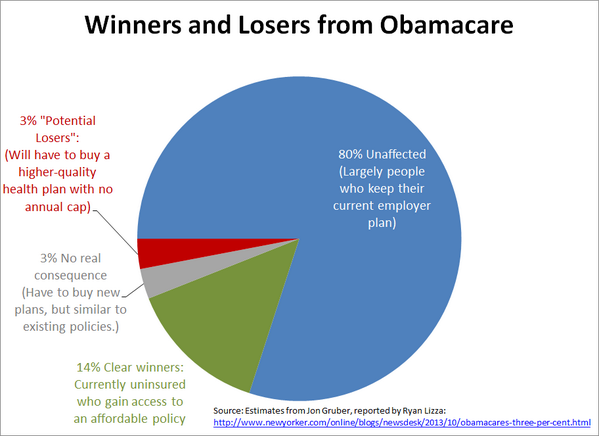
  • the cancelled policy is what Consumer Reports has called "junk insurance". A low annual cap or the insurance company's option to cancel if you actually get sick means that the policy really just provides the illusion of health insurance. In addition to the 50-million-or-so uninsured Americans pre-ObamaCare, about 25 million had insurance that would not have saved them from bankruptcy if they had a major health problem.
  • or, a better policy (typically, but not always) for less money is available on the ObamaCare exchanges.

There are exceptions, but here's the overall picture:

Nicholas Kristof reminds us of the real victims of our healthcare system: People who will die because they couldn't get affordable health insurance. They're not just abstract public-health statistics. They have names and stories. As Margaret Talbot writes in The New Yorker:
when it comes to evaluating the worth of Obamacare we may not remember the Web-site hiccups all that well. What we will remember, and what ultimately matters, is whether, in the next year, the A.C.A. fulfills its promise: to provide affordable health insurance to people who did not have it through an employer, could not afford it on their own, were denied it on the basis of preëxisting conditions, paid more for it than they should have because they were, say, women of child-bearing age, or could no longer get by because their insurance benefits had been capped.


A new poll shows why the "replace" part of the Republican slogan to "repeal and replace ObamaCare" will never happen: Republicans don't want a replacement. Among Republicans, repeal-and-don't-replace beats repeal-and-replace 42%-29%.

and the LAX shooting


Notice how closely the coverage tracks Juan Cole's 2012 "Top Ten Differences Between White Terrorists and Others". I don't want to make too much of the early hints that this guy is a right-wing wacko, but if he were a dark-skinned Muslim with similar hints of radical Islamist views, that would be the whole story.

and food stamp cuts

The Food Stamp program became less generous on November 1, when a benefit increase that was part of the 2009 stimulus program expired. Eligibility standards don't change, but families will get about 5% less help.

I have trouble getting excited about the expiration of a temporary program, but further food stamp cuts are on the docket. The current budget negotiations are supposed to reconcile the Senate's $4-billion-over-ten-years cut with the House's $40-billion-over-ten-years cut. About $76 billion was spent on food stamps this year.


The problem of scale: "Lawmakers could save millions by targeting food stamp fraud -- will they?" says the Fox News headline. Millions? Those who keep reading will find this acknowledgement: "The amount appears relatively small considering the government pays out roughly $70 billion in annual food stamps benefits."

Hmmm. I wonder if those "millions" are net savings, after accounting for the cost of implementing and enforcing whatever safeguards would prevent that relatively small amount of fraud. Fox doesn't link to the report the number comes from -- I think it's this one, although an automatic text search fails to find the $3.7 million figure in it -- but it looks like they're talking about gross savings, estimated by a suspiciously simplistic method.
The projected potential savings from fraud-cutting is detailed in the inspector general report, which found $3.7 million in questionable monthly payouts across 10 states. ... The $222 million figure was reached by multiplying the number by 12 to get an annual amount, then by five to get an estimate for all 50 states.

So on the bottom line, the headline "millions" in savings are probably considerably less than the article claims, and may even be negative.

and the NSA


Strangely, people who are OK with the NSA spying on you and me hit their limit when it was revealed that the NSA is spying on our allies.

and the Republican Civil War


The opening quote from Governor Kasich is a Republican-on-Republican attack, as Kasich struggles to govern in spite of his Republican legislature. Anybody who thinks President Obama could get along with the Right if he were only nicer to them should study Kasich, who was a Fox News host for six years.

People you never would have thought could be challenged from the Right are in danger of being challenged from the Right. The latest is Senator John Cornyn of Texas. A poll of Texas Republicans found that "a Tea Party candidate" beats Cornyn 46%-33%, though several specific challengers are less popular. (Cornyn beats Rep. Louis Gohmert 45%-20%.) You have to wonder about the poll, because the wording of some  questions seems biased, like "Do you support amnesty for illegal aliens?" But the horse-race questions look legit.

The craziest name suggested as a Cornyn challenger is fake historian David Barton. Barton's latest book, The Jefferson Lies, was withdrawn by the publisher, because "There were historical details — matters of fact, not matters of opinion, that were not supported at all." Barton's misrepresentations of American history figure prominently in Chris Rodda's debunking book Liars for Jesus.

And here's a future civil-war battleground:

and the filibuster and court rulings about abortion and contraception


I covered this in "The Filibuster and the War on Women".

and you also might be interested in ...


Nature giveth and nature taketh away.


You know who couldn't get a Texas voter ID on his first try? Former Speaker of the House Jim Wright. His driver's license had expired (which is probably a good thing, given that he's 90) and his faculty ID from TCU isn't one of the forms of ID accepted. (If he'd had a gun license, though, he'd have been fine. Let's hope that's expired too.) Fortunately, he could go home and find his birth certificate, which not all 90-year-olds can do.

The point of the law isn't to verify who you are -- Wright did that the first time -- it's to make it harder to vote. There's no evidence of a voter-impersonation problem in Texas or anywhere else. And there's really no evidence for a forged-ID-to-enable-voter-impersonation problem.


The Organisation for the Prohibition of Chemical Weapons (OPCW) announced Thursday that Syria
has completed the functional destruction of critical equipment for all of its declared chemical weapons production facilities and mixing/filling plants, rendering them inoperable.

... The next milestone for the mission will be 15 November, by which time the Executive Council must approve a detailed plan of destruction submitted by Syria to eliminate its chemical weapons stockpile.


I still can't decide whether I want to see the Ender's Game movie. But there's no denying how far Orson Scott Card has gone off the rails. It's not just the gay-marriage-justifies-revolution screed ("when government is the enemy of marriage, then the people who are actually creating successful marriages have no choice but to change governments, by whatever means is made possible or necessary. ... Biological imperatives trump laws."), it's this "plausible" scenario for Obama making himself dictator-for-life.

Interesting re-interpretation of the novel on Salon: It's not really about war or genocide, it's "an imaginative portrait of the inner life of an abused child, a fledgling psyche trying to reconcile the unbearable contradiction in receiving both love and gratuitous pain from the same source."


Abstract ideas have consequences. According to Scientific American, believing in Satan and the existence of pure evil affects views on a number of political issues.
BPE [belief in pure evil] predicts such effects as: harsher punishments for crimes (e.g. murder, assault, theft), stronger reported support for the death penalty, and decreased support for criminal rehabilitation. Follow-up studies corroborate these findings, showing that BPE also predicts the degree to which participants perceive the world to be dangerous and vile, the perceived need for preemptive military aggression to solve conflicts, and reported support for torture.

I'd love to see research on my hypothesis connecting BPE to conspiracy theories. This is from the 2010 Weekly Sift article "Propaganda Lessons from the Religious Right":
The Devil is the ultimate sinister conspirator, motivated by pure evil. Once you have a Devil, it follows without evidence that there is a conspiracy against anything true and good and right. How could there not be? The Devil is against it, and unless he has suddenly lost his innate cleverness and his characteristic ability to lie and tempt and cajole, he will have followers.

So if you are arguing in front of a Devil-postulating audience, you don’t have prove that there is a conspiracy against the Good — of course there is — you only have to identify that conspiracy. The Manichean frame (God/Devil, Good/Evil) is sitting there, waiting for you to connect yourself with Light and your opponent with Darkness.


This is the kind of thing that gives Congress a bad image: Part of the deal to end the shutdown/debt-ceiling standoff was to have a later vote on a "resolution to disapprove" of the debt-ceiling hike. That resolution was voted on in the Senate Tuesday, and lost on a party-line vote.

Here's the ridiculous part: 27 Republican senators who voted to "disapprove" also voted for the deal they're disapproving of. So, did the Devil make them cast that vote?


In five years, copyrights from the 1920s will start expiring, as they would have long ago if Disney and other copyright-owning corporations didn't keep lobbying for extensions.

Extending copyrights on existing works is a pure corruption issue: There's no public interest whatsoever in preventing Mickey Mouse and Batman from entering the public domain the way older cultural icons like Sherlock Holmes and Scrooge did long ago. Copyrights are supposed to be incentives for creators, but as Lawrence Lessig puts it: "No matter what the US Congress does with current law, George Gershwin is not going to produce anything more."

The big money is already gearing up to buy another act of Congress. But there's an internet and a blogosphere this time around, so they'll have to buy their legislation in full public view.


American neighborhoods are getting more economically stratified.
Using U.S. Census data from 1970-2000 and American Community Survey data from 2005-2011, Cornell's Kendra Bischoff and Stanford's Sean F. Reardon found that more people are living in extremely high income areas or low income areas, while fewer are living in areas characterized as middle-income.
Kevin Drum annotates the chart:
This is yet another sign of the collapse of the American middle class, and it's a bad omen for the American political system. We increasingly lack a shared culture or shared experiences, and that makes democracy a tough act to pull off. The well-off have less and less interaction with the poor outside of the market economy, and less and less empathy for how they live their lives. For too many of us, the "general welfare" these days is just an academic abstraction, not a lived experience.

and finally, something too good not to use


Miley Cyrus and Robin Thicke get Attenborrowed.