Monday, August 23, 2010

Humble, Competent People

If economists could manage to get themselves thought of as humble, competent people on a level with dentists, that would be splendid.

-- John Maynard Keynes, 1931

In this week's Sift:

  • The Sift Bookshelf: ECONned by Yves Smith. The writer of the blog Naked Capitalism has a new book explaining the financial collapse. It's comprehensive, readable, and not at all pretty or reassuring. She believes the lessons of the crisis were not learned, and won't be learned until something even worse happens.
  • It's Important, But It's Not News. Some of the most significant stories play out too slowly to get the news media's attention. Here are two: A gene conferring antibiotic resistance on bacteria can jump from one strain to another, so many different diseases might soon be untreatable again. And global warming was supposed to increase plant growth, which would trap carbon and slow the process down. But it's not working out that way.
  • Short Notes. Disbelief in global warming is becoming a standard Republican position. Palin still doesn't understand the First Amendment. The surface slick is gone, but the underwater oil plume is still there. The Ground Zero Church. And more.


The Sift Bookshelf: ECONned by Yves Smith

I'm still trying to figure out what happened in the financial collapse of 2008. In April I reviewed The Big Short by Michael Lewis, which gave a trader's perspective and boiled the whole thing down to one problem: The Wall Street investment banks figured out how to trick the ratings agencies into giving AAA ratings to crap investments, and once that hole-in-the-system existed, they did the logical predatory thing and ran as much money through it as they could. Something-for-nothing deals have to collapse eventually, and the collapse of this one ate up trillions.

I still think that's a true story, but it begs some larger questions: Such a story can only happen in a certain kind of world. How did we come to be living in that world? And why can't we seem to get out of it?

Yves Smith's ECONned: How Unenlightened Self Interest Undermined Democracy and Corrupted Capitalism provides a larger context for the collapse and explains why it is likely to happen again.

Economics. Rather than a single point of failure, Smith describes problems on many levels. She starts with economics -- both the way it has developed and the way it has been popularized for political discussion.

Since World War II, economics research has become increasingly mathematical. An economist makes his/her name by expressing something economical in an equation, and then proving that equation from more abstract assumptions.

The problem is that economics is not really that kind of science; inherently it's more like sociology than like physics. So turning an economy into a mathematical model involves making very unrealistic assumptions. (For a detailed criticism of those assumptions, see Eric Beinhocker's The Origin of Wealth, which I reviewed last year.)

Several of those bad assumptions play a role in the 2008 collapse:

  • Random distributions are normal distributions. Normal distributions are the easiest to deal with mathematically, but it's well known that actual economic variables have much fatter tails than a normal distribution. In laymen's terms: Extreme events that the model says happen every million years might in fact happen every ten or twenty years.
  • Markets tend toward equilibrium. Engineers who design complex systems understand that there's a trade-off between efficiency and stability: Things that work really well (when they work) have a disturbing tendency to blow up (when they don't). But if you assume from the outset that markets are stable -- that's what this assumption boils down to -- then you can ignore those nasty explosions and focus all your attention on efficiency.
  • Perfect information. The easiest markets to model are the ones where everybody knows everything. But if some participants have inside knowledge and use it to exploit the others -- that's more like sociology than physics. It's hard to put into an equation.
  • Uncorrelated markets stay uncorrelated. In normal times, gold trading in Zurich has nothing to do with wheat trading in Chicago which has nothing to do with the price of houses in Las Vegas. But in a crisis all markets are correlated -- because people who need to raise cash in a hurry sell everything they can.

If all these bad assumptions led economists to conclude that we should confiscate wealth and distribute it to the poor, the powers that be would see through them instantly. But conveniently, they lead to a result that is attractive to the kind of corporations and plutocrats who hire economists and support business schools: Business should be free to do what it wants, and the invisible hand of the market will make it all come out right.

So procedural bias has aligned with patron bias -- the technique you want to use gives you the answer that your sponsor wants to hear. Why question it?

This creates economic "common sense" that is actually nonsensical. And that's why regulators like Alan Greenspan decided that they didn't need to intervene in the housing bubble or the debt explosion, and why the Clinton administration went along with leaving credit default swaps unregulated. Their common sense told them to trust the market.

The same economic common sense told people that greed is good; the market would sort it out and impose whatever moral discipline was necessary. And so everyone discounted the problem that Nobel Prize winner Amartya Sen illustrates with this little story:

"Where is the railway station?" he asks me. "There," I say, pointing to the post office, "and would you please post this letter for me on the way?" "Yes," he says, determined to open the envelope and check whether it contains something valuable.

In other words, if everyone looks for selfish advantage in every interaction, nothing works. Every-man-for-himself competition only makes sense as a small component carefully constrained inside a system of honesty and cooperation.

Wall Street corporate culture. Wall Street investment banks increasingly have adopted the total-selfishness model Sen was criticizing. Traditionally, the goal of an investment bank was to have long-term relationships with large, profitable corporations -- and to help them become larger and more profitable. (You can see this same attitude in the ad agency of Mad Men. Don Draper is no saint, but he sees his interests as aligned with his clients' interests.)

Over the last few decades, investment banks have shifted from a long-term relationship model to a short-term trading model, where the goal is to make as much money as possible on every transaction. That means taking advantage of the client whenever possible -- buyer beware -- even if it destroys the relationship and even if it destroys the client altogether.

The result was predictable to anyone who understood Sen's point: A banker who sees his clients as prey will soon start seeing his stockholders as prey too. The trader who cares nothing for his long-term relationship with the client will also not care about his long-term relationship with his firm. And so trades that create short-term profits (and bonuses) but put the firm in long-term danger -- those are good trades from the perspective of a short-term predator.

The final stages of the financial collapse -- the ones that made even masters-of-the-universe like Goldman Sachs insolvent without a government bailout -- involved complex transactions that tricked internal accounting systems into booking future profits as current profits (and paying bonuses on them), even though those future profits would ultimately turn into losses. The pirates pillaged their own firms.

Smith is one of the few authors to call this what it is: looting.

Bailout and reform. By the time things unraveled in 2008, the government had to do something and it was going to cost the taxpayers money. The economy would have collapsed otherwise.

But what the government did -- under both Bush and Obama -- was to replace the looted money and otherwise leave the system untouched. They treated the collapse as a glitch, not as a structural problem that needed a structural solution. (And not as incompetence that required a wholesale housecleaning of every bailed-out firm.)

What's more, the same policy-makers who watched it all happen and made excuses for Wall Street as the looting unfolded -- Tim Geithner, Ben Bernanke and others -- are overseeing the reform process, such as it is.

Smith concludes:

We have not built enough checks into the process to assure that the banking class will not go out and create the same train wrecks again on a grander scale. In fact, as things stand now, they are almost guaranteed to do precisely that.

If this were just corruption, it would be bad enough. But Smith points to a deeper problem she calls "cognitive regulatory capture": The Geithners and Bernankes share the economic common sense that created the disaster, and they don't know how to look at the world differently.

To a lesser extent, the American people share this economic common sense as well. So although the public would relish sending a few bankers to jail, free-market rhetoric is still popular and there is little political support for any alternate financial vision.

And finally, there is a truth no one wants to face up to: Economic growth used to be based on increased employment and increased wages -- which led to increased consumer spending and increased production in a virtuous cycle. Recent booms have been based on asset bubbles that created collateral for increased debt. Consequently,

no one seems prepared to accept that healthier practices will result in much more costly and less readily available debt.

At the moment, no one has painted a convincing picture of how we get the economy moving again without another debt-based asset bubble. Until the public has such a picture firmly in mind, it will look at a future without cheap debt the way that an addict looks at a future without drugs.


Rolling Stone's Matt Taibbi shares Smith's skepticism about the post-crisis reforms in his article Wall Street's Big Win:

During the yearlong legislative battle that forged [the Dodd-Frank] bill, Congress took a long, hard look at the shape of the modern American economy – and then decided that it didn't have the stones to wipe out our country's one dependably thriving profit center: theft.

He also sees regulatory capture:

Throughout the negotiations over the bill, in fact, Geithner acted almost like a liaison to the financial industry, pushing for Wall Street-friendly changes on everything from bailouts (his initial proposal allowed the White House to unilaterally fork over taxpayer money to banks in unlimited amounts) to high-risk investments (he fought to let megabanks hold on to their derivatives desks).

And the underlying problem:

In a sense, the failure of Congress to treat the disease is a tacit admission that it has no strategy for our economy going forward that doesn't involve continually inflating and reinflating speculative bubbles. Which sucks, because what happened to our economy over the past three years, and is still happening to it now, was not an accident or an oversight, but a sweeping crime wave unleashed by a financial industry gone completely over to the dark side.

Both ECONned and The Big Short make a point that bears repeating: The financial sector makes so much money because it is so inefficient.

In the standard Econ 101 capitalist fantasy, that statement makes no sense. The whole justification for profit is that entrepreneurs add value to the system either by enabling people to do new things or do the same things more cheaply. On the surface profit looks like money taken out of the system, but in fact it's just a small slice of the value entrepreneurs put into the system.

Take Henry Ford, for example. His combination of assembly line production and mass marketing made it possible for middle-class people to afford cars. He made $100 million in a single year in the 1920s, but so what? Even after subtracting his profit, he added value to the American economy.

If the bankers were doing something similar, if they were just siphoning off a portion of the value they add to the financial system, who could grudge it to them? They'd be matching up lenders and borrowers more efficiently; creating a payments system that got money from buyers to retailers with less overhead; writing more transparent, more accessible insurance policies that helped people insure exactly what they needed to for less money. We'd all benefit from their actions.

But they're not doing any of that. None of the new financial products concocted during the bubble years created value for ordinary people. Instead, they invented confusing products precisely so that they could sell people things they didn't need, get them to take risks they didn't understand and couldn't afford, and trick them into paying large fees that weren't obvious when the contracts were signed.

This is not the everybody-wins capitalism of Econ 101. The huge salaries and bonuses of the bankers are simply a drain on the economy. We get nothing back from them.


It's Important, But It's Not News

News is whatever has happened since the last time we talked. So CNN thinks of news in minute-to-minute terms, newspapers day-to-day, and Time week-to-week. Only at high school reunions are multi-year processes considered news.

But important things do happen on a five-year or twenty-year or hundred-year timescale. When should CNN tell you about them? To their credit, CNN and other news outlets sneak them in once in a while (if they can be tied to something that happened since the last time you tuned in). But if you blink, you miss them.

Here are two that crossed my radar screen recently:

New antibiotic-resistant bacteria. Somewhere in the back of your mind you probably already know about drug-resistant bacteria like MRSA (staph) or XDR-TB (tuberculosis) or C-DIFF. Well, those pesky bugs are just the overture. It's going to get a lot worse over the next 10 years or so.

The underlying problem is that overuse of antibiotics creates an environment where drug-resistance can evolve. Every time we rain antibiotic hell down on some population of bacteria, the germs that are less susceptible to that antibiotic get an advantage over their competition. Over time, the bugs pick up one resistance after another.

We used to think about resistance in terms of individual strains of bacteria, but now researchers have discovered the NDM-1 gene

which passes easily between types of bacteria called enterobacteriaceae such as E. coli and Klebsiella pneumoniae and makes them resistant to almost all of the powerful, last-line group of antibiotics called carbapenems.

So NDM-1 is not just a small step for a germ, it's a giant leap for germ-kind. It works like this:

The gene is carried on a plasmid, a small section of DNA that can move from one bug to another, passing on drug-resistance as it goes. These have, according to the paper [in the current issue of Lancet], "an alarming potential to spread and diversify among bacterial populations."

The gene's discoverer, Professor Tim Walsh of Cardiff University, comments:

Even if scientists started work immediately on discovering new antibiotics against the threat, there will be nothing available soon. We have a bleak window of maybe 10 years, where we are going to have to use the antibiotics we have very wisely, but also grapple with the reality that we have nothing to treat these infections with.

NDM-1 bacteria apparently are already widespread in India. Medical tourism -- Brits saving money by getting their surgeries done in India -- is bringing it back to the United Kingdom. From there, who knows?

The potential problem isn't just plague-like infections that so far haven't surfaced. Antibiotics provide the foundation on which the rest of modern medicine has been built. Without effective antibiotics, organ transplants are impossible and every abdominal surgery is life-threatening.

Plants aren't keeping pace with global warming. A few years ago scientists thought that as the Earth got warmer, the total planetary plant mass would increase too. It seemed to make sense: warmer weather, longer growing seasons, more and bigger plants.

Plants capture carbon out of the air and hold it in their bodies, so plant growth would be a stabilizing factor: People putting more carbon into the atmosphere would lead to more plants taking it out.

It's not happening.

Global plant growth is now overall declining and this is because, while some areas are still benefiting from an increased growing season, other areas are starting to be retarded by drought and water deficits

If an extended growing season would help anywhere, it would be someplace with long winters and good soil. Someplace like, say, Russia. See the problem?

So it turns out that plants (like shrinking polar icecaps) are a de-stablizing factor in global warming: The more carbon in the atmosphere, the hotter it gets, and the more the deserts expand, leading to plants taking less carbon out of the atmosphere.


Short Notes

At a debate among New Hampshire Republican Senate candidates, all six agreed that man-made global warming is unproven. When the Milwaukee Journal Sentinel asked Wisconsin Republican Senate candidate Ron Johnson about global warming, he said "I think it's far more likely that it's just sunspot activity."  Asked what he thinks CO2 does in the atmosphere, Johnson said, "I think it's sucked down by trees and helps trees grow."


Sarah Palin continues to have no idea what the First Amendment says. She thinks it means that she and the people who agree with her shouldn't be criticized for saying crazy things -- and she's been remarkably consistent about that interpretation for the last two years.


The BP oil slick may be gone from the surface, but there's a mile-wide, 20-mile long plume about 3600 feet down. A Florida State oceanographer told Congress:

I expect the hydrocarbon imprint of the BP discharge will be detectable in the marine environment for the rest of my life. The oil is not gone and is not going away anytime soon.

A lot has been made of the poll showing that increasing numbers of Americans (18% now) think President Obama is a Muslim, but I think they're missing the real point: How would you know -- not just suspect, but objectively know -- if the media were biased and that one side or the other had a propaganda advantage?

Well, it's obvious, isn't it? If people were getting biased information, they'd believe false things that slanted in one direction. Like "Obama's a Muslim" or "Obama wasn't born in this country". Crazy crap like that.


Jon Stewart demonstrates how the same techniques Fox uses to connect the imam behind the Ground Zero Mosque to terrorism can also connect Rupert Murdoch..


And what's up with that church near Ground Zero that Fox cares so much about? Is it getting worse treatment than the mosque? No. The hold-up is about whether it will get a public subsidy to rebuild, an issue that doesn't apply to the mosque.


Each story I hear about the Christianization of our armed forces is a little more outrageous than the last one. Here, Chris Rodda reports about a company being marched out to attend a Christian rock concert, with those who opt out being put on maintenance duty instead.

The Weekly Sift appears every Monday afternoon. If you would like to receive it by email, write to WeeklySift at gmail.com.

Monday, August 16, 2010

Risks and Sacrifices

We must be prepared to make the same heroic sacrifices for the cause of peace that we make ungrudgingly for the cause of war.

-- Albert Einstein, 1930

In this week's Sift:

  • Lining Up the Next War. Talk about attacking Iran stopped for a while after Obama got elected. It's back.
  • Fire, Flood, Drought. The bad stuff that's happening this summer doesn't necessarily prove global warming, but it's the kind of thing you can expect to see more of if the Earth keeps getting hotter.
  • Short Notes. The L.A. Times' Framework site is a stunning collection of topical photos. Glenn Beck sounds more and more like an evangelist, or maybe a messiah. Why Palin won't run. A bogus argument for repatriating Muslims. VW's prototype Dung Beetle. Government isn't spending as much as you think. And more.


Lining Up the Next War

In the 19th century, a grain trader (in a reference I've never been able to find again) remarked that studying the fluctuations of the wheat market was like watching a wrestling match with a blanket thrown over it: You can tell when the wrestlers are doing something, but not what it is or who is doing it.

I had the same feeling this week when the idea of war with Iran surfaced again. During the Bush administration this used to happen every few months. Someone who wanted us to attack Iran would leak some (possibly false) information about how they were closer to building nuclear weapons than previously thought, and the right-wing media would go wild. Or someone who didn't want war would leak some (possibly false) information that the decision to attack Iran had already been made, and the administration was in the process of creating the official justifications. Then the left-wing media would go wild.

I have gotten cynical about all this: It's a wrestling match under a blanket. I can't figure out who really wants us to attack Iran and why, or who is opposing them and why. As we saw in the build-up to the Iraq War, the reasons that appear in the media are almost all attempts at manipulation. It is difficult to figure out who really believes what.

President Obama's election ended that talk for a while. But it started again this week with Jeffrey Goldberg's article ("The Point of No Return") which is on the cover of the current Atlantic. (Well, it really started two weeks before that in the Weekly Standard, a publication so far to the right that it's hard to take seriously. What country do they want to live in peace with?)

Goldberg's article begins with a list of all the peaceful ways a crisis could be avoided, and then concludes that none are likely.

What is more likely, then, is that one day next spring, the Israeli national-security adviser, Uzi Arad, and the Israeli defense minister, Ehud Barak, will simultaneously telephone their counterparts at the White House and the Pentagon, to inform them that their prime minister, Benjamin Netanyahu, has just ordered roughly one hundred F-15Es, F-16Is, F-16Cs, and other aircraft of the Israeli air force to fly east toward Iran … They will tell their American colleagues that Israel was left with no choice. They will not be asking for permission, because it will be too late to ask for permission.

Goldberg's visions are dramatically specific: names, timetables, model numbers of airplanes. His highly placed Israeli sources have reached "consensus … that there is a better than 50 percent chance that Israel will launch a strike by next July."

Once we take that "better than 50 percent chance" as a given, Goldberg's next question is whether it would be better for the United States to launch the attack instead: Our air force is bigger and would have a better chance of success. An anonymous source identified as an "Arab foreign minister" thinks we should attack, or at least make a serious bluff:

Iran will continue on this reckless path, unless the administration starts to speak unreasonably. The best way to avoid striking Iran is to make Iran think that the U.S. is about to strike Iran.

And of course these Arab countries will all rejoice if we do attack, just as Iraqis greeted us as liberators. And the democracy movement in Iran will rally around us rather than around their own government. And as Iranians are having their noses rubbed in the dirt, they will not think: "We really do need nuclear weapons."

It's striking how Goldberg's article appears to set a reasonable tone, while simultaneously removing all serious points of contention from the discussion: He takes as given that the Iranians are bent on getting nuclear weapons as soon as possible, and doesn't even mention that the most recent National Intelligence Estimate disagrees. And besides, what matters is not what is true, but what the Israelis believe. They feel threatened, so there will be war; our only choice is what kind of war it will be.

He offers the possibility that maybe the threat of an American strike will be enough. But of course if it isn't, we'll then have to go through with the threat, won't we? Not because it will work -- that's another possible point of contention that is somehow irrelevant -- but because we'd lose credibility.

And the dire scenarios that justify the risks of war never justify corresponding risks of peace-making: The vision of a nuclear-free Middle East, with Israel's WMD programs also on the table, never comes up:

The most crucial component of Israeli national-security doctrine, a tenet that dates back to the 1960s, when Israel developed its own nuclear capability as a response to the Jewish experience during the Holocaust, is that no regional adversary should be allowed to achieve nuclear parity with the reborn and still-besieged Jewish state.

Unalterable. Carved in stone. Reasonable people wouldn't even question it. Why can't those crazy Iranians just accept that they live under the nuclear hegemony of a hostile power?

Other writers have taken up the details of Goldberg's argument: Flynt Leverett and Hillary Mann Leverett in Foreign Policy, Glenn Greenwald, and Jonathan Schwarz, just to name a few.

They point out that Goldberg has done this before: in a 2002 New Yorker article about the evils of Saddam Hussein, including his ties to al Qaeda (that proved to be mythical) and ominous assessments of his WMD program (also mythical):

There is some debate among arms-control experts about exactly when Saddam will have nuclear capabilities. But there is no disagreement that Iraq, if unchecked, will have them soon, and a nuclear-armed Iraq would alter forever the balance of power in the Middle East.

There is no accountability in journalism. The invasion of Iraq has cost trillions of dollars, thousands of American lives, and tens or maybe hundreds of thousands of Iraqi lives -- all to avoid nightmare scenarios that turned out to be imaginary. Eight years later, one of the primary purveyors of those nightmares is back with new nightmares, pushing a new war to avoid them. And a respectable publication like The Atlantic gives him their cover.

But the problem is not Goldberg, or all the other malpracticing journalists who justified the Iraq War with falsehoods and are still getting published. (Judith Miller had an article in the Wall Street Journal last Monday -- about Iraq, no less.) Goldberg's article is a move under the blanket. There will be more as the case for attacking Iran marches further into the mainstream. Where are these notions coming from, ultimately? Who knows?

But they will all push one Big Illusion: that war is the safe option. If we can't figure out what else to do, we should go to war, because that always works. Articles and talking heads will pretend to examine the what-ifs, but they will take for granted that Iran can only respond in foreseeable ways, and will express confidence that we have those scenarios covered.

That's not what happened in Iraq. None of the war-pushers' crystal balls predicted a popular insurgency that we'd still be fighting seven years later. (Other crystal balls did show an insurgency. But the public didn't hear those voices until it was too late.) But nothing is more typical of war: Push an enemy to the wall and he becomes desperate and clever. He thinks of new options that your think-tank experts didn't consider.

War is not safe. No matter what cards you are holding or think that the other players are holding, war is a wild risk. We can't let the propagandists fool us into forgetting that again.


Or maybe the next war won't be televised. Sunday's New York Times focused on

the Obama administration’s shadow war against Al Qaeda and its allies. In roughly a dozen countries — from the deserts of North Africa, to the mountains of Pakistan, to former Soviet republics crippled by ethnic and religious strife — the United States has significantly increased military and intelligence operations, pursuing the enemy using robotic drones and commando teams, paying contractors to spy and training local operatives to chase terrorists.

When it works, it's just the thing: Imagine if a robot drone had blown up Bin Laden's inner circle while they were planning 9-11. The bad guys vanish and we aren't left picking up the pieces of some country's shattered government.

The NYT does a good job of outlining the problems too: Robot drones don't develop relationships with the local population. So your intelligence is always second hand, and you blow up the wrong people sometimes. When you do, on-the-ground al Qaeda propagandists are there to take advantage.

And there's a larger problem: The temptations of a secret murder machine are more than human virtue can handle. Even if it isn't being abused now, someday it will be.


Fire, Flood, Drought

This summer we've seen record heat and drought in Russia ruin the wheat crop and lead to wildfires that filled Moscow with smoke. (It looked even worse from space.) We've seen record monsoons in Pakistan lead to floods, at least 1500 deaths so far, and  and massive public health problems. Greenland just lost a 100-square mile chunk of ice -- the biggest in 50 years.

So is it the Apocalypse or global warming? Lester Brown is cautious about his claims, but says the Russia crop failure is exactly the kind of thing we should expect to see more of as the Earth heats up.

Are this record heat wave and the associated crop shortfall the result of climate change? Not necessarily. No single heat wave, however extreme, can be attributed to global warming. What we can say is that heat and drought similar to that experienced in Russia are projected to occur more frequently as the earth's temperature continues to rise in the decades ahead. This Russian heat wave lets us see just how brutal future climate change can be.

He then connects these dots:

  • heat waves shrink harvests (about 10% for every degree degree Celsius or 1.8 degrees Fahrenheit)
  • every year the Earth has 80 million more mouths to feed
  • about 3 billion people (mostly in places like China and India) are taking advantage of economic growth to eat more meat, which ultimately requires more grain
  • around 30% of the U.S. grain harvest is producing ethanol fuel for cars

And concludes:

Surging annual growth in grain demand at a time when the earth is heating up, when climate events are becoming more extreme, and when water shortages are spreading makes it difficult for the world's farmers to keep up. This situation underlines the urgency of cutting carbon emissions quickly--before climate change spins out of control.

Ditto for Pakistan and Greenland. These kinds of things could happen at random, but they'll happen at random a lot more often as the climate gets hotter.


Short Notes

You could pleasantly spend hours rummaging through the L.A. Times photography site Framework. The Pictures in the News feature is always worthwhile. Want cute animals? We got cute animals. Meteors over Stonehenge? Something out of the archives? Something pastoral? Newsy? Artsy? Sporty?

Most places on the web, you have to sift through a lot of crap to find the really good stuff. Not here. It's just one OMG shot after another until you decide to stop.


Glenn Beck wants to save your soul, and he's getting increasing messianic about it.


Markos Moulitsas and I have the same assessment of Sarah Palin:

So watch, she'll make noise about running for president in 2012, but when push comes to shove, she doesn't have the work ethic to actually campaign. She'll bask in the attention, sell lots of books, and get $100K per speech. But the second it becomes hard work, she'll call it quits.

I predict a long attention-milking tease: a year or more of hints and winks, culminating in an announcement that she needs to protect her family from the vicious media, and besides she can do more good for the American people by tweeting 140-character policy treatises and giving $100K speeches to audiences who don't get to ask questions.


Here's a lesson in how propagandists can turn legitimate research to their own purposes. In a survey of French Muslims, 60% said they identified equally as French and as Muslim, 14% as primarily French, and 22% as primarily Muslim. The headline reporting this in Le Figaro described French Muslims as "well integrated".

This got quoted by a Danish psychologist as "only 14% of the Muslim populations … see themselves as more French … than Muslim", which supports his claim that "Integration of Muslims in western societies is not possible."

And this Dane is then referenced by Bryan Fischer of the American Family Association who calls for "a halt to the immigration of Muslims into the U.S." and repatriation of "Muslims who have already immigrated here … back to Muslim countries".  He attributes this conclusion to "simple Judeo-Christian compassion". After all, "Why force [American Muslims] to chafe against the freedom, liberty and civil rights we cherish in the West?"

Just for context, I'd like to see a survey of people who contribute to the American Family Association: Do they consider themselves primarily Christian, primarily American, or equally Christian and American?


Anderson Cooper has been debunking the "terror baby" fantasy of the extreme Right. (They think pregnant terrorist women will come here to have their babies, and that they will then take those babies home to raise as terrorists. In 20 years: a terrorist with U.S. citizenship!) He asks Rep. Gohmert if he has any evidence for his claims, lets Gohmert rant without cutting off his mike, but repeatedly points out that Gohmert has offered no evidence.

I'm sure Gohmert sees this as evidence of Cooper's "left-wing bias". But if someone claims the sky is green, there's nothing biased about going outside, looking up, and reporting that the sky is still blue. That's a reporter's job.


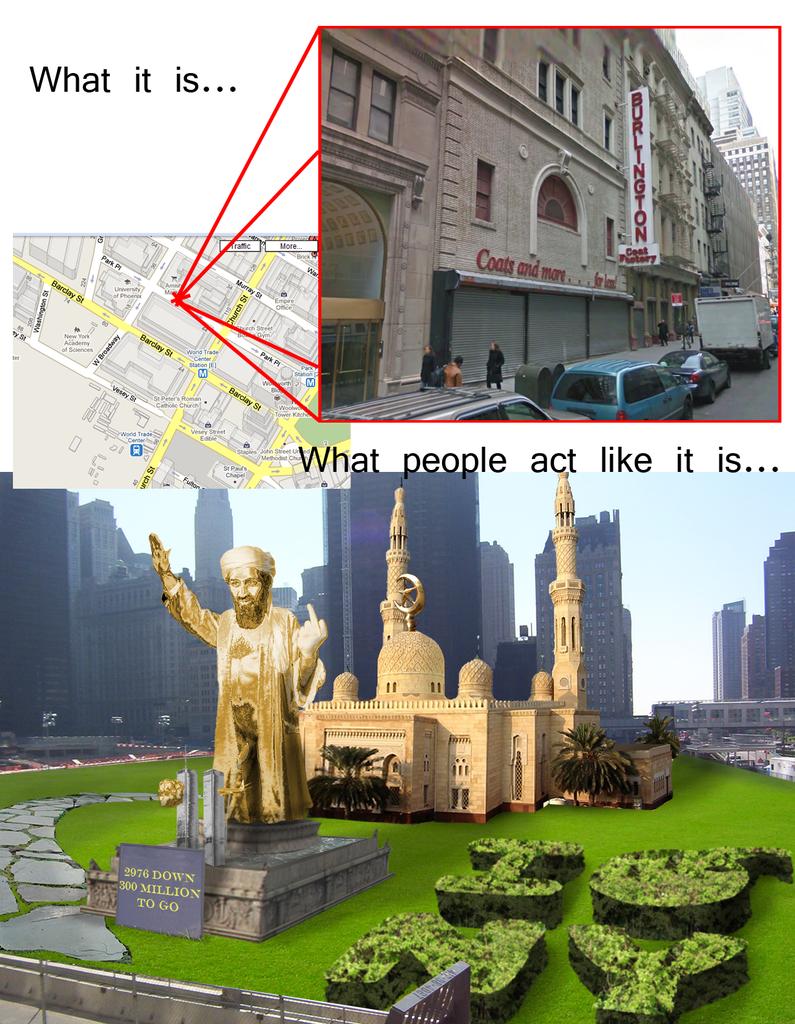
I can't remember the last time I agreed with something at National Review, but Josh Barro pulls together all the sensible points about the Ground Zero Mosque -- including one I hadn't thought about: In Manhattan, a 13-story building two blocks away is invisible (a point made even more graphically by this image). And then he explains the issue in terms conservatives ought to understand:

Part of supporting limited government is understanding that sometimes, things you don’t like will happen, and the government (especially the federal government) won’t do anything about it. Getting to do what you want comes at the price of other people getting to do what they want—including build mosques where you’d prefer they didn’t.

Canadian citizen Omar Khadr would have been a child if we'd tried him promptly. But after 8 years in Guantanamo we can try him as an adult.


In honor of the 90th anniversary of women's suffrage, Gail Collins tells the story of Harry Burn, a 24-year-old state legislator who casts the decisive vote for Tennessee to ratify the 19th amendment after getting a note from his Mom.


Yes, you can run a car on sewage. VW has a methane-powered prototype it calls the Bio Bug, but I prefer Discovery's name for it: the Dung Beetle.

Or, if you want to use human muscle rather than human waste, there's this muscle/electric hybrid. Four "rowers" can get it going 60 mph on their own, or you can tap the battery. Or look at it this way: If it runs out of juice, you can still row your way home.


Portugal gets 45% of its electricity from renewable sources. It's expensive, but it works.


The Conservapedia -- the right-wing response to that leftist Wikipedia -- says that Einstein's theory of relativity is "heavily promoted by liberals". But Conservapedia knows it must be false because it doesn't allow for action-at-a-distance, as witnessed by John 4:46-54.


The Onion reports an everyday environmental disaster: A crude oil tanker safely reaches port. "In a matter of days, this oil may be refined into a lighter substance that, when burned as fuel in vehicles, homes, and businesses, will poison the earth's atmosphere on a terrifying scale."

The Onion News Network holds a talking-heads debate on whether Biblical theories of Armageddon should be taught in addition to global warming. "What's so wrong," the anchor asks "with kids being exposed to both views of how they'll die?"

And Onion Sports Network discusses a football coach's decision to retire from his family to spend more time with the team. OSN reports that after 41 years of family life the coach "felt that he had nothing left to prove as a husband and father." The OSN expert then speculates on who will replace the coach as head of the household, with attention focusing on a neighbor, his wife's high school boyfriend, and another former football coach.


If you ask anybody, they'll tell you that government spending is way up under Obama, and the economy's continuing weakness is proof that government spending doesn't work as a stimulus.

Well, not exactly. Increased federal spending has mainly just compensated for decreased state and local spending. So net government spending isn't way up, and now that the federal stimulus (which included major aid to the states) is ending, the overall amount of government spending in the economy is set to go down.

Conservatives will describe those losing their government jobs as "bureaucrats", but most of them will be teachers, firemen, and police.

Paul Krugman makes the same point in a wonkier way.


The Weekly Sift appears every Monday afternoon. If you would like to receive it by email, write to WeeklySift at gmail.com.
 

Monday, August 9, 2010

Evolving Traditions

By marriage, the husband and wife are one person in law: that is, the very being or legal existence of the woman is suspended during the marriage, or at least is incorporated and consolidated into that of the husband. … The husband also (by the old law) might give his wife moderate correction. For, as he is to answer for her misbehavior, the law thought it reasonable to entrust him with this power of restraining her, by domestic chastisement, in the same moderation that a man is allowed to correct his servants or children.

-- Sir William Blackstone

Commentaries on the Laws of England (1769)

In this week's Sift:

  • Proposition 8 is Unconstitutional. The trial record may be as important as the ruling. If same-sex-marriage opponents think there's so much "evidence" supporting their position, why didn't they present any?
  • The Sift Bookshelf: The Living Constitution. An easy-to-read new book explains how interpretations of the Constitution legitimately change with time.
  • Ground Zero Mosque, Part II. "Opposing" the mosque can mean two very different things, but not many mosque opponents are making the distinction clear.
  • Short Notes. What Fox thinks of the 14th Amendment. China takes on bold new infrastructure projects, while we let things fall apart. Superman saves a home in the real world. A suggestion for protesting the Tea Party. Civil disobedience in Arizona. And where you can hear me next Sunday.


Proposition 8 is Unconstitutional

Every few months, it seems, the saga of same-sex marriage in California takes another twist or turn. Since the voters passed Proposition 22 ten years ago, there have been votes by the legislature, vetoes by the governor, civil disobedience by the City of San Francisco, a second referendum passing a constitutional amendment, and countless trips up and down the state court system.

By May, 2009, things had gone as far as they could at the state level: The voters had passed Proposition 8, which wrote one-man-one-woman into the state constitution, and the California Supreme Court had recognized its validity (while still upholding the 18,000 same-sex marriages performed prior to Prop 8).

At that point a liberal/conservative all-star team of lawyers decided to take the argument federal. Ted Olson and David Boies, who had been the opposing lawyers in Bush v. Gore, filed suit in federal court to have Prop 8 declared unconstitutional under the 14th Amendment, which guarantees "equal protection of the laws" and "due process of law" to everyone.

Wednesday they succeeded in their first step: Judge Vaughn Walker declared Prop 8 unconstitutional. (Judge Walker's ruling is long, but easy to read.)

As I explained last month after the Defense of Marriage Act was declared unconstitutional, just about all same-sex-marriage decisions hang on the same question: Laws that treat one group of people differently from another have to pass the rational basis test, which asks whether the law is "rationally related to furthering a legitimate government interest". Can a law banning same-sex marriage pass that test? What legitimate government interest is furthered by treating same-sex couples differently from opposite-sex couples?

This is why court decisions often come out differently than referenda: Voters don't have to answer that question. As Judge Walker put it:

The state does not have an interest in enforcing private moral or religious beliefs without an accompanying secular purpose.

The secular logic of Prop 8 hangs on some real-world questions about the institution of marriage, its effects on children, the nature of homosexuality, and so on. So Judge Walker held a trial to gather testimony on those issues.

Evidence-based knowledge vs. faith-based knowledge. Boies and Olson called a series of expert witnesses: historians to describe the long-term evolution in American marriage laws (allowing wives to own property, allowing interracial marriage, etc.) and the history of discrimination against homosexuals; demographers to compare same-sex couples to opposite-sex couples (they're not that different); economists to assess the impact of Prop 8 on the City of San Francisco (negative) and on same-sex couples and their children (also negative); social scientists to assess the affects of social stigma on gays and lesbians (bad), the impact of seven years of same-sex marriage on family issues in Massachusetts (negligible), and how children raised by same-sex couples compare to those raised by opposite-sex couples (not much difference); psychologists to discuss whether therapy can change a person's sexual orientation (it can't) and whether same-sex couples receive the same psychological benefits from marriage as opposite-sex couples (they do), and so on.

In other words, every question a reasonable person would ask about the impact of Prop 8 was answered by a professor of some relevant subject with peer-reviewed publications in the field, who cited actual research on the topic.

The defenders of Prop 8 did nothing of the kind. (The name of the case is Perry v. Schwarzenegger, but although California officials like Gov. Schwarzenegger and Attorney General Brown were named in the suit, they wanted no part of defending Prop 8. So the job passed to the people who got Prop 8 on the ballot in the first place.) They announced a number of expert witnesses, but only called two of them to the stand -- neither of whom was actually in expert in what he was testifying about, and one of whom, David Blankenhorn, doesn't seem to be an expert in much of anything. (This section of Judge Walker's opinion is a good primer on the legal definition of expert witness.) Rachel Maddow spent an entire segment of her show Wednesday making fun of Blankenhorn's "expertise".

WaPo's Jonathan Capehart commented:

if I were the conservatives I would troop back into court -- and sue the pro-Prop 8 attorneys for malpractice.

Here's an example from Judge Walker's decison:

At oral argument on proponents’ motion for summary judgment, the court posed to proponents’ counsel the assumption that “the state’s interest in marriage is procreative” and inquired how permitting same-sex marriage impairs or adversely affects that interest. Counsel replied that the inquiry was “not the legally relevant question,” but when pressed for an answer, counsel replied: “Your honor, my answer is: I don’t know. I don’t know.”

The impression the trial leaves -- and this may have political implications even if the ruling is overturned by the Supreme Court -- is that the logic of banning same-sex marriage is all 30-second sound bites and won't stand up to scrutiny. The Religious Right may claim that there is massive evidence ( James Dobson has claimed "more than ten thousand studies") relating same-sex marriage to dire outcomes for society, but when they had a chance to present their evidence in court, they folded.

As David Boies said on Face the Nation (in response to Tony Perkins of the Family Research Council):

It's easy to sit around and ... cite studies that either don't exist or don't say what you say they do. … But when they come into court and they have to support those opinions and they have to defend those opinions under oath and cross-examination, those opinions just melt away. And that's what happened here. There simply wasn't any evidence, there weren't any of those studies. There weren't any empirical studies. That's just made up. That's junk science. It's easy to say that on television. But a witness stand is a lonely place to lie. And when you come into court you can't do that.

This case may affect the overall national discussion in the same way that the Dover intelligent design case did. After a court show-down in which one side has no real evidence to present, it's hard for the media to go back to he-said-she-said coverage.

Marriage evolution. Testimony from the historians dismantled another standard talking point: That marriage has been one thing for thousands of years and now gay activists want to change it to something else.

To the extent that the phrase traditional marriage means anything at all, it refers to the kind of relationship this week's Sift quote describes: domination of the wife by the husband. Through all of American history marriage has been slowly evolving away from that: allowing wives to own property; letting them sign contracts and accept employment without their husbands' approval; protecting against domestic violence; recognizing marital rape; and so on.

As a result of that evolution, marriage laws no longer enforce separate gender roles. So the gender-specific titles of husband and wife no longer correspond to any legal rights or responsibilities not included in spouse.

Without that evolution -- in the 18th-century world of Blackstone's Commentaries -- Prop 8 proponents would be right: Same-sex marriage makes no sense if the law requires a dominant male husband and a submissive female wife; two men or two women can't do it.

But in marriage as it stands today (and how many people would really want to go back?) two men or two women can fulfill the legal roles of spouses as well as opposite-sex couples do. Laws that prevent them from doing so are relics of a system whose underlying logic was abandoned decades ago.

Impact. Ultimately this is headed for the Supreme Court, where (as Dahlia Lithwick explains) the case will be decided by Justice Kennedy, the Court's swing vote.

If the Supreme Court reverses Judge Walker, the impact of would not be as great as some people seem to think. It would be harder for a future Supreme Court to find protection for same-sex marriage in the 14th amendment, but state legislatures could still recognize same-sex marriage and state courts could still find a same-sex couple's right to marry in their state constitutions.


Rather than take on the evidence, most "family values" spokesmen attacked the judge: He's gay. And all those professors of whatever who testified? They're gay too. What more do you need to know?


While Boies does CBS, Olson is handling Fox.


Stephen Colbert sees Judge Walker's decision as "Arma-gay-ddon".


Humorist Andy Borowitz explains why most marriages are already gay:

"Soon after marrying, most men stop hitting on women and start shopping for furniture," Dr. Logsdon said. "Scientifically speaking, how gay is that?"


I'm coming to like NYT's conservative columnist Ross Douthat even though I seldom agree with him. He consistently offers something genuine to disagree about, and doesn't just spout nonsense and make stuff up.


The Sift Bookshelf: The Living Constitution

The Living Constitution by David Strauss is the best popularization of constitutional law I have read. It is short (139 pages of 300-350 words each), readable, and well organized. Best of all, it does something important: debunks the theory of constitutional interpretation that you most commonly run across in the media (originalism) and provides an alternative that makes sense out of what the courts have been doing for the last 200-or-so years.

Let's start with originalism. This theory says that the Founders had a definite idea in mind when they wrote each line of the Constitution, and that the role of a judge is to ascertain that idea and apply it to the case at hand. There are two problems with originalism: (1) it's impossible to carry out; and (2) it violates Thomas Jefferson's principle that the dead should not rule the living. (De-sound-biting that a little: The democratic principle of "the consent of the governed" doesn't mean much if the consent was given once and for all in 1787.)

Strauss brings home the impossibility of knowing the Founders' original intent by recalling what Americans went through in the 1970s around the Equal Rights Amendment. (The ERA was passed by Congress in 1972, but fell just short of ratification by 3/4 of the states, so it is not part of the Constitution now.)

If the ERA had passed, originalism would have future judges try to ascertain and apply what the people alive in the 1970s had "intended" by it. That's laughable to anybody who lived through the 1970s, because to a very large extent we didn't know. (I remember hearing long arguments about whether the ERA would force all bathrooms to be unisex.) Different people intended different things, and we couldn't agree on what the ERA would mean even for the situations we could envision, much less situations that might arise in 200 years.

I know the founding generation was supposed to be full of giants, but were they really that much more self-aware than the Americans of 1972?

So, if we admit we can't always find a well-defined meaning by recreating the mindset of 1787, how are we supposed follow the Constitution? Well, some things are obvious, like a president's term lasting four years or senators needing to be 30 years old. But how "freedom of the press" applies to the Internet, or exactly what constitutes "abridging the freedom of speech" -- now or in 1787 -- requires some interpreting. How do we do it?

The defenders of originalism say that the only alternative is anarchy; the law will be whatever the current judge wants it to be, until he's overruled by some other judge.

Strauss describes the alternative method of common law, a pre-constitutional process we inherit from England. Under common law, a judge considers how similar cases have been decided in the past. And if there's still wiggle room, s/he resolves it by applying more abstract principles of justice, fairness, and common sense to the facts of the case at hand. For centuries, common law provided a workable legal system even in situations where there was no written law.

Strauss claims that this is in fact what our courts have been doing for the last two centuries: applying the text of the Constitution when it is clear (four-year presidential terms), consulting precedents to interpret provisions that are not clear (abridging freedom of speech), and attempting to resolve the remaining uncertainties with justice, fairness, and common sense.

A written constitution combined with a common-law method of interpretation produces a "living constitution" -- one whose meaning evolves from generation to generation.

Strauss' examples are the best part of the book. He devotes a chapter to Brown v. Board of Education, the 1954 Supreme Court decision that desegregated public schools. Half a century later, everybody likes the Brown decision. But it clearly violated originalism: Hardly anybody who voted for the 14th Amendment in 1868 thought they were voting for desegregation.

On the surface, Brown also violates common law, because it reverses a precedent rather than following it. The key precedent in this case isPlessy v. Ferguson, an 1896 decision saying that the 14th Amendment's promise of "the equal protection protection of the laws" can be satisfied by facilities that are "separate but equal".

Looking deeper, though, Strauss shows that the 1954 Court was not just saying "Our moral values are better than the 1896 Court's moral values." He goes through a series of cases between 1896 and 1954 in which the Court tried to make separate-but-equal work. In case after case, it decided that the specific separate arrangements at hand (mostly concerning segregated law schools) were not equal. If you collected all those precedents, it became hard to imagine how to design racially separate facilities that the Court would consider equal.

So when the 1954 Court says that racially separate schools can't be equal, it isn't pulling that conclusion out of its own sensitive conscience. Instead, it's amalgamating the conclusions of many specific cases decided since 1896, and coming up with an interpretive scheme that retroactively explains those decisions better than separate-but-equal did.

That's how the common-law method works: You stick with an interpretation until the exceptions start to overwhelm the rule, and then you come up with a new interpretation that handles the exceptions better. It's flexible enough to evolve through accumulated experience, but it's not open to individual whim.


Ground Zero Mosque, Part II

Since I first wrote about the Ground Zero Mosque two weeks ago, more people and organizations have come out against it -- bigots and right-wing extremists, of course, but also people who should know better like the Anti-Defamation LeagueJohn McCain, and the Wiesenthal Center.

Their statements all fudge an important issue: When you say you're "against" the mosque, do you mean "I wish the people building it would reconsider" or do you mean "I want the government to stop them"? The first expresses sympathy for the people who feel insulted by the mosque; the second attacks religious freedom in America and sides with anti-Muslim bigots.

It's important to be clear about this. Whenever a minority tries to exercise its rights, it's going to be unpopular. In such a climate, announcing that you oppose their efforts is going to encourage bigotry, even if you claim that's not your intention and even if you word your statement carefully. The headlines you generate are more important than your precise phrasing. The ADL should know that from its own experience battling anti-Semitism. (Some other Jewish groups have supported the mosque project.)


In response to the ADL's statement, CNN's Fareed Zakaria returned an award and honorarium the ADL gave him five years ago.


The poll showing that New Yorkers oppose the mosque fudges the same issue. The question asked was:

Do you support or oppose the proposal to build the Cordoba House, a 15 story Muslim Cultural Center in lower Manhattan 2 blocks from the site of the World Trade Center?

I wonder if you could get the opposite result ("New Yorkers Support Mosque") by asking Mayor Bloomberg's question:

Should government attempt to deny private citizens the right to build a house of worship on private property based on their particular religion?


Short Notes

It's striking how much of this Sift revolves around the 14th Amendment, or, as Fox & Friends calls it, "the anchor baby amendment."


Here's one way in which China has already replaced the United States as the leader of the world. A few decades ago, if you saw plans for some crazily futuristic public-works project, you knew it had to be in America. Now it has to be in China.

Check this out: Train-car-sized buses that use the same right-of-way as ordinary highways, but they sit up so high that cars drive under them. They're like rolling overpasses. More artist-conception pictures here. Construction in Beijing is supposed to start later this year.

Meanwhile, our cities are turning off streetlights and breaking up roads because we're not willing to pay taxes to maintain them.


In the real world, a family home facing foreclosure is not usually considered a job for Superman. Except this one time. A previously unexamined stack of old magazines in the basement turned out to include a copy of Superman's debut comic, Action #1. It's expected to bring $250,000 at auction.


Jesus' General is normally a satirist, but he seems serious about this suggestion: Go to a September 12 Tea Party rally and burn a Confederate flag in protest.


The parts of Arizona's immigration law that were not thrown out by the courts went into effect July 29. Resistance to the law has also begun.


If you happen to be near Bedford, Massachusetts around 10 a.m. next Sunday morning, come listen to me preach on "Spirituality and the Humanist" at First Parish Church.


The Weekly Sift appears every Monday afternoon. If you would like to receive it by email, write to WeeklySift at gmail.com.
Monday, August 2, 2010

Severed from the People

The press-politics system that produces this kind of news is so inward-looking that it threatens to sever the government from the people.

-- Lance Bennett, Regina Lawrence, and Steven Livingston, When the Press Fails

In this week's Sift:

  • Why WikiLeaks Isn't Ending the War. A theory from a three-year-old book explains why the WikiLeaks story is more like the Downing Street Memo than the Pentagon Papers.
  • The End of (Military) History? Andrew Bacevich claims: "The Western way of war has run its course." How close is he to being right?
  • The Oil Spill. The worst didn't happen: The well is capped and the surface slick has mostly dissipated. Now the media pendulum may swing too far in the other direction and tell us the spill was never a big deal.
  • Race, Class, and Jim Webb. Senator Webb's article "Diversity and the Myth of White Privilege" is not nearly as bad as its headline.
  • Corporations 3, Humans 0. The impact of the Supreme Court's Citizens United decision isn't just theoretical any more. Corporate power may be reaching a tipping point.
  • Short Notes The NH primary would be a granite stumbling block for a Palin candidacy. Reagan's budget director won't drink the tax-cut kool-aid. Glenn Beck's golden fleece.


Why WikiLeaks Isn't Ending the War

This week's mystery was something that didn't happen: Why didn't WikiLeaks' release of 91,000 U.S. military documents about the war in Afghanistan (75,000 available to the public so far) start a firestorm that forces a major change in the conduct of that war, or maybe even a withdrawal?

The leak hit public awareness a week ago Sunday, with simultaneous articles in the New York Times, the London newspaper The Guardian, and Germany's Der Spiegel, the three outlets WikiLeaks had given an advance look.

Wednesday, the House passed another Afghan war appropriation as if nothing had happened. By yesterday, Frank Rich was reassuring us that the Pentagon Papers hadn't ended the Vietnam War singlehandedly either. He offered this weak consolation:

What Ellsberg’s leak did do was ratify the downward trend-line of the war’s narrative. The WikiLeaks legacy may echo that.

By this morning, the WikiLeaks story had all but vanished. The front page of the Times' web site still had a link to a Sunday news story about Defense Secretary Gates' claim that the leak damaged national security, but nothing about undermining support for the war. Even the liberal blog TPM wasn't talking about it.

So what's up with that?

By fortuitous coincidence, my Journalism Reading Project had uncovered a book that explained it: When the Press Fails by Bennet, Lawrence, and Livingston. It came out in 2007 and examined coverage of the Bush administration, from the Iraq build-up to Abu Ghraib to Hurricane Katrina. The mystery the authors were trying to solve is why

a press system dedicated to telling "both sides of the story" so often reported only one.

In the pre-war debate about Iraq we often heard only the administration's side, even when its message was false. Abu Ghraib started out to be a this-changes-everything story, but before long the administration got control of it -- changing the media's terminology from torture to abuse and focusing on "a few bad apples" of low rank rather than the guilt at the top.

How did that happen, given that journalists themselves are likely to be liberals? The authors did a lot of quantitative analysis about the trajectory of major stories, and came up with this theory [italics theirs]:

what carries a story is not necessarily its truth or importance, but whether it is driven by dominant officials within institutional decision-making arenas such as executive policy circles, or legislative or judicial processes.

In other words, the press isn't covering the issue, it's covering the government's decision-making process about the issue. If something important is revealed, the mainstream press will cover it -- once, for the sake of the public record. But to keep a story on the front pages, some important player in the government -- somebody powerful enough to change things -- has to pick up the ball and run with it. So if Congress holds hearings, or if the courts get involved, or if there is a rift between factions in the administration, the press will cover it.

But if no official does anything, the story dies. No matter how important it is.

Right now, no powerful force is bucking the administration's Afghanistan policy. Republicans are generally pro-war and Democrats are mostly pro-Obama. There's an anti-war faction among Congressional Democrats (102 House Dems voted against the most recent appropriation), but they don't control anything big enough to make news. So far, there doesn't seem to be anything in the leaks that someone could take to court and hope to win.

So there it stands: The information is in the public record for those who really want to know, but it won't be news again until somebody with power uses it to take action. If they ever do.


The best parallel here isn't the Pentagon Papers, it's the Downing Street Memo. Leaked in 2005, it proved that the Bush administration was set from Day One on an Iraq invasion and manipulated the public to support one.

It was dynamite, and it got covered -- sort of. But Republicans held firm and the Democrats in Congress weren't ready to make a big push to end the war. So the memo became part of the public record, but never part of a why-the-war-must-end narrative that competed seriously with the administration's narrative.

When the Press Fails uses the terminology of frames, and puts it this way:

a productive frame contest exists in the news only when information independent of an administration is put on a par with information obtained from that administration, and when the media present a coherent counterperspective, not just bits and pieces of alternative perspectives.

That's exactly what the mainstream media doesn't believe it should be doing: starting a "frame contest" with the administration. They'll throw the facts out there, but not pull them together into an alternative point of view and push it. That would be a role for a propagandist, not an "objective" journalist.


Unfortunately, When the Press Fails lacks perspective on a Democratic administration. The main thing to observe about coverage of Obama is that the conservative flagships -- Fox News and the Washington Times -- don't play by the mainstream media rules. They have no scruple about keeping a story going on their own (see the New Black Panther Party story) or presenting a counterframe that isn't supported by any powerful institution.


The End of (Military) History?

Andrew Bacevich (bio) posted a challenging article this week, The End of (Military) History? announcing that "the Western way of war has run its course."

Like the book he takes his title from (Francis Fukuyama's The End of History), Bacevich is overstating things, but he does have a case: Recent wars demonstrate the huge gap between what most Americans think war is supposed to accomplish and what it can actually do for us.

For most of human history, war was good business if you were good at it. You could sack other capitals and bring their treasures back home. You could ransom prisoners, sell conquered subjects into slavery, impose taxes on foreign cities, and so on. The Caesars built Rome on the profits of war.

That model started sputtering in the American Civil War and failed completely in World War I, which bankrupted even the winners. Why? Industrialization and modern communications made it possible to turn an entire population into a war machine. That was so expensive and so mutually destructive that the economics no longer made sense: If you won, you could claim a larger piece of the pie, but the pie had shrunk so much and cost so much to win that it wasn't worth it.

Plus, modern wealth isn't sackable. You can carry gold and slaves back home with you, but not an electrical grid or an educated work force. By some measures, South Korea has the world's best internet system. But if Kim Jong-il conquered the South, all he could do is destroy that system. He couldn't sack it and bring it home.

But even if they didn't profit, winners still got to impose their will. America no longer has slavery because the North won the Civil War. Germany is democratic and France is not fascist (rather than the reverse) because the Allies won World War II.

But even that justification has been failing in most wars since Vietnam. We (and the Israelis, who are Bacevich's second example) keep winning on the battlefield, but failing to impose our will. (Afghanistan is Exhibit A.) Military history is almost certainly not over, but we need to take a hard look at what's going on, and lower our unreasonable expectations.

Here's what I think war can do today:

  • Prevent somebody else from gaining an advantage by force. That's the lesson of the First Gulf War: Saddam conquered Kuwait, we threw him out, and Kuwait more-or-less went back to normal.
  • Destroy things that need destroying. Israel's air raid on Saddam's nuclear reactor, for example. If Saddam had really had WMDs in 2003, and if our goal in invading Iraq had been to destroy them and leave, it could have worked.
  • Free prisoners or capture (or kill) people you want to bring to justice. We haven't been able to pull off a capture of Bin Laden, for example, but at least that is within the realm of military possibility.
  • Finally, If you're willing to go that far, genocide and ethnic cleansing still work. You can kill everybody, or drive out an indigenous population and repopulate the land with your own people. (That's how ethnically European people like me came to be Americans in the first place.)

I think that's a complete list. If what you want to do isn't on it, or if you can't get what you want by threatening one of those things, then you can't do it with military force.

Where we've gotten in trouble, I believe, is that certain ways of imposing your will depend on the ultimate threat of genocide, which we are not willing to do. It's like in the movies, where everyone has to do what you say because you've got the gun. In practice, it doesn't work that way unless people believe you're willing to kill them -- and not even then, if they're willing to die.

I think a lot of Americans still have that movie-gun expectation: We've got tanks in the streets and bombers in the air, so everyone has to do what we say. When they don't, we have no next step.

Assuming (as I do) that genocide and ethnic cleansing are going to stay off our list of options, war is not that useful to us any more, except to deter other nations from going to war. There are a few additional situations where a raid might accomplish something worthwhile, but that's about it.

That capability cost us $782 billion in fiscal 2009.


The Oil Spill

This week's other surprise was that the BP oil spill is dissipating faster than most people expected. (Some sources are saying faster than anybody expected, but back in May this guy was predicting exactly what's happening now. I wasn't convinced, but I linked you to him in June because he looked honest and plausible.)

Naturally, the media pendulum is swinging back too far in the other direction: The oil spill is no big deal, Nature takes care of these things on its own, environmentalists tried to scare everybody about nothing, and so on.

Let's get our bearings. One of the worst possibilities isn't happening: A big oil slick won't cover the surface for years to come, cutting off oxygen and turning some large chunk of the Gulf of Mexico into a dead zone before spilling out into the Atlantic. Religious people should thank God and everyone else should be feeling some unfocused gratitude. It could have been a lot worse.

But that doesn't mean everything is fine now. The slick has broken up into smaller particles, many of which have sunk to lower levels. But the oil is not gone, and neither is the chemical dispersant BP used in unprecedented quantities. Grist's Brad Johnson explains.


Stephen Colbert knows what has happened to the oil. Noting that since the BP well has been capped, spills have appeared in Michigan and Louisiana, Colbert concludes: "The oil has achieved whack-a-mole technology."


Race, Class, and Jim Webb

Democratic Senator Jim Webb of Virginia walked into a mine field by writing a column in the Wall Street Journal about race. It came at either a good or a bad time, depending on your point of view. For months, Fox News and the rest of the right-wing media had been banging the drum about racism against whites, trumping up a series of baseless stories that culminated in the Shirley Sherrod fiasco.

Finally the Right had gone too far, and voices from the Left weren't going to let them get away with it this time. Last week I pointed you to Rachel Maddow's connect-the-dots reporting about Fox News attempt to stir fear that "black people are coming for you." This week Joan Walsh picked up that message, naming it "the 50-state Southern Strategy" after Richard Nixon's successful effort to turn white resentment into votes in the South.

So it was disheartening when, three days after the Sherrod resignation, Webb's column appeared in the WSJ under the headline "Diversity and the Myth of White Privilege". I like Webb, so I offer this excuse for him: The term white privilege doesn't appear in his article, and I know from experience that editors (not writers) compose headlines. So Webb's headline may have surprised him as much as anybody.

The left side of the blogosphere struck back hard. David Sirota (who has been a Webb fan in the past) wrote a column inducting him (and NYT columnist Ross Douhat, who made a similar point)  into "The Cult of White Victimhood". Author Tim Wise pulled Webb's article apart line-by-line in an article that drew 435 comments -- with few Webb defenders -- at Daily Kos.

Webb, though, is arguing something a little more nuanced than "black people are coming for you". A major theme of Webb's political career is class. In his book A Time to Fight he says:

Contrary to the bellicosity of the right-wing talk-show mavens, it is not class warfare or envy to point out that economic inequalities persist in our society. In fact, the reverse is true: It is class warfare from the top down to pretend that such inequalities don't matter.

In the context of his career and its message, I don't think Webb is saying that white privilege is a myth. I think he's pointing out that White America has class divisions. And whenever there is a price to pay for racial justice, upper-class whites make sure that lower-class whites pay it. (This is one theme of Anthony Lukas' Pulizer-winning book Common Ground about the desegregation of Boston public schools. Upper-class whites sent their children to private schools or moved to upscale suburbs unaffected by desegregation, leaving lower-class whites and blacks to hash out the problems.)

When Yale decides to admit fewer whites, the George W. Bushes don't lose their place. Douhat references a study of admissions at elite colleges:

For minority applicants, the lower a family’s socioeconomic position, the more likely the student was to be admitted. For whites, though, it was the reverse. An upper-middle-class white applicant was three times more likely to be admitted than a lower-class white with similar qualifications.

This is a double-win for the white upper class: Not only do they avoid losing any of their own privileges, they turn lower-class whites and blacks against each other.

Webb wants to focus affirmative action programs more narrowly on the descendants of the victims of slavery and Jim Crow, rather than on everyone who isn't white. And he hints that upper-class blacks don't need help either. Presumably this would lessen the impact of affirmative action on lower-class whites.

I haven't thought enough about that proposal to comment on it. (I'd rather see a direct assault on upper-class white privilege, with less lower-class collateral damage, but that may be politically impossible.) But I do think that Webb and Douhat are expressing part of the racial conversation we need to be having. While rejecting the outright propaganda Fox has been giving us, I think race is an issue where we need a little less purity-of-message and more listening to all honest opinions.


Corporations 3, Humans 0

In January, when the Supreme Court granted new first amendment rights to corporations, pro-human activists comforted themselves with two thoughts. The first said that corporations wouldn't do much with their new rights, and the second said that it wouldn't matter as long as we had good disclosure laws, so that people knew whose propaganda they were listening to.

Bad news on both counts: First, coal companies are going to use their newly granted rights to campaign for Kentucky Republicans in this year's House and Senate races. Mine safety advocate Tony Oppegard says:

Between them, ICG and Massey have had 41 miners killed in just two disasters. It’s disturbing to see companies that don’t have strong safety records try to defeat politicians, like Ben Chandler, who have fought for stronger mine safety.

Second, a Republican filibuster in the Senate has blocked the DISCLOSE act, a bill to force corporations to identify themselves in political ads they buy.

Summing up: Through their Republican Party subsidiary, corporations already wield enough political power to insure that they can anonymously spend vast sums to acquire more political power. As Kent Brockman once famously announced, "I, for one, welcome our new insect overlords."


Short Notes

It's always satisfying when the hard data backs up your intuition: If Sarah Palin runs for president, she'll have a problem here in the New Hampshire primary. A new poll of NH Republicans says Palin runs fifth with 9% of the vote.


David Stockman was Ronald Reagan's budget director and ought to know a thing or two about conservative economics. In yesterday's NYT, he wrote a stunning indictment of current Republican economic proposals -- particularly extending Bush's tax cuts for the wealthy beyond their original expiration date:

Republicans used to believe that prosperity depended upon the regular balancing of accounts — in government, in international trade, on the ledgers of central banks and in the financial affairs of private households and businesses, too. But the new catechism, as practiced by Republican policymakers for decades now, has amounted to little more than money printing and deficit finance — vulgar Keynesianism robed in the ideological vestments of the prosperous classes.


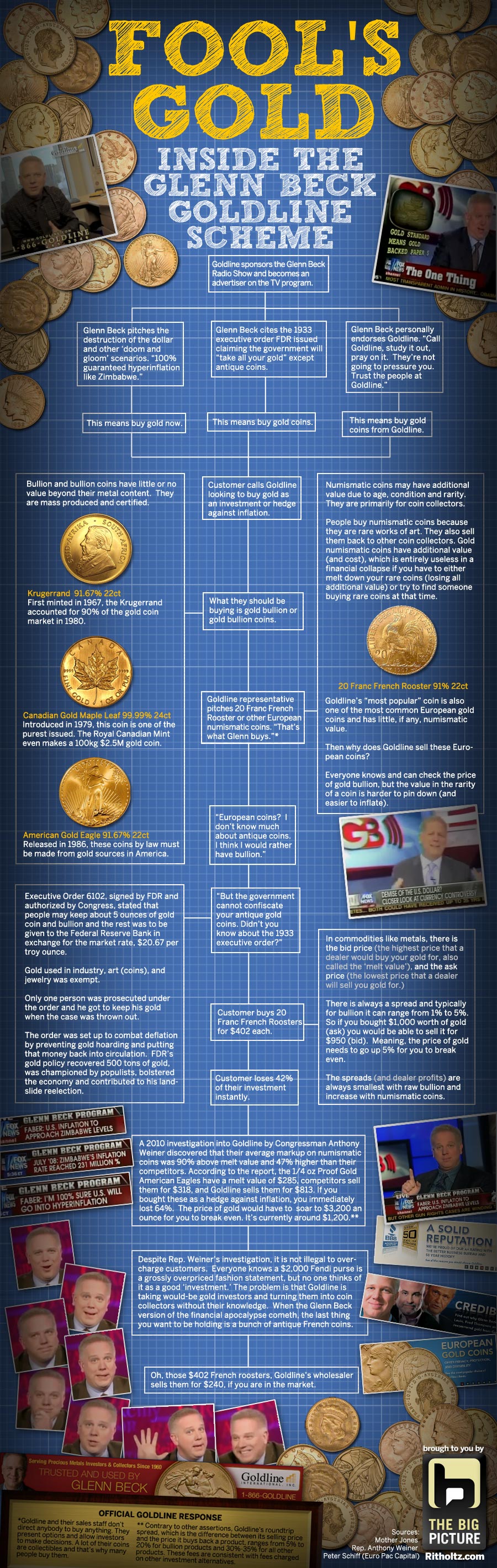
A graphic explanation of how Glenn Beck is helping a sponsor fleece his listeners. Short version: Get them worried that the currency is going to collapse, invent a conspiracy theory about how the government is going to confiscate gold bullion, and then personally vouch for a company that will sell them gold coins at a huge mark-up.