Monday, May 8, 2017

If Only

Nobody dies because they don't have access to health care.

- Rep. Raul Labrador (R-Idaho)

This week's featured posts are "Climate of Propaganda" and "Much Ado About Religious Liberty".

This week everybody was talking about the French election

The centrist globalist, Emmanuel Macron, won a decisive victory over neo-fascist Marine Le Pen. Following up the Dutch election in March, where a similar neo-fascist did much worse than expected, I wonder if Josh Marshall is right: "Perhaps Trump victory saved Europe." I don't think other countries look at our right-wing populist leader and say, "We should have one of those here."

As they did in the U.S., Russian intelligence operatives favored the right-wing candidate by various means, including promoting fake news stories and hacking the Macron campaign's computers.

and ObamaCare repeal

To my great surprise, House Republicans passed a bill, 217-213, with all Democrats voting no. It looks like a very bad bill, which is probably why they passed it before the Congressional Budget Office had a chance to analyze it. That analysis will probably come out next week, and then we'll know just how many millions of people have to lose their insurance so that the rich can get another tax cut.

Trump and the House Republicans staged a celebration in the Rose Garden, as if something major had already been achieved just by moving the bill on to the Senate. (Did you ever see so many aging white guys in suits? If you study the photo really hard, you can find a woman on the lower right. I haven't spotted any non-whites.)

What mainly seems to have been accomplished, though, is shifting the blame in case of failure: Conservative House Republicans can go back to their districts and say "We fulfilled our promise to repeal ObamaCare. It's not our fault the Senate killed it." Republicans from moderate districts, though, are left holding the bag: They're responsible for the bill they voted for, whether it becomes law or not.

That's why The Cook Political Report immediately shifted its projection on 20 congressional races, judging that conditions in all of them have gotten more favorable for Democrats.

Republicans' 217-213 passage of the American Health Care Act on Thursday guarantees Democrats will have at least one major on-the-record vote to exploit in the next elections. Although it's the first of potentially many explosive votes, House Republicans' willingness to spend political capital on a proposal that garnered the support of just 17 percent of the public in a March Quinnipiac poll is consistent with past scenarios that have generated a midterm wave.

... Of the 23 Republicans sitting in districts won by Hillary Clinton in 2016, 14 voted for the repeal and replace measure. ... [S]everal of the 20 Republicans who voted against AHCA could end up being blamed anyway, much as 17 of the 30 Democrats who took a pass on the ACA and then ran for reelection ended up losing in 2010. For others, tough votes could make the prospect of retirement more appealing.

Emphasizing the point a little: The bill passed the House because Republican "moderates" caved to the Freedom Caucus, as they so often do. The number who caved were exactly as many as were needed to pass the bill, plus one. More might have surrendered their principles had their votes been necessary.

Remember this whenever you're tempted to vote for your local Republican candidates because (individually) they sound like reasonable people. Maybe they are, but that doesn't mean they have the courage to stand up to their party's majority, which is not at all reasonable.


Indications are that Senate Republicans will want to do something different. I wouldn't be surprised if they also passed something that repealed ObamaCare, even if it is very different from what the House passed. And that's when things start to get real: Can the House and Senate compromise on a bill that they can both pass?

I remain skeptical. From a certain point of view, having two irreconcilable bills is the best possible solution: Nothing actually changes, so no victims will haunt Republican candidates in 2018. And each house can say that it did its job, while the other one was unreasonable.


Here are 50 organizations opposing TrumpCare: AARP, AMA, the Catholic Health Association of the United States, and 47 others.

and Trump's empty "religious liberty" executive order

I covered this in one of the featured posts.

but it's worth considering whether ObamaCare saves lives

The quote at the top of the page raises an interesting issue. Do Americans die for lack of health insurance, or did they prior to ObamaCare?

Anecdotally, the answer is clearly Yes. It's not hard at all to find accounts by people who believe their dead loved ones could have been saved by better insurance, or people saying "ObamaCare saved my life."

In a common-sense discussion, the answer is also clearly Yes. Republicans will tell you about emergency rooms, and how nobody who needs emergency help is turned away. And that's true, as far as it goes. But life-saving health care is more than just emergency care. Where you'd expect to see universal health insurance save lives is by identifying common chronic problems like high blood pressure, ones that don't have the kind of obvious symptoms that would motivate you to go to an ER. If you're getting regular check-ups, your doctor spots that stuff early and gets it under control. Years later, you don't have a stroke.

Statistically, the question is trickier. A lot of pre-ObamaCare statistics indicated that Americans suffered from a lack of health care. MinnPost wrote in 2012:

The United States has a higher rate of “amenable deaths” — deaths that could have been avoided if individuals had received timely and effective medical care — than France, Germany or the U.K, according to a new study published online Wednesday in the journal Health Affairs.

The study also found that most of the Americans who are dying as a result of this higher rate are under the age of 65. In other words, people who are not eligible for Medicare. In France, Germany, and the U.K., affordable, universal health-care coverage is available to everybody, regardless of age.

More recently, a study looked at the effect of RomneyCare in Massachusetts and concluded that covering 830 more people results in one less death each year. These kinds of stats are responsible for most of the articles about the tens of thousands of people who will die from TrumpCare.

However, RomneyCare expanded private insurance coverage, and most of ObamaCare's effect comes from expanding Medicaid, so that they're not precisely comparable. And an experiment in Oregon on expanding Medicaid didn't show a major effect. It concluded:

This randomized, controlled study showed that Medicaid coverage generated no significant improvements in measured physical health outcomes in the first 2 years, but it did increase use of health care services, raise rates of diabetes detection and management, lower rates of depression, and reduce financial strain.

Possibly a longer-term experiment would show a life-saving effect, but that's more guesswork than science.

So: Pre-ObamaCare America had lots and lots of unnecessary deaths, so the people who say it was "the best healthcare system in the world" are full of it. It's not scientifically provable that ObamaCare is fixing that problem, but repealing it and throwing millions of people out of the health insurance system won't fix it either.

In short, there's room to criticize ObamaCare. But doing so still leaves you with a question: How do we get American health care up to the level of, say, France?

and you may also be interested in

The Russia investigation is still perking along. James Comey testified again, and Sally Yates testifies today. (Comey's explanation of why it was appropriate to discuss the Clinton investigation right before the election but not the Trump investigation still doesn't satisfy me. Nate Silver concludes that his decision probably swayed the election.)

At times it may look like nothing is happening, but we gray-haired folks recall that Watergate was like this too. The mills grind slowly. The Watergate break-in happened in July of 1972, and Nixon resigned in August of 1974.


The Wikipedia people are getting into daily journalism. It will be based on subscriptions rather than ads.

Josh Marshall wasn't intending to talk about WikiTribune, but his comments are relevant: Because the costs of digital publishing are so low, there will always be a glut of online news outlets chasing a finite pool of ad dollars. The golden age of American journalism worked because one or two newspapers in each major city monopolized the local ad market. That model isn't coming back.


Another model that doesn't work any more: the regional shopping mall. I'm trying to guess when the next recession will start and why, because we're getting close to the normal life span of an economic expansion (6-8 years, usually). A collapse of retail jobs could be the spark.


New Orleans is still arguing about whether to remove some of its Confederate statues. I don't mind so much the ones in parks, but to me all the Confederate soldiers outside of city halls and court houses look like white sentinels warning blacks not to come here for justice or to register to vote. Also, I'd like to see statues of the Southerners whose Civil War experiences seem much more heroic to me: slaves who escaped to join the Union Army, and came back to free their fellow slaves. Where are their monuments?

The Atlantic points out an unsurprising coincidence:

A timeline of the genesis of the Confederate sites shows two notable spikes. One comes around the turn of the 20th century, just after Plessy v. Ferguson, and just as many Southern states were establishing repressive race laws. The second runs from the mid-1950s to the mid-1960s—the peak of the civil-rights movement. In other words, the erection of Confederate monuments has been a way to perform cultural resistance to black equality.

and let's close with an amusing image

Monday, May 1, 2017

100 Days of Stuff

Every report on [Trump's] 'flip-flopping' suffers by the implication that he had some sort of position in the first place. Nope. He said stuff.

- Jay Rosen

This week's featured post is "Why cutting rich people's taxes doesn't create jobs".

This week everybody was still talking about Trump's 100 Days

Matt Yglesias disputes the conventional wisdom that Trump's first hundred days have been a failure. It all depends on what you think he's trying to achieve. If he's trying to make a lot of money, he's doing very well.

It's certainly true that Paul Ryan’s speakership of the House is failing, arguable that Mitch McConnell’s tenure as majority leader of the Senate is failing, and indisputably true that the Koch brothers’ drive to infuse hardcore libertarian ideological zeal into the GOP is failing.

But Trump isn’t failing. He and his family appear to be making money hand over fist. It's a spectacle the likes of which we've never seen in the United States, and while it may end in disaster for the Trumps someday, for now it shows no real sign of failure.

He goes on to outline the ways Trump is known to be profiting from his presidency, right down to the $35,000 the Secret Service has spent renting golf carts from Trump's Mar-a-Lago club so that they can follow him around the golf course.
The Jay Rosen tweetstorm I pulled the opening quote from is a good summary of the problems the press has faced in these hundred days.
Forced to choose between inventing a language for a presidency without precedent and distorting the picture by relying on normal terms, newswriters have frequently chosen inaccuracy by means of a received language, even though they know there's nothing normal here.
So they've referred to a one-page memo as a "tax plan" for lack of anything else to call it. And they speculate about the success or failure of Trump's "foreign policy" when it's not clear he has any policies. To say that he faces a "steep learning curve" assumes that he is learning, or even trying to learn.
The Guardian's Lawrence Douglas expresses my view on Trump's first hundred days: The institutions of American democracy held up under the initial assault. That doesn't mean the danger is over, but it is a good time to take note of
  • our own accomplishments as protesters,
  • the independence of our judges,
  • the good work done by our embattled journalists,
  • and the commitment of government employees to the missions of their organizations rather than the whims of a flighty new president.
Finally, some credit must go to Trump himself.
In his sheer incompetence and inconstancy, Trump has emerged as our best bulwark against Trump. ... [His] very craving for adulation, the need to chalk up successes, the deep, even cynical, pragmatism also predicted that Trump would have no stomach for Bannon’s reign of terror. The banishing of Bannon from the innermost precincts of power can only be viewed as a good.

Along those same lines, I recently devoted a couple hours to watching Leni Riefenstahl's classic of Nazi propaganda, The Triumph of the Will, which was released in 1935, near the beginning of the Nazi regime. One of the things I learned is that Hitler was much better at this kind of thing than Trump has been. Hitler channeled the German people's pride, and reflected it back to them. In the scenes we see, he wastes no time telling Germans how great he is; other people do that. Hitler accepts the crowd's adulation and tells them how great Germany is, how great the German people are.

Trump's make-America-great-again campaign theme played to many of those same emotions. Like 1930s Germany (but to a lesser degree), a large chunk of the American public feels humiliated by the course of recent decades, and longs to feel national pride again. But Trump is too weak and too needy to get his ego out of the way and just make himself a mirror for the nation's self-admiration. Even when he's surrounded by adoring fans, he has to keep talking about himself and his own wonderfulness.

So Trump has character flaws that keep him from achieving the full authoritarian potential of the moment. Thank God for that.


Quantifying the unquantifiable: The WaPo fact-checkers have identified 488 false or misleading statements made by President Trump, or just under five per day.
the pace and volume of the president’s misstatements means that we cannot possibly keep up. The president’s speeches and interviews are so chock full of false and misleading claims that The Fact Checker often must resort to roundups that offer a brief summary of the facts that the president has gotten wrong.

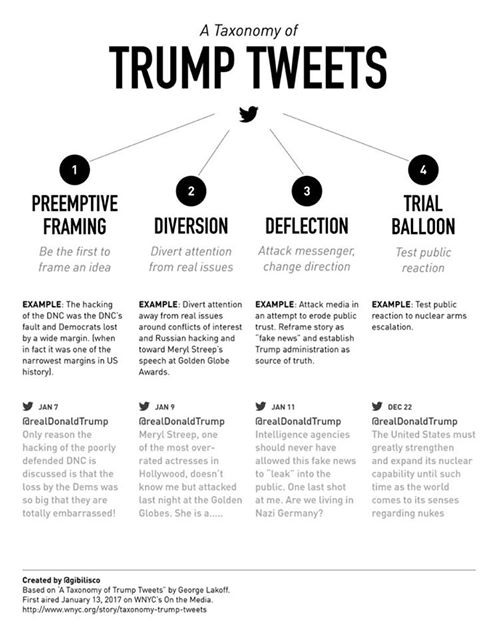
I've long been a fan of cognitive scientist George Lakoff. Here's an instructive graphic from him.

and his self-serving one-page tax "plan"

Remember back when that black guy was president and the size of the federal debt was an existential threat to the country? Deficits were going to turn us into Greece or something?

Oh, never mind. Let's cut taxes.

Describing a single-page memo as a "tax plan" is a bit of a stretch, but the administration wanted to get a proposal in under the 100-day window, and this was the best it could do. For example, it suggests lowering the number of tax brackets from seven to three (10%, 25%, and 35%), but doesn't specify the income ranges those brackets apply to. So there's no way to know exactly what the effect will be on any particular person's taxes, like yours.

One person who clearly will pay less tax, though, is Donald Trump. He claims the opposite, because of course he would claim that. (I no longer think of Trump's falsehoods as lies. I think he simply says whatever sounds good, and any positive or negative correlation with reality is purely incidental.) And no one can conclusively prove otherwise, because he won't release his tax returns. But everything we know about the Trump Organization matches up well with the cuts he's proposing on things like pass-through corporations.

He proposes eliminating most tax deductions, but keeping the deduction on mortgage interest. This also has self-serving benefits: Without that deduction, the price the Trump Organization could charge for the condos it has for sale would drop considerably.

Plus, we have two pages of Trump taxes from 2005.

That return also implied that without the alternative minimum tax, which Trump wants to repeal, he would have paid less than 3.5 percent of his income in federal income taxes. Cutting the pass-through rate while repealing the AMT would probably reduce his tax burden to roughly half that level. Instead of paying $38 million, he could've paid less than $3 million.
So if we apply his proposal retroactively to his 2005 taxes, Trump would pay less than a tenth of what he paid before, and save himself $35 million.

Has any previous president ever proposed legislation that would make himself richer at the rate of $35 million a year? I doubt it.


One reason we're talking about a one-page memo rather than an actual piece of legislation Congress might vote on is that Trump has yet to appoint the person responsible for writing that bill.
For 470 of 556 key positions that require Senate confirmation, Trump has yet to announce a nominee at all, according to a tracker maintained by the Partnership for Public Service and Washington Post. In nearly half the cases where he has announced a nominee, the White House hasn't formally sent the nominations to the Senate, awaiting clearance from the Office of Government Ethics and an FBI background check.
One of those 470 empty slots is the Assistant Secretary of the Treasury for Tax Policy.
I may argue with his arithmetic, but I'll give CNBC's Jake Novak credit for saying openly what other conservatives believe silently:
Unless Social Security, Medicare, and defense are significantly reformed and cut, not even a 100-percent tax increase will get us out of debt. And the myth that the public will not tolerate changes and cuts to those programs at all is just that -- a myth.
So our budget problem, according to Novak, isn't that so many billionaires and giant corporations pay zero tax; or that the ones that do often pay a lower rate than secretaries; our problem is that not enough old people are eating cat food or dying in the street.

And for the sake of argument, let's say he's right: Suppose that in the long run we really do have to cut entitlement programs. That's no excuse for ignoring the revenue side of the equation: We'd have to cut entitlements less if the rich were paying more tax.

and Obama getting paid to speak

In September, Barack Obama is scheduled to speak at a conference on health care sponsored by Wall Street firm Cantor Fitzgerald. He'll receive a $400,000 speaking fee.

I'm of two minds about this. On the one hand, liberals could really use a saint about now, and Obama would make a good one. I would love it if he spent the rest of his life living humbly, saying wise things, and inspiring a new generation of social justice warriors.

On the other hand, I'm always skeptical when we raise standards just in time for them to apply to the black guy. Ex-presidents command large fees on the speaking circuit, and have done so at least since Ronald Reagan's $2 million tour of Japan. They also sell a lot of books (that goes back to Ulysses S. Grant) and make big bucks that way. Most of them haven't really needed the money (Grant did), so foregoing these big paydays doesn't seem like that much to ask. But why start with Obama?

Any big cash conduit could be used for bribery, so we ought to stay alert for that. But while $400K would be a huge amount of money to all but the richest Americans, it seems to be the going rate for the small number of speakers who have Obama's level of star power. (BTW: This was also my opinion of Hillary Clinton's speeches. Getting her on your speaking list put your conference or lecture series on the map. That was worth the price to a lot of organizations, without any assumption that they'd get favorable treatment in some future administration.)

One way conservatives like to tie liberals in knots is by building purity traps. Isn't it hypocritical that Al Gore has a big home that uses a lot of electricity, or that Bill McKibben flies, or that Warren Buffett tries to minimize his company's tax bill, or that all of us who claim to care about the homeless aren't living in cardboard boxes ourselves?

We need to stop cooperating with this kind of stuff. There is no limit to how pure you could possibly be, and no one who lives inside an unjust system can be entirely untainted by that injustice. If Obama decides to go for sainthood, I'll cheer him on. But I think that should be his decision.

but I wish I understood the infighting among Democrats and other liberals

The most important issue I haven't been writing about is the continuing struggle between so-called "establishment" Democrats (who mostly supported Hillary in the primaries) and so-called "progressives" (who mostly supported Bernie). I haven't written about it for a very specific reason: I don't understand it, and I don't want to compound the ambient cluelessness by adding my voice to it.

At a point in our political history where anyone to the left of John Kasich ought to be uniting to protect American democratic traditions against Trump, an incredible amount of vitriol is going back and forth between people who are all some distance from that line.

From the Left, Cornell West is writing:

Even as we forge a united front against Trump’s neofascist efforts, we must admit the Democratic party has failed us and we have to move on. Where? To what? When brother Nick Brana, a former Bernie campaign staffer, told me about the emerging progressive populist or social democratic party – the People’s party – that builds on the ruins of a dying Democratic party and creates new constituencies in this moment of transition and liquidation, I said count me in.
Bernie himself is on a muddled "unity tour" with newly elected DNC chair Tom Perez, in which he denies being a Democrat.

Meanwhile, Bernie is facing criticism for supporting a candidate who's squishy on abortion rights, and for not bridging the gap that kept blacks and Hispanics from supporting him in 2016.

With the diverse Democratic base in the southern states being a major reason why Sanders lost, you’d think that his movement would make a major effort to reach out to Black voters and find a way to meet them on the issues that they care about.

Nope. Instead, we are seeing a doubling down on a focus of the white working class and hostility to identity politics.

I'm hoping to understand all this better and write something useful about it before long. But here's where I'm starting: Everybody is talking about "the Democratic Party" is if it were a much more solid entity than it really is. The Democratic Party is nothing more or less than the sum total of the people who vote in Democratic primaries. If a unified movement of people -- whether from the left or the center (or even from the far right, if they could somehow manage it) -- can win those primaries, then the party is theirs.

That's the test: Run candidates. Turn people out to vote for them. And if you lose, don't blame other factions for running their own candidates and turning out people to vote for them. That's just how democracy works.

and you might also be interested in

Congress has a deal to keep the government open for the rest of the fiscal year, which ends September 30. It will be voted on this week.

If you've read any John le Carré Cold War spy novels, you're familiar with the subtle ways intelligence agencies set each other up: Leak this document, let that defector escape to tell some particular story, arrest somebody who otherwise would be in a position to debunk that story, and so on. One side leaves a trail of bread crumbs that they know someone on the other side will follow to a predictable result, which he will then believe because of the effort he had to invest to put all the pieces together.

In "Pathology of a Fake News Story", Leon Derczynski claims those tactics are now being used on journalists and even on ordinary people who try to get to the bottom of things.

Imagine this. You’re an educated person with a bit of time, and you visit the doctor with a long-standing non-threatening complaint. They suggest a medicine you’ve tried before, or perhaps you’d like to try a new one. Prudently, you check out the suggested drug. You read a few articles about it, but they look like the typical marketing literature. You find four or five academic papers on the drug; most of the trials look good, with a benefit in the majority of cases. There’s one that’s inconclusive, but it’s in a less major journal, with a small sample size. You then go and check out a few review sites; most of the reviews are positive — the drug’s no panacea, but it’s better. A few of the reviews are very negative, but seem to be from people who are a little bit crazy, not using the drug right, have many other conditions, and so on. So you conclude, it looks legitimate; none of the stories look controlled, and everywhere you look, you see what you’d expect to see from a decent drug. Except it’s not. Everything you’ve read — all the end-user comments, all the peer-reviewed articles, are shills, put there by the pharma corporation to make their drug look good, and make it look good in a way that “smells” legitimate.

This astroturfing practice is well-studied; Sharyl Attkisson has a talk on it that’s worth checking out. The central idea is to place stories, evidence and so on in the locations that a knowledgeable, [skeptical] person would search, and give them the imperfections and angle that we all expect to see in genuine evidence.

The next step seems kind of clear: if you want to control the media, you can do so by astroturfing for journalists. Where will they look? What does good, genuine evidence look like for them?

The implications of this seem terribly nihilistic to me. The future looks like a place where, no matter how careful you are, you can't believe anything about anything, because a disinformation AI might always be one step ahead of you. How can I be sure that Leon Derczynski even exists? How can you be sure that I do?
To no one's great surprise, there still is no ObamaCare repeal coming out of the House.

The New York Times needs to accept that there's no way to include a far-right columnist in its stable without becoming a conduit for disinformation. That was the lesson from Bret Stephens first NYT column "Climate of Complete Certainty", which fits nicely into the fossil-fuel industry's doubt-raising agenda on climate change: Don't just sponsor outright denial, also put reasonable-sounding people out there to raise enough doubt to prevent action.

The column is full of strawman arguments against radical environmentalists who are pushing scare scenarios beyond the scientific evidence. But strangely, Stephens offers no specific examples. He raises the stereotype; that's enough.

For a more detailed response, see Brian Kahn.

and let's close with some cartoons

Polish cartoonist Paweł Kuczyński creates many striking images, like this one:

Monday, April 24, 2017

Meanwhile on Planet A

There is no Planet B.

- popular sign at Saturday's science marches

This week's featured post is "What's Our Story?", wondering how we can raise energy to defend Western values when we no longer believe the story the West has been telling about itself.

This week everybody was talking about Trump's first 100 days

which end next Saturday. I was tempted to write my own summary, but there are too many already. The Atlantic's is pretty good. (At this point, Paul Ryan will be happy if we can get through the 100th day without a government shutdown. The biggest sticking point is funding for the Wall, which -- surprise! -- Mexico isn't paying for.) What I will do is quickly review what I said I would watch for out of the Trump administration: One more thing I should say is that my worst fears haven't manifested, and it may be too late for their most likely scenario. Last November, my biggest fear was that Trump's first few actions would be popular. He'd be victimizing out-groups like Muslims, immigrants, and blacks, and the English-speaking white majority would love it. That popularity would set a snowball rolling that first Republicans, and then Democrats, and then the courts would be afraid to stand in front of. Before you know it, we'd have the kind of fascist populism I described in "How Populism Goes Bad". That didn't happen. Trump is incredibly unpopular for a president at the 100-day mark. His approval rating is around 40%, and has never been higher than 45%. Before him, Bill Clinton was the least popular modern president at 100 days, with a 55% approval rating. Democrats are united, the courts are ruling against him, and even congressional Republicans may be starting to stand up to him.

and the Georgia congressional election

When Trump appointed congressional Republicans to his cabinet, he created a series of special elections to replace them. All the districts are in deep-red areas, so he didn't think he was in danger of losing any of them. Well, Trump's general unpopularity and the corresponding mobilization of Democrats has so far made those elections surprisingly competitive. Two weeks ago in Kansas, the Republican held on to a seat that Mike Pompeo had won in 2016 by 30 points, but only by 7 this time. This week in Georgia, Democrat Jon Ossoff got 48% of the vote in a district where Republican Tom Price got 62% just a few months ago. If Ossoff had gotten 50%, he'd have won the seat. As it stands, he faces a June runoff against Karen Handel, who finished second with 20% in a divided Republican field. 538's Harry Enten thinks the runoff looks like a coin flip. You'd think a few of the Republicans who voted for non-Handel candidates would move to Ossoff, but Republicans have a way of uniting against Democrats when the chips are down.

and the March for Science

Saturday there were marches all over the country (and even all over the world) to protest three main things Wherever you were, there was a march nearby. I was in Santa Fe, where I marched from the downtown plaza to the state capitol with "a few thousand" other people. (I took the picture to the right while Senator Udall was speaking. The crowd behind me was at least as big.) Marches in the bigger cities were even larger. I've seen estimates of 40,000 in Chicago, 50,000 in St. Paul, and so on. In D.C., the "early" crowd was estimated at 15,000, and I haven't heard how big it eventually got. I'm not sure where this woman was:

and Bill O'Reilly

Apparently, if you harass enough women in the workplace over a long enough period of time, and if some of them are brave and determined enough to inspire the others to come forward, and if boycotters make advertisers notice, and if The New York Times does a story about it, and if there's a corporate parent that just doesn't want the grief, then you might lose your job. Clearly, we've come a long way. Of course, you also might become president. There are still a few bugs in the system.

but the French election might turn out to be even more important

I wish I understood France well enough to tell you about it in detail. The headline is that someone from outside the traditional national-party structure, Emmanuel Macron, was the leading candidate in France's presidential election, getting 24% of the vote. That will put him into a runoff in two weeks with the second-place finisher, Marine Le Pen, who got 22%. Le Pen, who leads the party that her father founded, is not quite the anti-semitic fascist that he was, but represents France's radical right. She is the Trump-Putin candidate: anti-immigrant, anti-Muslim, anti-EU, anti-NATO. Polls say that supporters of the other candidates will unite around Macron in the runoff, so the disaster of a Le Pen presidency might be avoided.

and you might also be interested in

Paul Krugman has a good analogy for understanding the Republicans' inability to come up with an ObamaCare replacement plan: trying to stuff a big balloon into a small box.
Republicans have ... successfully convinced many voters that they could preserve the good stuff [of ObamaCare] — the dramatic expansion of coverage that has brought the percentage of Americans without health insurance to a record low — while reducing premiums, shrinking deductibles and, of course, doing away with the taxes on high incomes that pay for the program.
But healthcare costs money, and people who are poor or sick don't have enough to pay for it. The government -- or somebody -- has to make up the difference. The repeated attempts at a Republican plan are all ways to try to hide the gap: You can't pull out the government money -- which is the main GOP goal -- and keep the same level of coverage. So every time a plan gets well enough defined for the CBO to rate it, it turns out that millions of people will lose their health insurance.
The important thing to remember is that these problems don’t keep popping up because the people devising the plans are careless, and keep forgetting crucial issues. They’re popping up because the G.O.P. is trying to stuff a big balloon into a small box, and every time you squeeze it somewhere it inflates someplace else.

Matt Yglesias: If you tell working-class voters in dying communities that the mill or the mine is going to reopen and give them back their old jobs, you're not respecting them, you're pandering to them.
Shaun King makes a point relevant to my post last week on cold racism: There's a simple reason that conservatives were upset by Obama's golfing vacations, but are far less upset by Trump's far more frequent golfing vacations: Obama's golfing marked him as an "uppity Negro".
Ordinarily, you don't see a lot of stores closing unless the economy is in recession. But they are now. Possible reasons: Internet shopping has gotten big enough to hurt store traffic. Developers overbuilt malls, expecting growth that never happened. Consumers are spending less on stuff and more on experiences like vacations or meals.
Attorney General Sessions:
I really am amazed that a judge sitting on an island in the Pacific can issue an order that stops the President of the United States from what appears to be clearly his statutory and Constitutional power.
Someone needs to explain to the AG (1) how the federal court system works, and (2) that Hawaii is a state equal to any other state. This is yet another dog whistle to racists whose idea of "real America" doesn't extend out to Hawaii. Personally, I'm amazed that someone from Alabama has the stones to denigrate Hawaii.
When Republicans take over state government, one of the first things they do is make it harder to vote. My state of New Hampshire elected a Republican governor in November, and already had Republican control of both houses of the legislature. And so now comes an unusually insidious form of voter suppression:
According to the bill, wrongful voting/voter fraud is now considered to occur simply when a person “registers to vote on election day using an affidavit to satisfy proof of being qualified ... and fails to provide a copy of the document by mail or present the document in person to the town or city clerk by the deadline.” This legitimate voter who doesn’t have documentation can now be subject to a fine of up to $5,000. He will also be removed from the voter rolls.
So if you take advantage of New Hampshire's same-day registration, you now have to produce paperwork showing that you're a permanent resident within 10 days, and if you don't, you'll be fined. So a legitimate New Hampshire resident who votes, but doesn't get around to producing the required documentation within ten days is a criminal. The bill has already passed the Senate on a party-line vote, with Republicans voting to criminalize legitimate voters.
The IRS is going to start using private collection agencies to get people to pay overdue taxes. What could possibly go wrong? I already get spam phone calls from boiler-room operations claiming to represent the IRS.
As you listen to your Bose headphones, they're also listening to you. Well, not exactly, but almost. According to a new lawsuit, if you use the associated Bose app, it will tell Bose what you listen to, and Bose sells that information. Apparently, someone who knows what songs, podcasts, audiobooks, etc. you listen to can make a lot of good guesses about the rest of your life.

and let's close with some advertising that shouldn't work

This image off their Facebook page may look like it can't possibly come from a real business, but while crossing Missouri on I-44 I saw a billboard with the same slogan.

Monday, April 17, 2017

Treacherous Division

Maintaining the division between the Colony and the Nation is treacherous precisely because of the constant threat that the tools honed in the Colony will be wielded in the Nation; that tyranny and violence tolerated at the periphery will ultimately infiltrate the core.

- Chris Hayes, A Colony in a Nation

This week's featured post is a suggestion for framing discussions about the more subtle forms of racism: "Racism, Hot and Cold". And it's an appropriate time to look back at my attempt in 2013 to promote a secular Easter mythology in "Wrestling with Easter".

This week everybody was talking about rumors of war

The Syria attack got Trump such good press that many were skeptical Thursday when we dropped the Massive Ordinance Air Blast (MOAB, a.k.a. Mother of All Bombs) in Afghanistan. But Vox thinks it was legit.

“It’s a weapon that has a narrow target set,” an Air Force official told me. “It’s primarily intended for soft to medium surface targets — targets like a cave and canyon environment.”

The area hit in Afghanistan appears to be one of the few targets that fit this profile.

All the same, it was weird to watch the chest-thumping on the Right over a big-but-mostly-meaningless explosion. Our national pride used to be based on stuff like inventing the light bulb or landing on the Moon. Now it comes from dropping really big bombs.
The more worrisome situation is North Korea, which has been ramping up both its nuclear tests and its missile tests. The Guardian reports:
There has been little doubt in recent years that the end-point of the North Korean programme is an arsenal of working ICBMs and nuclear warheads small enough to put on top of them. The dilemma of how to stop it reaching that goal is the hardest problem facing any US administration, a point that Barack Obama repeatedly made to Trump during the presidential transition. ... Trump seems to be hoping that by introducing some unpredictability into this static scenario, he can frighten the Chinese government into putting real pressure on Pyongyang. There are some signs that might be working, with hints in China’s semi-official media that Beijing could tighten oil deliveries, North Korea’s lifeline.

Trump's reliance on China may explain why he's reversed himself on his currency manipulation charge. Branding China a "currency manipulator" -- something he was going to do "on Day 1" of his administration -- would have begun a formal process that would likely have led to tariffs and a trade war. Now he's changed his mind.
Like Syria, North Korea is a situation where no one has any really good ideas. North Korea probably already has the ability to destroy Seoul, a South Korean mega-city of about 25 million. So a preemptive war could have an enormous cost. But waiting for the North Korean regime to gain the power to similarly threaten Tokyo or Los Angeles is not a great prospect either. Some Trump fans thought the MOAB blast was a warning to North Korea, but actually it wouldn't be much of a threat there. Vox again:
“If you think about what a target profile might look like in either Iran or North Korea — both of those countries have air defense systems,” [University of Kentucky Professor Rob] Farley says. “This is a weapon dropped from a C-130, which is not a stealthy aircraft and not really a combat aircraft at all. This is not a weapon you can drop on someone who has an active defense of the target — fighters or any kind of surface-to-air missile.”

Fortunately, yesterday's North Korean missile test seems to have failed.
In any international conflict, we hear the argument that "You can't talk to [insert name of foreign leader], he's crazy." On occasion it might be true, but it really can't be true every single time. Maybe it's true about Kim Jong-Un; a lot of people certainly think so. But this article in Newsweek from last year claims not.

and the United Air Lines fiasco

By now you've undoubtedly heard the story and probably even seen the videos: Dr. David Dao, who was already seated, refused United's compensation offer for leaving the plane and was dragged off my force.

Criticizing United for this incident is shooting fish in a barrel; everybody has done it already. Twitter has a #NewUnitedAirlinesMotto hashtag, with gems like: "If we can't beat our competitors, we'll beat our customers" and "United: Putting the hospital in hospitality". Jimmy Kimmel created a new United commercial.

But United's situation is even worse than it initially appeared: Early coverage assumed that the fine print of its ticket agreement gave United the legal right to do what it did, even if it obviously shouldn't have. But now it looks like United is wrong even legally. Apparently, the contract allows United to "refuse boarding" to a passenger for just about any reason, including that they have some other use for the seat. But nothing gave them the right to remove Dao after they had boarded him, unless he was being disruptive -- and he didn't become a problem passenger until after they started trying to remove him.

Beyond that, the interesting articles are about the larger meaning of this event. Is the problem these particular United employees? United itself? Airlines in general? Capitalism? I think the quote at the top of this page, which comes from Chris Hayes' A Colony in a Nation (discussed last week) nails it.

Maintaining the division between the Colony and the Nation is treacherous precisely because of the constant threat that the tools honed in the Colony will be wielded in the Nation; that tyranny and violence tolerated at the periphery will ultimately infiltrate the core.

In other words: We tolerate that in poor, black neighborhoods, people who don't do what some authority tells them are beaten and/or dragged away by police, even if the authority is overstepping. Whenever someone gets killed in such a circumstance, you will inevitably hear the argument: "Why didn't he just do what the officer told him?"

Once that idea gets out there -- that (even if you're in the right) you do what you're told or face violence -- it's not going to stay in its box. Socially, an airliner may seem far, far away from Ferguson or Baltimore. But when you're sitting in your middle seat, you're powerless too. So you'd better do what you're told or face violence.

Once we accept this kind of violence, there's no way to define a boundary that will keep it away from you. The only solution is to resolve that people will not be treated that way. All people, everywhere.

and the continuing retreat of liberal democracy

Turkish voters passed a referendum taking power away from its parliament and centering it in the executive. The Erdogan government has been getting increasingly autocratic for some time, and this is a big step further down that road. (The idea that a narrow majority can authorize this kind of sweeping change is scary in itself, and typical of the rise of dictators.)

A coup against Erdogan failed last year, and he has used that opportunity to rule in an "emergency" mode. International observers judged that a valid referendum could not take place under these circumstances.

For a long time, Turkey seemed headed towards membership in the European Union, which would have exacerbated Brexit-like pressures on countries that didn't want a large influx of poor Turks looking for jobs, but also was liberalizing Turkey internally. Now that process seems to be over.


Now all eyes turn to France, where the first round of a presidential election will be held on Sunday. It's uncertain which two of the current 11 candidates will be in the run-off on May 7, but one of them is likely to be Marine Le Pen, leader of the extreme-right National Front.

but this article is also worth your time

Rick Perlstein has been writing books about the history of the American Right for many years, beginning in 2001 with Before the Storm about the Goldwater movement, and continuing with Nixonland and the most recent in the series The Invisible Bridge, which takes the story up to Ronald Reagan's nearly successful challenge to President Ford's renomination in 1976.

Now he recognizes that the story he and other historians of the Right have been telling doesn't lead to Trump, and that has him re-evaluating his whole approach.

If Donald Trump is the latest chapter of conservatism’s story, might historians have been telling that story wrong?

His article "I Thought I Understood the American Right. Trump Proved Me Wrong." is a fascinating history of historians trying to make sense out of events whose consequences are still playing out. When the main thing they knew about Goldwater was his landslide loss to LBJ in 1964, he looked like an aberrant throwback, which is how Richard Hofstadter portrayed him in "The Paranoid Style in American Politics."

Then his campaign became the forerunner of Ronald Reagan's victory in 1980, and historians began telling a different story of conservatism's march to respectability. Now the story of "modern conservatism" begins in 1955, with William F. Buckley's National Review rejecting the conspiracy theories of the John Birch Society, the nativism and racism of the KKK, and the anti-modernism of the Scopes Monkey Trial.

But Trump, Perlstein now recognizes, has a lot more to do with the old, crazy conservatism than with Buckley-style respectable conservatism. That means that the march to respectability was always partly an illusion, the old conservatism must always have been there under the surface, and the roots of Trump go back further than Perlstein had thought.

and you might also be interested in

Apparently the attempt to raise an uproar about Susan Rice was just another Trump attempt to distract from his own Russia scandal.
After a review of the same intelligence reports brought to light by House Intelligence Chairman Devin Nunes, both Republican and Democratic lawmakers and aides have so far found no evidence that Obama administration officials did anything unusual or illegal, multiple sources in both parties tell CNN.

Josh Marshall reflects that few presidents arrive in office really prepared for the job, and each of Bill Clinton, George W. Bush, and Barack Obama had to learn a lot in their early days. But Trump is unique in that he truly seems not to have previously understood that knowledge was possible. When he discovers something that literally everyone who pays attention to the news already knew (like that health care is complicated, or that China and Korea have a long and difficult history), he presents it as if we should all be as surprised as he is.
Having failed to repeal ObamaCare, Trump is threatening to break it. If he thinks this threat is going to get Democrats to go along with his repeal plan, he's going to have to think again.
Thursday Trump signed a bill that allows states to deny federal grants to Planned Parenthood.
Now that the rule has been repealed, states can effectively block Planned Parenthood and other abortion providers from funds associated with the Title X Family Planning program, which was established in 1970 to subsidize organizations that offer services related to contraception, pregnancy care, fertility and cancer screenings primarily for low-income people.
This is widely misunderstood as "defunding Planned Parenthood", as if there were a "subsidize Planned Parenthood" line somewhere in the federal budget. What the federal government in fact subsidizes are services, which people can get by going to the service-provider of their choice.

So basically, what Trump and Republicans at the state level are doing here is anti-freedom. They're saying that you can't get your federally subsidized cancer screening or contraception where you want to get it. You have to get it from some provider conservatives approve of.


Free college was one of Bernie Sanders' most popular proposals. New York state is now moving in that direction. The SUNY and CUNY systems will be tuition-free to in-state students whose families make less than $100,000, if they fulfill academic requirements and stay in the state after graduation.
Jay Rosen is promoting the expansion of the Dutch news organization De Correspondent to the American market. He says De Correspondent looks as if it were built around the question: "What if news organizations optimized every part of the operation for trust?"
Conservative media outlets loved to run stories about how the Obamas were "living large" at the public expense, as if life in the White House had been spartan until 2009. But Trump's expenses are blowing away Obama's numbers. Vanity Fair reports:
In all eight years of President Barack Obama’s presidency, his travel, both personal and professional, amounted to a total of $97 million, according to Judicial Watch. That puts Trump on track to surpass Obama’s travel spending over the course of two terms in about one year.
Judicial Watch, it's worth pointing out, is a conservative group that was outraged at that $97 million figure.
The sheriff's department in Lake County, Florida made a video to try to scare drug dealers. It ought to scare pretty much everybody. I think I might rather run into drug dealers than these masked vigilantes.
Democratic strategist Jess McIntosh discovers that her Dad gets his news from alt-right web sites, and he isn't completely sure that she doesn't eat babies.

and let's close with an amusing way to waste time

Fifty pictures that sum up each of the fifty states. Like North Carolina:

Monday, April 10, 2017

Where It Ends

You know where a war begins, but you never know where it ends.
- Otto von Bismarck
This week's featured posts are "Where Did That Come From?" (about the Syria attack) and "Justice and the Police" (connecting the latest from Trump's Justice Department to the analysis in Chris Hayes' A Colony in a Nation).

This week everybody was talking about the Syria

I covered this at length in one of the featured posts.
One further thought: During the Obama years, Republicans often ridiculed his teleprompter, as if the President himself were simply a mouthpiece for words written by someone else. To me, that criticism always misfired, because Obama in fact had a deep understanding of the issues and thought quite well on his feet.
But watching Trump's announcement of the cruise missile attack, I couldn't help thinking that I was hearing a teleprompter speak and not a president. Trump read his statement slowly, always looking to the screen on one side or the other, and never forward into the camera.

and the byzantine rivalries inside the White House

Steve Bannon's star seems to be in decline. He was removed from the National Security Council, a role a political operative should never have had to begin with. Some attribute his removal to National Security Adviser H. R. McMaster, while others credit/blame Jared Kushner.
Breitbart, the alt-right pseudo-news site Bannon ran before becoming Trump's chief strategist, continues to be Bannon's propaganda outlet. Of late, it has taken a strong anti-Kushner tack. After the NSC announcement, it gave major space to an interview with Ned Ryun of American Majority (an organization devoted to training new conservative leaders). He described Bannon's demotion as part of a power struggle between
national populists, really led by Bannon, versus, quite frankly – there’s no other way to describe them – the liberal New York City set that have come in.
i.e., Kushner and his wife Ivanka Trump.
God bless them, they’re part of the Trump family, but let’s not kid ourselves: they are part of the Manhattan liberal set. ... I think we should start asking questions – who are they really? What has been their experience? What is their worldview? Because I’m starting to suspect their worldview does not line up with the campaign promises that Trump was making. ... I’ve got to tell you, my hope is that Trump will say, "I know what got me in. I know what brought me to the White House. Steve Bannon is really the lead cheerleader on that front. Keep Steve close. Listen to Steve."
I find it fascinating that Bannonists are calling themselves "national populists" and focusing on appealing to the white working-class voters in the Trump base. If they're ever looking for a Tea-Party-like name, how about National Populist American Workers' Party? That has a ring to it, don't you think?

One Kushner ally the National Populists (Nappies?) particularly hate is Gary Cohn, the former Goldman Sachs COO who is head of the National Economic Council and has been rumored as a replacement for Reince Preibus as chief of staff.
Beneath all the Breitbart codewords -- liberal, New York, globalist -- is a meaning you have to go to the more extreme sources to translate: Jew. Kushner was born Jewish and Ivanka converted, but Cohn is the alt-Right's worst nightmare: an honest-to-HaShem Jewish banker.

and the Senate approving Gorsuch

Senate Republicans had to change Senate rules on the fly to do it, eliminating the filibuster on Supreme Court nominations.
There are those who mourn this move, or who wish Democrats had saved their filibuster for some future nomination, but I don't see it. What is to be mourned here are the traditions of fair play and mutual respect that for centuries allowed the Senate to use the filibuster responsibly.
Until the last two decades, the filibuster was an extreme tactic, reserved for situations in which the minority wanted to serve notice that it was aggrieved in more than just an ordinary way. Filibustering was outside the range of ordinary negotiating tactics, similar to when a spouse threatens to leave.
A number of major bills, ones that opponents must have thought were important, were not filibustered: the Social Security amendments that created Medicare and Medicaid in 1965, for example. Entire years might go by without a filibuster.
As the graph shows, use of the filibuster started to ramp up around 1970, gradually increased in the next few decades, and then spiked after Republicans became the minority in 2007. Mitch McConnell's years as minority leader saw unprecedented obstruction; it became a commonplace that "it takes 60 votes to do anything in the Senate".
Among McConnell's new tactics was the blockade of an office, without regard to the qualifications of the individual nominated to fill it. He attempted to keep the Consumer Financial Protection Board from operating, and very nearly brought the National Labor Relations Board to a halt by refusing to let any nominee come to a vote. That's what led Democrats to eliminate the filibuster on all nominations but the Supreme Court in 2013.
McConnell was majority leader by 2016, when he blockaded the Supreme Court seat that opened when Justice Scalia died. If there had been something objectionable about Merrick Garland -- a generally moderate judge of sterling record -- Republicans might have rejected Garland for cause and let President Obama nominate someone else, as the Founders intended. But the point of this maneuver was to prevent the seat from being filled, in hopes a Republican president might someday fill it. This was entirely unprecedented in American history.
Democrats couldn't simply go back to the status quo after that. Returning to the marriage analogy, it would be like one spouse accepting that the other had won an argument by violence, and pretending that everything could go back to normal afterward. The courtly traditions of the Senate are gone now; pretending they can be restored without any acknowledgment of the gravity of the Garland nomination would be pointless.
It would have been similarly pointless to save the filibuster for the next nomination. If the Republican majority is determined to have its way, regardless of previous Senate traditions, then it will. A tool that exists only as long as you never use it is worthless.
While Senate traditions of collegiality are something to mourn for, the filibuster itself is not. Without the traditional restraints on its use, it becomes an instrument of minority obstruction, and enables the kind of gridlock we saw in the last six years of the Obama administration. Right now, liberals may wish they could stop more things from happening, but ultimately minority obstruction undermines the efficacy of democracy. If the people vote for something, they should get it. If they don't like it, they should vote for something else.

but don't forget about the Russia investigation

This week's development was that House Intelligence Chair Devan Nunes recused himself from the investigation. He'll continue as committee chair, but Rep. Mike Conaway of Texas will fill his role on the Russia probe.
Trump and his people have tried to make a distracting pseudo-scandal out of Susan Rice having names of Trump's people "unmasked" from intelligence reports. So far, though, nothing we've learned seems all that suspicious to people who understand the process. For people who don't, here's a primer.

and you might also be interested in

As I explained last week, the effort to revive ObamaCare repeal is going nowhere. Congress is taking its April recess with no further action, in spite of Trump's statement on March 28 that such a deal would be "easy" and happen "quickly".
Matt Yglesias points to another area where Trump's rhetoric outstrips anything actually in the works: infrastructure. He continues to talk about the $1 trillion infrastructure idea he floated during the campaign, but there is no actual plan Congress could vote on, and no one appears to be making one. Yglesias refers to an infrastructure plan as "vaporware", a software industry term for promised features that aren't actually being programmed.

I can't vouch for the underlying data, but this map of each state's largest employer is interesting: It's usually either Walmart, a university, or a healthcare provider. Boeing in Washington and Intel in Oregon are the only manufacturers.

and let's close with some dancing

I really should save this for the week when Bannon gets fired, but it's never a bad time to watch a parrot rock out.

Monday, April 3, 2017

Lessons Learned

[Jared] Kushner will [apply] the lessons he learned from being born rich and marrying the right person.

- Simon Maloy

This week's experiment in multiple shorter posts: "The Future Goes to Jared" points to Jared Kushner as a paradigm for success in the Second Gilded Age, "Freedom (Comcast's) vs. Rights (Yours)" elaborates a freedom vs. rights theme I raised in 2015, and "Can We Get Real About Opioids?".

This week everybody was talking about Mike Flynn

Trump's former national security adviser shopped for an immunity deal and apparently hasn't gotten one. The Wall Street Journal article that broke this story is behind their paywall, but some independent confirmation is at NBC.

Two possibilities: The first is that Flynn's testimony could illuminate the entire network of Trump/Russia connections and bring down Trump himself. That notion was clearly in Josh Marshall's mind:

You only get immunity if you deliver someone else higher up the ladder. And there's only one person higher up the ladder.

The other is that Flynn is maneuvering. He faces a long list of legal problems, so maybe he wants to wriggle out without giving much in return. Alex Whiting at Just Security analyzes:

If he had something good, Flynn and his lawyer would approach the prosecutors quietly, go through the proffer process in confidence, and reach a deal. Why? Because prosecutors have an interest in keeping their investigation secret, and Flynn’s lawyer knows that. The last thing Flynn’s lawyer would do if he thought he had the goods would be to go public, because that would potentially compromise the criminal inquiry and would certainly irritate the prosecutors, the very people Flynn’s lawyer would be trying to win over.

I suspect that Flynn’s lawyer is really targeting Congress. He is hoping that one of the Congressional committees will take the bait and grant him immunity in exchange for his testimony.

Either way, two conclusions seem obvious: Flynn believes that by the time this is all over, somebody will want to prosecute him for something, and he's not trusting Trump to pardon him. (That's  probably a good idea given the way Sean Spicer has been pretending Flynn was never a major player.)

This flashes me back to something Senate Watergate Committee Chair Sam Ervin wrote:

As we contemplate the motives that inspired [the] misdeeds [of Nixon's lieutenants], we acquire a new awareness of the significance of Cardinal Wolsey's poignant lament: "Had I but serv'd my God with half the zeal I serv'd my King, he would not in mine age have left me naked to mine enemies."

(The content of the Wolsey quote is historical, but the phrasing comes from Shakespeare's Henry VIII.)

and Devin Nunes

The information that Devin Nunes brought to the White House on March 22 -- that the Trump transition team had been inadvertently caught up in surveillance targeted at others, so Trump's Obama-wiretapped-me tweet might have had some tangential basis -- appears to have come from the White House to begin with. The New York Times identifies Nunes' sources as Ezra Cohen-Watnick from the National Security Council and Michael Ellis from the White House Counsel's office. The Washington Post adds a third source, NSC lawyer John Eisenberg.

None of them are the "whistleblowers" Nunes has been claiming, unless, as Josh Marshall adds, "we now consider people disseminating information from the White House on the President's behalf 'whistleblowers'."

The obvious question: Why do White House staffers need to sneak information to the chair of the House Intelligence Committee, so that he can brief the President about it and talk about it (obliquely) to the press? Adam Schiff, the committee's leading Democrat, asks:

This looks nothing like a whistleblower case. And again, I think the White House needs to answer: Is this instead a case where they wished to effectively launder information through our committee to avoid the true source of the information?

Vox summarizes:

Put more bluntly: Members of the Trump White House selectively leaked classified intelligence that doesn’t actually support their boss’s claim to a credulous congressman who uncritically parroted the information in a press conference just hours later.

Nunes kinda-sorta denied this, calling the reports "mostly wrong" and filled with "innuendo".

Currently, the House investigation is completely shut down, without even behind-closed-doors committee meetings. By participating in what appears to be a White House info-laundering maneuver, Nunes has lost credibility as a leader of the investigation.


Pulitzer-winning journalist Bart Gellman explains a little about how secret surveillance reports work, and then raises this question:

If events took place as just described, then what exactly were Trump’s appointees doing? I am not talking only about the political chore of ginning up (ostensible) support for the president’s baseless claims about illegal surveillance by President Obama. I mean this: why would a White House lawyer and the top White House intelligence adviser be requesting copies of these surveillance reports in the first place? Why would they go on to ask that the names be unmasked? There is no chance that the FBI would brief them about the substance or progress of its investigation into the Trump campaign’s connections to the Russian government. Were the president’s men using the surveillance assets of the U.S. government to track the FBI investigation from the outside?


Meanwhile, compared to its House equivalent, the Senate Intelligence Committee looks like a happy family. Republican Chair Richard Burr of North Carolina and ranking Democrat Mark Warner of Virginia have been presenting a united front and pledging to "get to the bottom of this".


For weeks, Josh Marshall has been talking about the "gravity" of the Trump/Russia scandal -- not in the sense of it being gravely serious (which it also is), but in the sense that people who get close to it keep getting pulled in. Why is Nunes sacrificing his reputation like this? Why did Jeff Sessions feel the need to lie to the Senate about his contacts with the Russians?

Astronomers can't see black holes directly. They map them by their event horizon and their effect on nearby stars and stellar matter. We can't see yet what's at the center of the Trump/Russia black hole. But we can tell a lot about its magnitude by the scope of the event horizon and the degree of its gravitational pull, which is immense.

and the Gorsuch nomination

DecisionDeskHQ counts 41 Democrats against. That puts the ball in McConnell's court: accept defeat or eliminate the filibuster?

and disarray in Congress

Republicans are continuing to promise that they'll come up with an ObamaCare replacement plan they can pass through Congress. Trump described this goal as "an easy one" that is going to happen "quickly". He also attacked the House Freedom Caucus for opposing the AHCA, and Paul Ryan warned them that if they couldn't come together Trump might cut a deal with Democrats instead.

I'm discounting all of that. Two things sunk the AHCA: Republicans have no consensus view of the government's proper role in healthcare, and the ideas that appeal to near-majority chunks of their caucus are deeply unpopular with the country. Neither can be fixed by reworking the details of a bill.

An analogy: When I'm good and truly stuck as a writer, invariably the problem turns out to be that my focus is too narrow to see the whole problem. I'm trying to find just the right word when the paragraph doesn't make sense, or I'm trying to clarify the presentation of an argument that -- if it were perfectly clear -- would have an obvious hole in it. When I'm stuck like that, my worst enemy is the thought that I'm almost there. I get unstuck by admitting that I'm nowhere near where I want to be, which allows me to back up and look at what's wrong with the bigger picture.

Republicans are still telling themselves that they're almost there on healthcare. As long as they keep doing that, they'll stay stuck. And the working-with-Democrats idea never includes any suggestions about what Democrats might want. That marks it as a fantasy.


They might run into the same problem on tax reform. The Koch brothers are advertising against Trump's border-adjustment tax. In the same way that the Republican position on healthcare has been defined by opposition to ObamaCare rather than any positive vision, their position on taxes has always been "less". They have no consensus on what should be taxed and how much.

They may not even prevent a government shutdown. Currently, the government is funded through April 28, and the clock is already ticking on the next basket of money. The WaPo identifies funding the Great Wall of Mexico as a possible issue, and New York points to defunding Planned Parenthood and/or ObamaCare.

and rolling back regulations that fight climate change

Tuesday, Trump issued a "Presidential Executive Order on Promoting Energy Independence and Economic Growth", which rolls back Obama's anti-climate-change executive orders. (Civics lesson: This is why you want to pass laws rather than just issue executive orders. Undoing a law is much harder.)

There have been two reactions to this:

  • Doom. Obama's orders were already half-measures, and now we're not even doing that much.
  • Shrug. Coal is dead for reasons that Trump can't change, and the renewable energy boom will continue.

The most sophisticated reaction I've seen is Brad Plumer's at Vox:

the first step in thinking about the road ahead for climate policy under Trump is understanding why federal action was so significant — and then figuring out what’s still possible if Trump rolls it back.

So Trump hasn't stopped progress against climate change cold, but it's still a real blow.


How can we know whether God exists? I take a hint from The New Yorker's David Owens:

Somewhat tantalizingly, it wouldn’t take much of a sea-level rise or storm surge to inundate the entire place, since [Mar-a-Lago's] sweeping lawns, like most of the rest of southern Florida, lie just a few feet above high tide.

but deep beneath the headlines, the tectonic plates of culture keep shifting

In 2015, I coined a maxim that I should repeat more often: Everything you thought was a category is actually a continuum.

The FX series Billions now has a gender-non-binary character. “Hello sir, my name is Taylor. My pronouns are they, theirs, and them.” Taylor isn't a boy pretending to be a girl, or a girl who wants to be a boy, or someone who feels out of place in their body. Taylor's social persona is not gender-specific. Within the universe of the show, the question "Is Taylor male or female?" has no answer.

After a few episodes, I'm surprised how easy it is to let that question go. The trip from bewilderment to "Why did I think that was a big deal?" is surprising short.

BBC's "The Social" has an enlightening video on non-binary identity. Here's another interesting testimony.

and you might also be interested in

One of the weirder projects out there: FOIA the Dead. When an obituary appears in the NYT, FOIA the Dead sends an automated Freedom of Information Act request to the FBI for whatever files it has on that person, then posts what it gets, if anything. Privacy rules prevent the FBI from releasing the files of living people without some good reason, but looser rules apply to the dead. So, for example, we can now know what the FBI had (not much) on journalist Morley Safer or Kennedy-assassination conspiracy-theorist Mark Lane.


White Democrats and white Republicans disagree more than ever on the sources of racial inequality.


Trump is now more unpopular than Obama ever was. The head-shaking thing is that his problems are entirely self-inflicted. The economy is fine. No new wars, major terrorist attacks, or natural disasters. We haven't even begun to speculate about whether something might be "Trump's Katrina".


If not for Russia and the Trump family's profiteering on the presidency, HHS Secretary Tom Price would be a front-page scandal. ProPublica reports:

On the same day the stockbroker for then-Georgia Congressman Tom Price bought him up to $90,000 of stock in six pharmaceutical companies last year, Price arranged to call a top U.S. health official, seeking to scuttle a controversial rule that could have hurt the firms’ profits and driven down their share prices, records obtained by ProPublica show.


The Kansas experiment in conservative economics continues to produce negative results: According to figures from the Fed, Kansas now has the worst economic growth in the nation. Meanwhile, the Republican legislature finally voted to expand Medicaid, and Governor Brownback vetoed it.


Thursday, UN Ambassador Nikki Haley announced a shift in U.S. policy towards Syria: We're no longer going to "focus on getting Assad out". In other words: We move closer to Russia's position and away from our NATO allies.


North Carolina is repealing and replacing its controversial bathroom bill. But the replacement retains a lot of bad stuff. Like the original, it makes a mockery of conservative rhetoric about local control by banning any city from protecting LGBT rights.

A similar mockery: Iowa just nullified any local attempt to raise the minimum wage. Five Iowa counties had voted to establish a wage higher than the federal minimum of $7.25, and in one it had already taken effect.

and let's close with another adaptation of a classic

Last week I posted "Donnie in the Room", my retelling of the TrumpCare saga in the style of "Casey at the Bat". This week, Sandi and Richard Riccardi do "The Boy from Mar-a-Lago".